
9 Bottlenecks Behind Delivery Delays at Scale

Discover nine operational bottlenecks that cause delivery delays as companies scale, and learn how leaders can improve execution clarity and delivery predictability.
Executive Summary
As software organizations grow, delivery becomes harder to coordinate. More teams, dependencies, approvals, and technology systems introduce operational complexity that can slow execution even when individual teams perform well.
For CTOs, COOs, and engineering leaders, understanding organizational scaling challenges is essential to improving delivery predictability.
Direct Answer: Delivery delays in growing organizations often result from unclear priorities, cross-team dependencies, slow decisions, overloaded teams, fragmented communication, and limited execution visibility. Leaders can reduce these bottlenecks by identifying workflow constraints, clarifying ownership, and improving coordination across delivery systems.
Why Does Execution Get Harder as Companies Scale?
Growth increases the number of decisions, handoffs, and dependencies required to deliver work.
Processes that function well with a few teams may become unreliable across multiple departments. Leaders may see healthy project dashboards while unresolved dependencies and decision delays accumulate.
Execution Clarity the ability to understand where execution is breaking down and why helps leaders identify constraints earlier and make informed decisions before delivery is affected.
The following nine bottlenecks explain where growing organizations commonly experience delivery friction.
What Are the 9 Bottlenecks Behind Delivery Delays?
1. Unclear Strategic Priorities
When departments interpret business goals differently, teams pursue competing initiatives. Frequent priority changes increase rework and reduce delivery focus.
2. Cross-Team Dependencies
Software delivery often requires coordination between engineering, product, security, and operations. Unmanaged dependencies create waiting time and missed commitments.
3. Slow Decision-Making
Delayed approvals, unclear authority, and repeated escalations prevent teams from moving forward, even when execution capacity is available.
4. Fragmented Communication
Information scattered across meetings, messages, and project tools creates misunderstandings and slows issue resolution.
5. Overloaded Teams
Excessive work in progress (WIP) increases context switching, reduces flow efficiency, and makes delivery timelines less predictable.
6. Unclear Accountability
When ownership of deliverables, decisions, or handoffs is ambiguous, important work can remain unresolved between teams.
7. Technology Complexity
Legacy systems, integration limitations, and technical debt introduce unexpected work and increase delivery uncertainty.
8. Inconsistent Execution Processes
Different planning, reporting, and escalation practices make it difficult to coordinate delivery across expanding teams.
9. Limited Leadership Visibility
Traditional status reporting may show progress without revealing blocked work, aging dependencies, or emerging delivery risks.
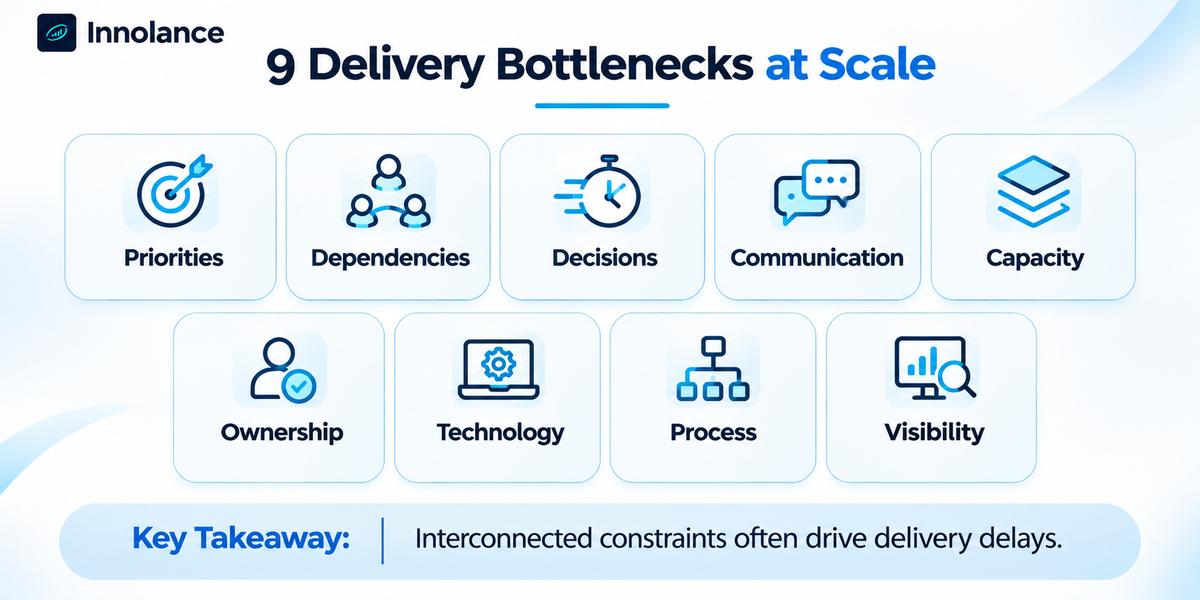
Key Takeaway: Delivery delays often emerge from interconnected organizational constraints rather than individual team performance.
How Do Operational Bottlenecks Affect Delivery Predictability?
Delivery predictability is the ability to make and meet realistic delivery commitments with reasonable consistency.
As organizations scale, operational inefficiencies increase waiting time, rework, and coordination costs.
For example, a feature may be technically complete but remain unreleased because security approval or integration work is delayed.
Similar coordination problems can appear in operational handoffs and supply chain delays, although software delivery requires its own workflow measures.
Leaders should examine how work moves between teams rather than relying exclusively on completion percentages.
Which Metrics Reveal Delivery Bottlenecks?
Five indicators help leaders diagnose execution constraints:
- Commitment Reliability: Percentage of planned commitments delivered as agreed.
- Cycle Time: Time required to complete work after it begins.
- Work in Progress: Number of active tasks competing for team capacity.
- Blocked Work Age: How long work remains unable to progress.
- Decision Velocity: Time required to resolve decisions affecting delivery.
Together, these metrics reveal where execution slows and where leadership intervention may be needed.
How Can Leaders Reduce Delivery Delays at Scale?
Improving scaling operations requires a repeatable approach to identifying and resolving constraints.
Observe → Diagnose → Prioritize → Resolve → Monitor
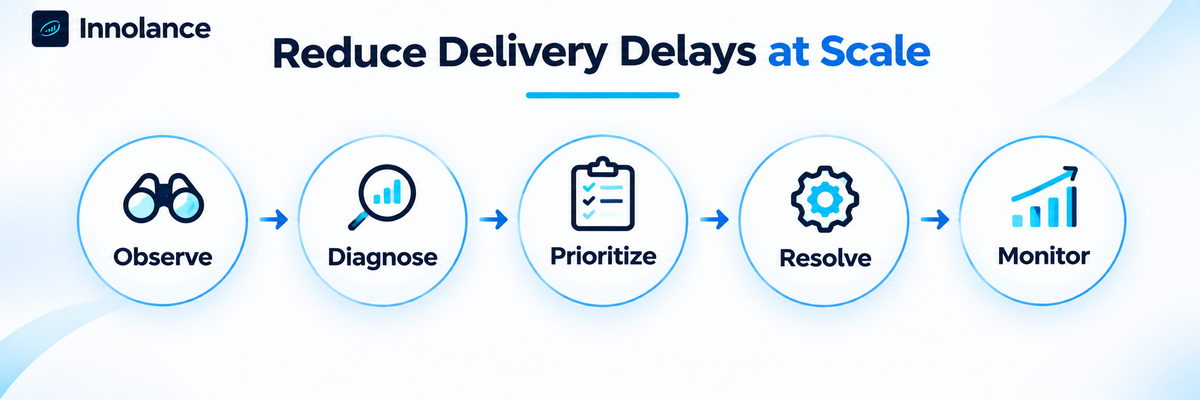
Leaders should first observe workflow patterns and identify recurring delays. Next, diagnose whether the constraint involves capacity, dependencies, decisions, or technology.
Prioritize the bottlenecks with the greatest effect on delivery commitments, implement targeted improvements, and monitor whether delivery performance stabilizes.
An effective execution strategy connects business priorities with operational decisions and measurable delivery outcomes.
What Should Leaders Do Next?
Begin by reviewing one delayed initiative and tracing its path across teams, approvals, and dependencies.
Identify where work waited, which decisions slowed progress, and whether existing reporting revealed those risks early enough.
Innolance helps organizations improve Execution Clarity by examining delivery constraints, cross-functional alignment, and operational execution patterns.
Through a diagnostic approach, leaders can identify the underlying causes of delays and prioritize improvements that strengthen delivery predictability.
Frequently Asked Questions
What causes delivery delays in growing organizations?
Common causes include competing priorities, unmanaged dependencies, slow decisions, overloaded teams, technology complexity, and limited execution visibility.
Why does execution become harder as companies scale?
Growth increases coordination requirements, organizational dependencies, and decision complexity, making consistent execution more difficult.
How can leaders improve delivery predictability?
Leaders can improve predictability by identifying workflow constraints, reducing unnecessary work in progress, clarifying decision ownership, and monitoring delivery reliability.
Key Takeaways
- Organizational growth introduces new dependencies and coordination challenges.
- Delivery bottlenecks often develop outside individual teams.
- Flow metrics and decision indicators reveal risks earlier than status reports alone.
- Execution Clarity helps leaders diagnose constraints and improve delivery reliability.
Conclusion
Delivery delays at scale are rarely caused by a single issue. They emerge when organizational complexity, dependencies, decisions, and workflows become difficult to coordinate.