CRM Data Governance for RevOps Teams in 2026
Learn how RevOps teams can improve CRM data quality with clear ownership, data standards, hygiene practices, and scalable governance controls.
Executive Summary
As B2B organizations grow, maintaining CRM data quality becomes increasingly difficult. More users, integrations, automation, imports, and lifecycle changes create more opportunities for duplicate records, inconsistent fields, missing information, and unclear ownership.
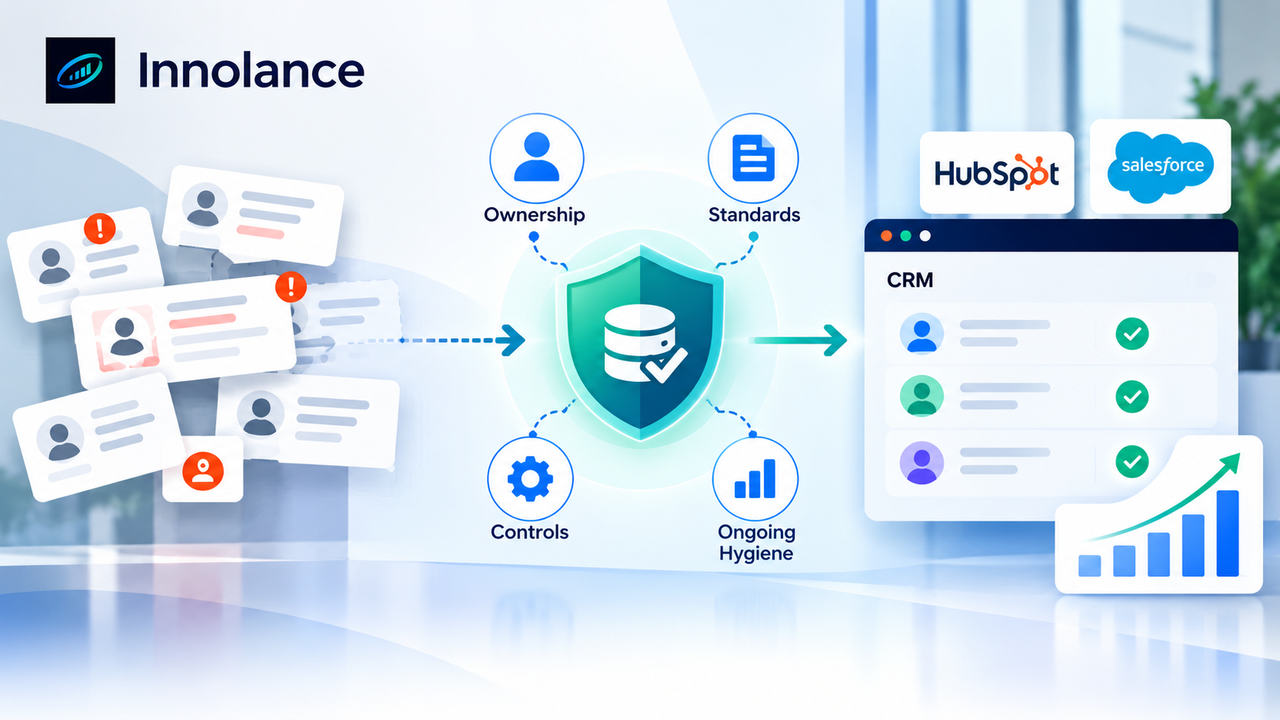
For HubSpot- and Salesforce-centric RevOps teams, one-time data cleansing is not enough. Sustainable CRM data quality requires clear ownership, consistent standards, preventive controls, ongoing hygiene, and measurable data-quality signals.
What Is CRM Data Governance?
CRM data governance is the system of ownership, standards, rules, and controls that determines how CRM data is created, maintained, validated, and used.
Data cleansing addresses existing problems. Governance helps prevent those problems from repeatedly returning.
As organizations scale, CRM data can enter through forms, integrations, imports, sales activity, marketing automation, service workflows, and manual updates. Without common standards, each source can introduce another variation of the truth.
Why Does CRM Data Quality Degrade During Growth?
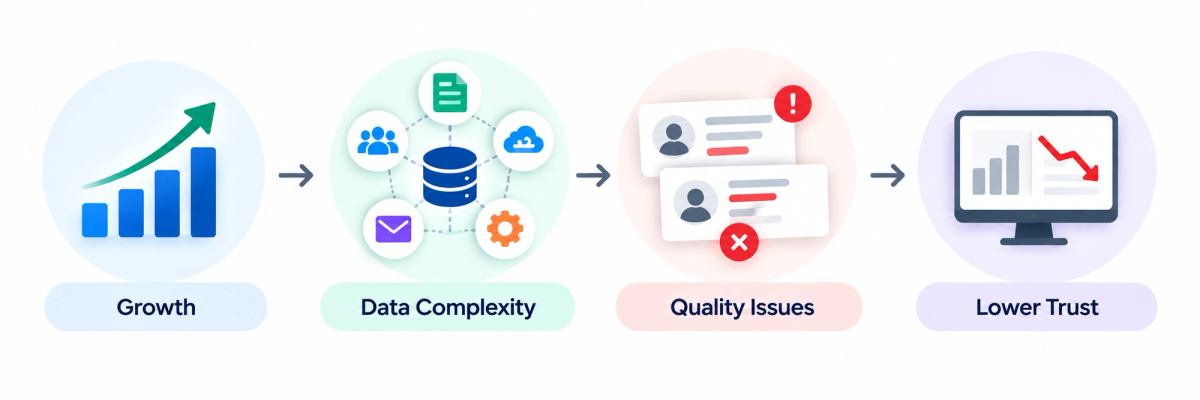
Growth increases both the volume of CRM data and the number of ways that data can change.
Duplicate records can fragment customer histories. Free-text fields introduce inconsistent terminology. Required information may be skipped. Integrations can apply different definitions to the same data, while outdated properties and workflows may remain active long after their original purpose disappears.
For RevOps teams, these problems extend beyond database cleanliness. Poor CRM data integrity can weaken segmentation, automation, pipeline reporting, handoffs, and leadership confidence in revenue information.
Key takeaway: CRM data quality problems scale when data creation grows faster than governance.
How Should RevOps Establish Data Ownership?
Every critical CRM data domain should have an accountable owner.
Sales Operations may govern opportunity and pipeline fields, while Marketing Operations may govern campaign and lead-source data. The exact ownership model can vary, but accountability should be explicit.
A practical CRM data dictionary should document:
- Field definition and purpose
- Data owner
- Accepted values and format
- Source system
- Required lifecycle stage
- Validation and maintenance rules
Clear ownership turns CRM governance from tribal knowledge into a repeatable operating discipline.
How Can Teams Prevent Duplicate and Low-Quality Data?
Effective duplicate data prevention starts before poor-quality records spread into reporting and downstream workflows.
RevOps teams should validate data at entry, standardize important field values, define matching rules, and reduce unnecessary free-text inputs. Required fields and validation controls can also help ensure critical information is captured consistently.
Existing records will still require periodic data cleansing, but cleanup should support governance rather than replace it.
Practical Tip: If the same data problem keeps returning after cleanup, investigate the process creating the problem instead of simply scheduling another cleanup.
What Should RevOps Measure?
CRM governance becomes easier to manage when teams monitor data-quality indicators before reporting or automation begins to fail.
Useful measures include:
- Required-field completion
- Duplicate rate
- Formatting issues
- Stale or incomplete records
- Unused properties
- Workflow exceptions
These measures help RevOps teams identify where CRM data quality is deteriorating and where stronger controls may be required.
The objective is not simply to create a cleaner database. It is to maintain a CRM that remains reliable as the organization changes.
How Do You Scale CRM Processes Without Losing Control?
Effective data quality management combines governance with automation.
Start with the CRM fields and objects that directly influence revenue workflows, reporting, and leadership decisions. Define ownership and standards first, then embed those standards into CRM processes using required fields, validation rules, duplicate detection, and automated quality controls.
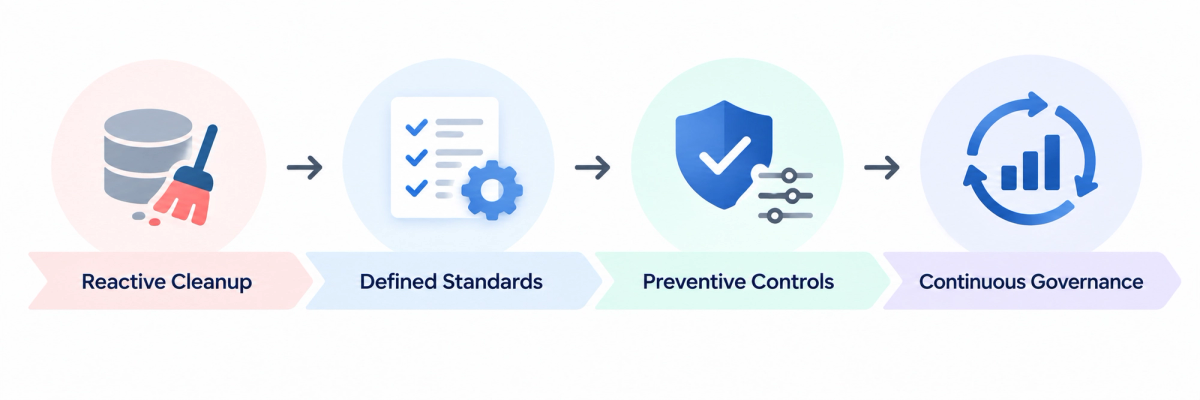
A scalable governance model creates a progression from:
Reactive Cleanup → Defined Standards → Preventive Controls → Continuous Governance
This approach helps teams move away from repeatedly fixing data and toward preventing quality issues earlier.
What Should RevOps Leaders Do Next?
Start by identifying the CRM data that revenue workflows, automation, reporting, and leadership decisions depend on most.
Audit its current quality. Define ownership. Document standards. Then identify where duplicate, incomplete, or inconsistent data is entering the process.
From there, move controls upstream so problems can be prevented before they affect downstream workflows and reporting.
For growing organizations, CRM optimization is therefore not simply a database-management exercise. Strong governance creates a more dependable operational foundation for automation, handoffs, reporting, and revenue decisions.
Conclusion
CRM data quality often deteriorates when an organization grows faster than its data standards, ownership model, and process controls.
For RevOps teams in 2026, maintaining CRM data integrity requires an ongoing governance discipline: clear ownership establishes accountability, standards define what reliable data looks like, preventive controls reduce errors at entry, and ongoing hygiene keeps the CRM aligned with changing business needs.
The goal is not to make the CRM perfectly clean at one point in time. It is to build a governed CRM that can remain trustworthy as the organization scales.