CRM Data Quality During Growth in 2026
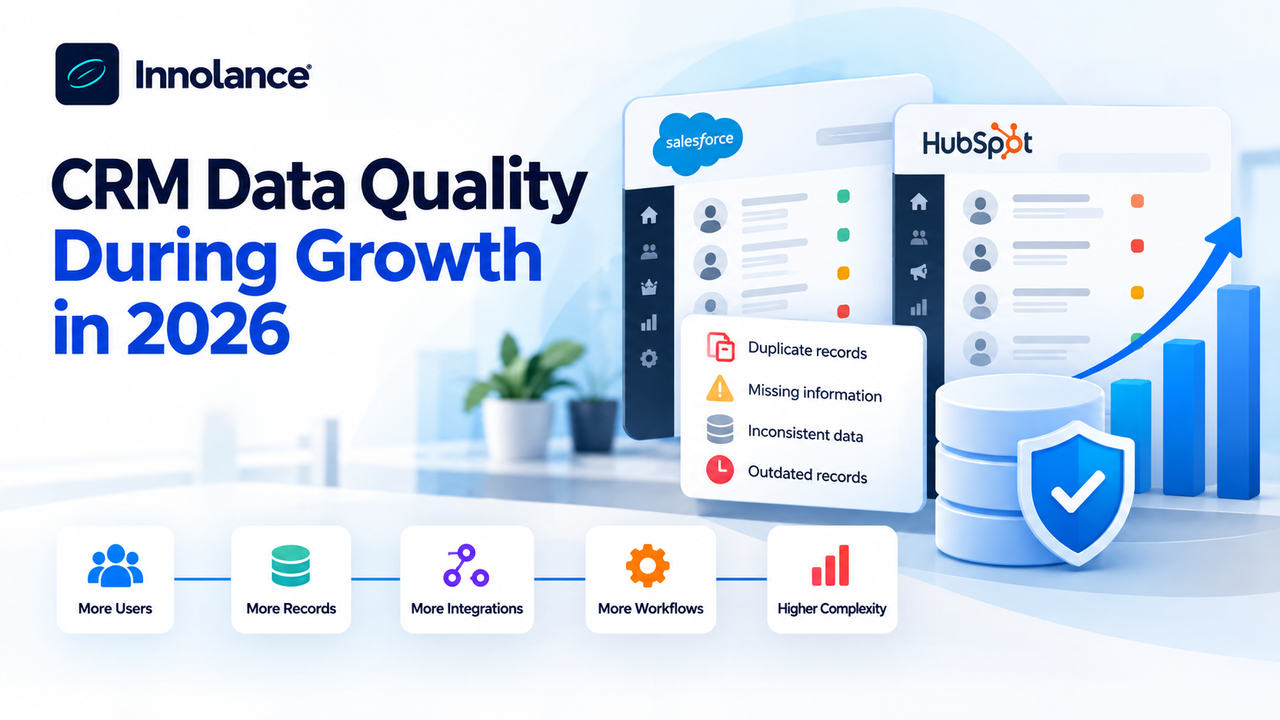
Learn why CRM data quality declines as Salesforce and HubSpot teams grow, and how governance, data hygiene, and standardized workflows improve accuracy.
CRM Data Quality During Growth in 2026
Executive Summary
As B2B organizations grow, maintaining reliable CRM data becomes increasingly challenging. More users, customer records, integrations, and workflows introduce opportunities for duplicate information, outdated records, inconsistent field definitions, and reporting errors.
For organizations using Salesforce and HubSpot, CRM data quality is essential for reliable sales forecasting, effective customer management, and confident business decisions.
Direct Answer: CRM data quality becomes harder to maintain during growth because increasing data volumes, inconsistent user practices, disconnected integrations, unclear ownership, and changing business processes create errors faster than teams can resolve them. Organizations can improve data reliability through standardized workflows, clear data governance, automated validation, and continuous CRM data hygiene.
Why Does CRM Data Quality Become Harder to Maintain During Growth?
CRM data quality refers to the accuracy, completeness, consistency, uniqueness, and timeliness of customer information stored in a CRM system.
A CRM environment that supports a small sales team may become significantly more complex as the organization expands.
New employees may enter information differently. Additional integrations introduce competing data sources. Changing sales processes create new reporting requirements and ownership responsibilities.
Common warning signs include:
- Duplicate contacts, accounts, and opportunities
- Missing or outdated customer information
- Inconsistent lead and opportunity stages
- Conflicting reports across departments
- Incorrect record ownership
- Frequent manual data corrections
Key Takeaway: CRM data quality problems often emerge when business growth outpaces the processes used to manage customer information.
How Does Scaling CRM Systems Create Data Accuracy Problems?
Scaling CRM systems involves expanding CRM users, records, integrations, automation, and workflows to support organizational growth.
As Salesforce and HubSpot environments become more complex, maintaining consistent data accuracy requires stronger operational controls.
For example, marketing automation may create new leads while sales representatives manually enter similar contacts. Without reliable matching rules, duplicate records can accumulate.
Similarly, disconnected integrations may overwrite accurate information with outdated values.
Organizations should establish clear field definitions, required data standards, and validation rules before expanding automation.
Practical Tip: Review the most frequently updated CRM fields and identify where information enters from multiple sources.
What Are the Five Drivers of CRM Data Quality?
Effective data quality management requires organizations to evaluate the operational factors that influence the reliability of customer information.
Five connected drivers are particularly important:
- Data Accuracy: Ensure customer and opportunity information reflects actual business conditions.
- Data Consistency: Standardize definitions across departments and connected systems.
- Data Ownership: Assign responsibility for creating, updating, and correcting records.
- Workflow Validation: Prevent incomplete or incorrect information from entering the CRM.
- Continuous Monitoring: Identify duplicate, outdated, or missing records before they affect reporting.
A practical framework connects these elements:
Accuracy → Consistency → Ownership → Validation → Monitoring
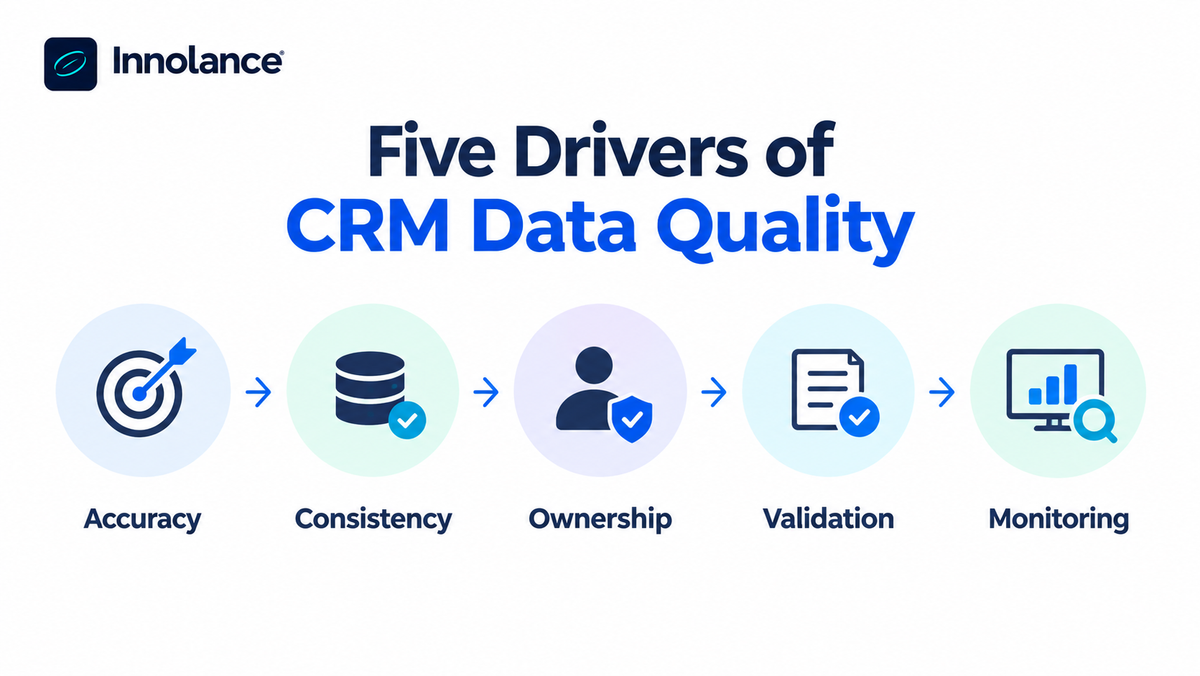
These drivers help organizations shift from reactive data cleanup toward preventive data management.
Key Takeaway: Reliable CRM data requires consistent processes, defined ownership, and continuous validation rather than occasional record corrections.
Why Does CRM Data Hygiene Become More Important as Teams Grow?
CRM data hygiene is the ongoing practice of identifying, correcting, and preventing inaccurate, incomplete, duplicate, or outdated customer records.
As teams grow, inconsistent data-entry habits can create recurring problems.
For example, different representatives may use different naming conventions, leave required fields incomplete, or fail to update customer information after important interactions.
Poor CRM data hygiene can weaken lead routing, customer segmentation, pipeline reporting, and sales forecasting.
Organizations should introduce duplicate detection, standardized data-entry rules, scheduled record reviews, and automated quality checks.
Practical Tip: Prioritize CRM fields that directly influence revenue reporting, customer handoffs, and operational decisions.
How Can Data Governance Prevent CRM Data Breakdowns?
Data governance defines the policies, responsibilities, and standards used to maintain reliable CRM information.
Without clear governance, employees may be uncertain about who owns records, which systems provide authoritative information, or how conflicting data should be resolved.
A practical governance model should answer:
- Who owns critical CRM records and fields?
- Which system serves as the source of truth?
- Who can create, edit, merge, or delete records?
- What validation rules apply to essential information?
- How are data quality issues identified and resolved?
For HubSpot and Salesforce environments, governance should also cover integration ownership, permission management, and lifecycle-stage definitions.
Key Takeaway: Strong data governance reduces recurring errors by making responsibilities and information standards clear.
How Does CRM User Adoption Affect Data Quality?
CRM technology cannot maintain accurate information when employees consistently bypass required workflows.
Low user adoption may result in outdated opportunity records, missing customer activities, inconsistent field updates, and disconnected spreadsheets.
Organizations should examine whether CRM processes support daily responsibilities or introduce unnecessary administrative work.
Simplifying workflows, providing role-specific training, and reinforcing consistent usage can improve both adoption and data reliability.
Managers should also use CRM information during regular business reviews to encourage accurate and timely updates.
Practical Tip: Monitor meaningful CRM activity, such as opportunity updates and required-field completion, rather than relying only on login counts.
Which Metrics Help Leaders Measure CRM Data Quality?
Revenue operations leaders should monitor measurable indicators that reveal whether CRM information remains reliable during growth.
Useful metrics include:
- Duplicate Record Rate: Percentage of records identified as duplicates
- Field Completeness: Percentage of required CRM fields populated
- Data Accuracy Rate: Percentage of sampled records verified as correct
- Record Freshness: Percentage of critical records updated within an agreed period
- Integration Error Rate: Frequency of failed or conflicting data synchronization
- Data Issue Resolution Time: Average time required to correct identified errors
Tracking these metrics helps leaders identify recurring issues and evaluate whether governance improvements are working.
How Can Leaders Build a Scalable CRM Data Quality Process?
Maintaining reliable CRM information requires a structured improvement process that evolves with organizational growth.
A practical improvement cycle is:
Assess → Standardize → Validate → Govern → Monitor
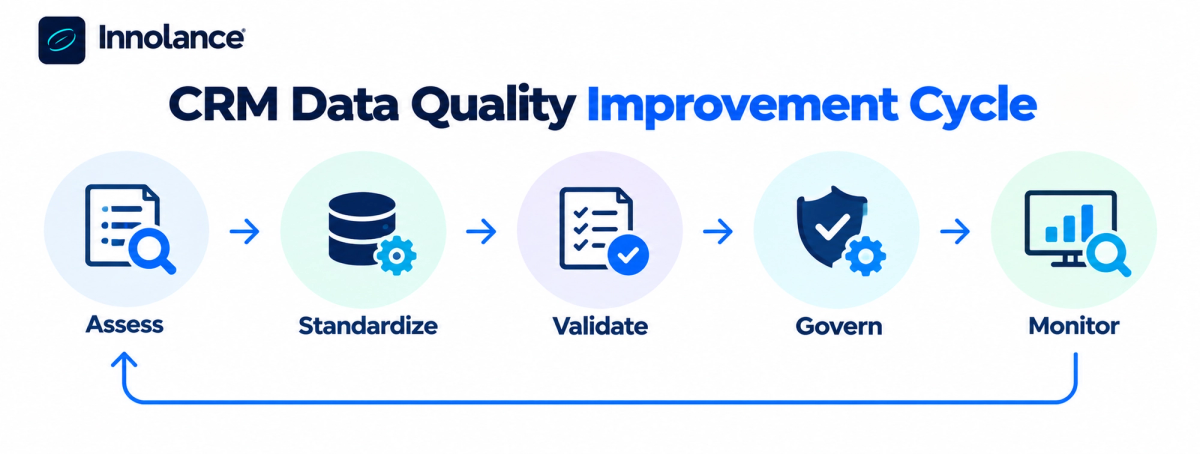
Begin by assessing duplicate records, incomplete fields, integration errors, and inconsistent workflows.
Standardize data definitions and ownership responsibilities. Introduce validation rules that prevent incorrect information from entering the system.
Establish governance practices and monitor quality indicators to identify recurring problems.
Automation can support duplicate detection, record validation, and synchronization monitoring. However, technology alone cannot resolve unclear ownership or conflicting business processes.
Key Takeaway: Sustainable CRM data quality depends on combining automated controls with clear governance and consistent employee practices.
What Should B2B Leaders Do Next?
Start with a focused assessment of one critical CRM workflow, such as lead management, opportunity tracking, or customer handoffs.
Trace how information enters Salesforce or HubSpot, moves between connected systems, changes ownership, and appears in reports.
Identify where duplicate records, outdated information, inconsistent definitions, or manual workarounds create reliability problems.
Prioritize improvements based on their impact on reporting accuracy, customer management, and revenue operations.
Innolance helps growing organizations examine CRM workflows, integrations, data governance, and adoption challenges to identify operational gaps affecting data reliability. This diagnostic approach supports practical improvements that strengthen CRM processes as businesses scale.
Frequently Asked Questions
Why does CRM data quality decline as companies grow?
CRM data quality often declines because more users, integrations, records, and workflows introduce inconsistent information, duplicate records, and unclear ownership responsibilities.
How can Salesforce and HubSpot teams improve CRM data accuracy?
Organizations can improve accuracy by standardizing field definitions, introducing validation rules, preventing duplicates, assigning ownership, and regularly reviewing critical customer information.
What is the difference between CRM data hygiene and data governance?
CRM data hygiene focuses on maintaining clean, accurate, and updated records. Data governance establishes the policies, standards, and responsibilities that help prevent data quality problems.
Can automation solve CRM data quality problems?
Automation can identify duplicates, validate required fields, and monitor integration errors. However, reliable data quality also requires consistent workflows, clear ownership, and employee adoption.
Conclusion
Maintaining CRM data quality during growth in 2026 requires more than periodic cleanup or additional CRM automation.
As Salesforce and HubSpot environments scale, inconsistent workflows, duplicate records, unclear ownership, and low user adoption can weaken data accuracy and reporting reliability.
By strengthening data governance, standardizing workflows, improving CRM data hygiene, and continuously monitoring quality indicators, B2B organizations can build a more reliable CRM foundation that supports sustainable growth.