
Embedded Teams vs Consulting for Delivery Improvement
Compare embedded delivery teams and traditional consulting to discover which approach improves delivery predictability, execution, and long-term operational ownership.
Executive Summary
Growing software organizations often struggle with unpredictable delivery, increasing dependencies, and operational complexity. Traditional consulting can help diagnose these challenges, while embedded delivery teams work alongside internal teams to implement improvements.
For CTOs, COOs, and engineering leaders evaluating delivery improvement alternatives, the right approach depends on the organization's execution challenges, available capabilities, and long-term ownership requirements.
Direct Answer: Alternatives to traditional consulting for delivery improvement include embedded delivery teams, internal transformation teams, managed services, and hybrid consulting models. Embedded teams can offer closer day-to-day collaboration and stronger knowledge transfer, while traditional consulting can provide independent expertise and strategic recommendations. The best choice depends on whether an organization needs diagnosis, implementation support, or sustained operational improvement.
Why Are Organizations Exploring Alternatives to Traditional Consulting?
As software organizations scale, delivery challenges become increasingly interconnected.
Cross-team dependencies, unclear priorities, delayed decisions, and inconsistent execution processes can reduce delivery predictability.
Traditional consulting often focuses on assessments, recommendations, and transformation roadmaps. These services can provide valuable independent perspectives, but organizations may still need internal capacity to implement changes.
Alternative consulting models address this challenge through closer collaboration, shared execution responsibilities, and continuous improvement.
The goal is not simply to receive recommendations but to establish improvements that remain effective after external support ends.
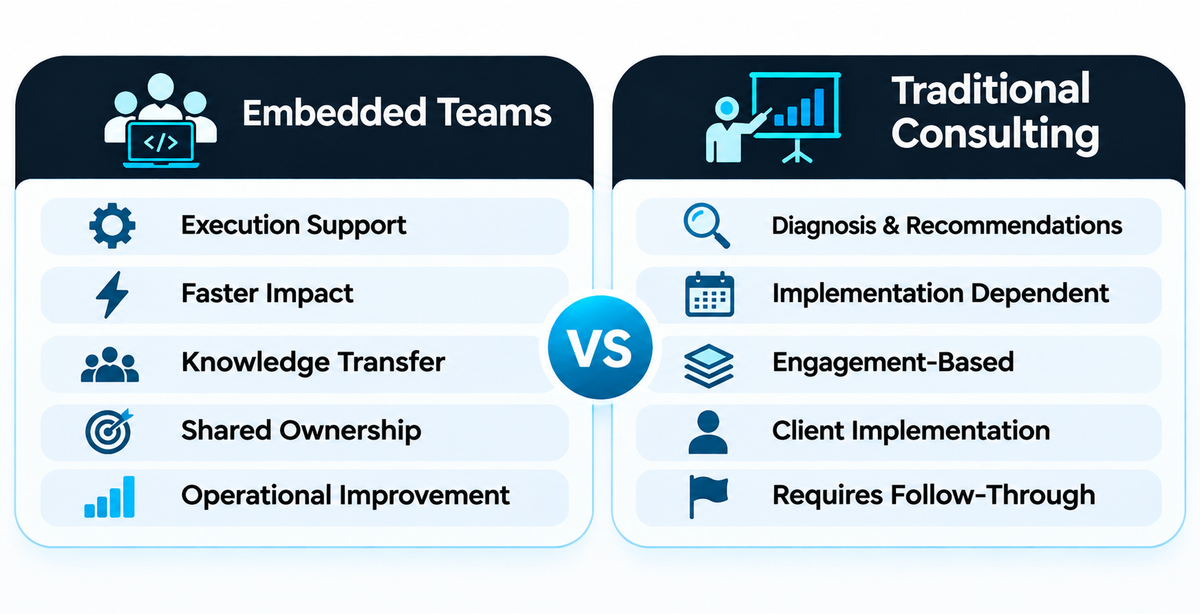
How Do Embedded Teams Compare With Traditional Consulting?
Embedded delivery teams work directly with internal engineering, product, and operational leaders to identify constraints and support implementation.
Traditional consulting engagements typically emphasize specialized analysis, strategic advice, and defined project deliverables, although some consulting firms also provide hands-on implementation.
Key differences:
- Delivery Improvement: Embedded teams provide continuous execution support, while traditional consulting often emphasizes diagnosis and recommendations.
- Speed to Impact: Embedded teams work directly within workflows, while consulting outcomes depend on how quickly recommendations are implemented.
- Internal Capabilities: Embedded teams encourage ongoing knowledge transfer, while consulting capability development varies by engagement.
- Operational Ownership: Embedded teams share execution responsibilities during the engagement, while traditional consulting often transfers implementation responsibility to the client.
- Long-Term Improvement: Embedded teams integrate improvements into daily operations, while consulting recommendations require sustained organizational follow-through.
Neither model guarantees better outcomes. Effectiveness depends on engagement design, leadership involvement, and organizational readiness.
Which Delivery Improvement Alternatives Should Leaders Consider?
Organizations can evaluate four common approaches.
1. Traditional Consulting
External specialists assess delivery challenges, recommend improvements, and help develop transformation strategies.
This approach is useful when leaders need independent analysis or specialized expertise.
2. Embedded Delivery Teams
Experienced delivery professionals collaborate with internal teams to improve workflows, resolve dependencies, and strengthen execution practices.
This approach may suit organizations that need hands-on implementation support.
3. Internal Transformation Teams
Organizations establish dedicated internal teams responsible for delivery transformation, process improvement, and operational performance.
This strengthens internal ownership but requires sufficient capacity and expertise.
4. Managed Services
External providers take responsibility for defined operational activities under agreed service expectations.
Managed services can support operational consistency, although organizations must maintain appropriate governance and accountability.
How Can Leaders Measure Delivery Improvement?
Regardless of the model selected, leaders should evaluate measurable delivery outcomes.
Five useful indicators include:
- Commitment Reliability: Percentage of planned commitments delivered as agreed.
- Cycle Time: Time required to complete work after it begins.
- Flow Efficiency: Percentage of elapsed delivery time spent on active work.
- Blocked Work Age: Time work remains delayed by unresolved constraints.
- Decision Velocity: Time required to resolve decisions affecting execution.
These measures help leaders distinguish meaningful operational improvement from activity-based progress reporting.
How Can Organizations Build Lasting Delivery Capabilities?
Sustainable improvement requires more than external expertise.
Organizations must develop internal capabilities to identify constraints, coordinate decisions, and monitor execution performance.
A practical improvement framework is:
Diagnose → Embed → Improve → Transfer → Sustain
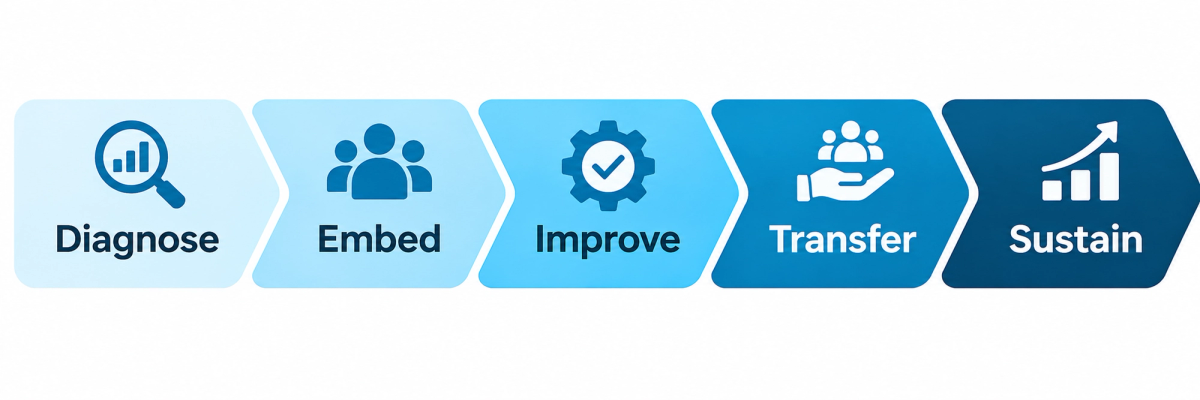
Leaders first diagnose recurring execution constraints. Next, they embed improvement practices into existing workflows, implement targeted changes, transfer knowledge to internal teams, and sustain progress through continuous measurement.
This approach can help organizations reduce dependence on external support while strengthening operational ownership.
What Should Leaders Do Next?
Start by identifying whether the organization primarily needs independent diagnosis, implementation capacity, or long-term operational support.
Review where delivery commitments become unreliable, which dependencies create delays, and whether internal teams have the capacity to resolve these issues.
Innolance approaches delivery improvement through Execution Clarity understanding where execution is breaking down and why.
Through ExecLens and its diagnostic approach, Innolance helps leaders identify execution constraints, improve visibility, and prioritize actions that support more predictable delivery.
The objective is to strengthen the organization's ability to manage execution, rather than create permanent dependence on outside consultants.
Frequently Asked Questions
What are the alternatives to traditional consulting for improving delivery?
Common alternatives include embedded delivery teams, internal transformation teams, managed services, and hybrid consulting arrangements that combine diagnosis with implementation support.
Are embedded teams better than traditional consulting?
Not necessarily. Embedded teams may be more suitable for hands-on execution improvement, while traditional consulting may be appropriate for independent assessments and specialized strategic expertise.
How can organizations improve delivery predictability?
Organizations can improve predictability by identifying workflow constraints, clarifying decision ownership, managing dependencies, reducing excessive work in progress, and monitoring delivery metrics.
Key Takeaways
- Delivery improvement alternatives should be evaluated against specific organizational needs.
- Embedded teams can connect external expertise with day-to-day execution.
- Traditional consulting remains valuable for independent diagnosis and strategic guidance.
- Internal capability building and operational ownership are essential for sustainable improvement.
Conclusion
Choosing between embedded teams and traditional consulting is not simply a decision about external expertise. It is a decision about how an organization will diagnose challenges, implement improvements, and sustain results.
By selecting an appropriate delivery improvement model and strengthening Execution Clarity, software leaders can improve coordination, build internal capabilities, and establish more predictable delivery outcomes.