
Everything You Need to Know About CRM Data Ownership
Learn how CRM data ownership helps RevOps teams maintain data quality, improve customer data accuracy, and scale HubSpot and Salesforce systems effectively.
Executive Summary
As B2B organizations grow, maintaining accurate CRM data becomes increasingly difficult. More users, customer records, integrations, and workflows introduce duplicate information, inconsistent updates, and unclear responsibilities.
For HubSpot and Salesforce-centric organizations, CRM data ownership helps maintain reliable customer information and supports scalable revenue operations.
Direct Answer: CRM data quality declines during growth because expanding teams, inconsistent data entry, disconnected systems, and unclear ownership create errors. Organizations can improve CRM data quality through defined responsibilities, standardized workflows, automated validation, and continuous monitoring.
What Is CRM Data Ownership?
CRM data ownership defines who is responsible for maintaining, validating, correcting, and governing customer information.
Clear ownership ensures sales, marketing, and revenue operations teams follow consistent standards and understand their responsibilities.
Without accountability, duplicate records, missing fields, and conflicting information can remain unresolved.
Why Does CRM Data Quality Decline During Growth?
Growing organizations face five common challenges:
- Inconsistent Data Entry: Employees use different formats and update practices.
- Unclear Ownership: Teams lack responsibility for correcting inaccurate records.
- Disconnected Systems: Integrations create duplicate or conflicting information.
- Workflow Complexity: Expanding processes increase incomplete updates and missed handoffs.
- Limited Monitoring: Problems remain unnoticed until reporting becomes unreliable.
These challenges reduce customer data accuracy and weaken revenue forecasting.
Key Takeaway: CRM data quality problems often result from disconnected processes and unclear accountability, not technology alone.
Who Should Own CRM Data Quality?
Effective CRM data management requires shared responsibility supported by centralized governance.
- Revenue Operations: Establishes data standards, governance policies, and KPIs.
- Sales: Maintains account, contact, and opportunity information.
- Marketing: Manages lead information and qualification consistency.
- CRM Administrators: Configures validation, integrations, and monitoring.
- Leadership: Reviews performance and reinforces accountability.
A practical ownership framework follows five steps:
Define → Assign → Validate → Monitor → Improve
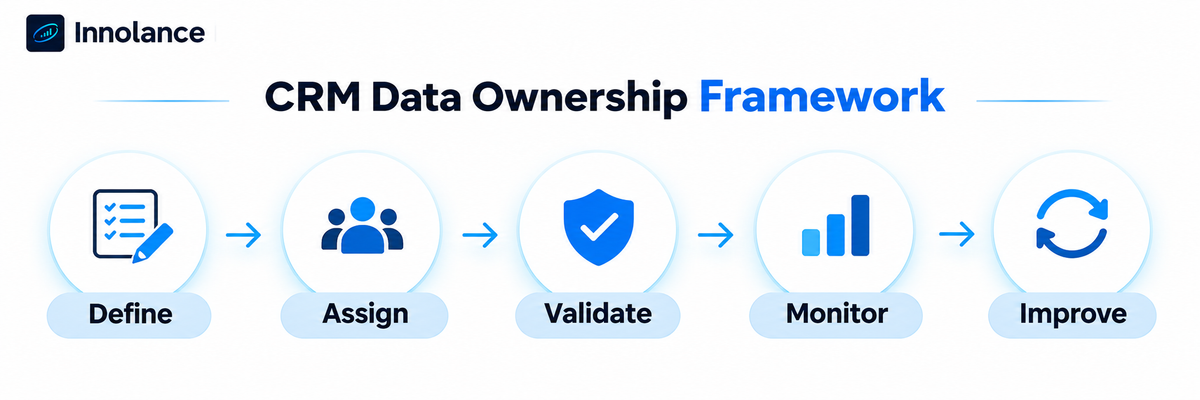
This framework clarifies responsibilities and supports consistent customer information as organizations scale.
How Can Organizations Maintain Customer Data Accuracy?
Organizations should standardize required fields, lifecycle stages, naming conventions, and record-update procedures.
Automated validation can identify missing information, incorrect formats, and duplicate records before they affect reporting.
HubSpot and Salesforce integrations also require clear rules defining which system owns shared fields and how conflicting updates are resolved.
Regular audits help identify recurring errors and ensure accountable teams address them.
Practical Tip: Prioritize fields affecting account ownership, opportunity status, customer handoffs, and pipeline reporting.
Which KPIs Help Measure CRM Data Quality?
RevOps leaders can monitor five practical indicators:
- Data Completeness Rate: Percentage of CRM records containing required information.
- Duplicate Record Rate: Percentage of customer records identified as duplicates.
- Data Accuracy Rate: Percentage of sampled records verified as correct.
- Field Consistency Rate: Percentage of fields following approved data standards.
- Data Correction Time: Average time required to resolve identified CRM data errors.
Tracking these metrics helps organizations detect problems early and evaluate improvements.
How Can RevOps Teams Improve CRM Scalability?
CRM scalability means supporting growing users, records, and workflows without compromising reliability.
A repeatable improvement cycle strengthens data governance:
Audit → Standardize → Assign → Automate → Monitor
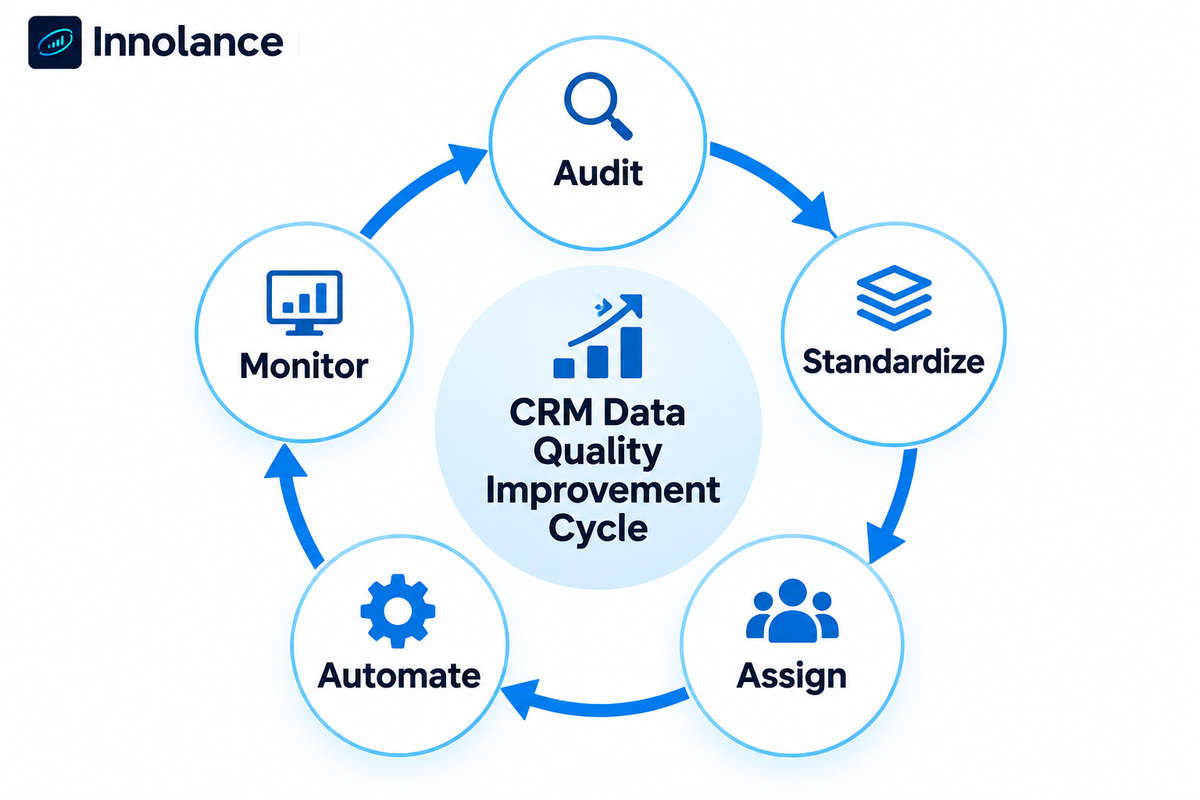
- Audit: Identify incomplete and duplicate records.
- Standardize: Establish consistent data definitions.
- Assign: Define responsibility for critical fields.
- Automate: Implement validation and duplicate detection.
- Monitor: Track KPIs and resolve recurring issues.
Automation reduces manual effort, but effective governance still requires clear ownership.
What Should Revenue Operations Leaders Do Next?
Start by identifying CRM fields essential to pipeline visibility, sales handoffs, and revenue forecasting.
Review who maintains these fields, where errors originate, and how inconsistencies are corrected.
Assign owners, establish quality standards, and introduce measurable monitoring.
Innolance helps organizations examine CRM workflows, integration challenges, and operational processes to identify gaps affecting data reliability.
This diagnostic approach helps leaders prioritize improvements that strengthen CRM data quality and support dependable revenue operations.
Frequently Asked Questions
What makes CRM data quality difficult during growth?
More users, inconsistent workflows, disconnected systems, and unclear ownership increase duplicate, incomplete, and conflicting records.
Who is responsible for CRM data ownership?
RevOps typically coordinates governance, while sales, marketing, administrators, and leadership maintain defined responsibilities.
How can HubSpot and Salesforce teams improve data quality?
They can standardize fields, assign owners, configure validation, manage integrations, and monitor quality KPIs.
Key Takeaways
- CRM growth increases data complexity and quality risks.
- Clear ownership strengthens accountability and data accuracy.
- Standardized processes and validation improve CRM reliability.
- Continuous monitoring supports scalable data governance.
Conclusion
Maintaining CRM data quality during growth requires more than additional technology.
Clear ownership, standardized workflows, reliable integrations, and measurable controls help organizations reduce reporting inconsistencies.
By strengthening CRM data ownership, RevOps teams can improve customer data accuracy and build a more reliable foundation for sustainable growth.