
Everything You Need to Know About Execution Bottlenecks

Learn how leaders uncover execution bottlenecks through workflow analysis, decision patterns, and cross-team visibility to improve delivery predictability.
Executive Summary
Execution bottlenecks can slow delivery even when teams are working efficiently and project dashboards appear healthy. Delayed decisions, unclear priorities, hidden dependencies, and fragmented leadership visibility often create constraints that individual teams cannot resolve.
For CTOs, COOs, and product and engineering leaders, execution bottleneck analysis helps identify where work slows, why delays repeat, and which organizational constraints require leadership attention.
Direct Answer: The best way to uncover execution bottlenecks is to examine workflow signals, decision patterns, cross-team dependencies, and leadership visibility together. Leaders should identify where work waits, trace recurring delays to their causes, and address the constraint limiting overall delivery performance.
What Are Execution Bottlenecks?
An execution bottleneck is a constraint that limits how effectively work moves from organizational priorities to completed outcomes.
Unlike isolated task delays, execution bottlenecks often affect multiple teams, initiatives, or decision-making processes.
Common examples include:
- Decisions waiting for leadership approval
- Conflicting priorities across departments
- Dependencies delaying multiple delivery teams
- Unclear ownership of critical decisions
- Frequent changes to delivery commitments
Execution Clarity the ability to understand where execution is breaking down and why helps leaders identify bottlenecks earlier, strengthen alignment, and make informed decisions before delivery is impacted.
Key Takeaway: Execution bottlenecks are not always team performance problems. They frequently reflect constraints in how organizations coordinate and make decisions.
Why Do Execution Bottlenecks Remain Hidden?
Traditional project dashboards often emphasize completed tasks, milestones, and delivery status.
However, these indicators may not reveal how long work waits for decisions, how frequently priorities change, or whether dependencies are creating delays across teams.
A project may appear on track while unresolved decisions accumulate behind the scenes.
This creates a gap between reported progress and actual delivery confidence.
Effective workflow analysis examines not only what teams complete but also what prevents work from moving forward.
Key Takeaway: Healthy-looking metrics do not necessarily indicate healthy execution.
What Are the Five Drivers of Execution Bottlenecks?
Execution bottlenecks typically result from five connected factors: organizational complexity, communication gaps, decision delays, delivery dependencies, and technology complexity.
1. Organizational Complexity
As organizations scale, additional teams, reporting structures, and approval layers can slow coordination.
2. Communication Gaps
Inconsistent information across leadership, product, and engineering teams creates misunderstandings about priorities and commitments.
3. Decision Delays
Unclear decision authority or competing leadership priorities can leave critical work waiting for approval.
4. Delivery Dependencies
When teams rely on other departments, platforms, or shared resources, delays can spread across multiple initiatives.
5. Technology Complexity
Disconnected systems, fragmented tools, and complicated technical environments can reduce visibility and interrupt workflows.
Organizational Complexity → Communication Gaps → Decision Delays → Delivery Dependencies → Technology Complexity
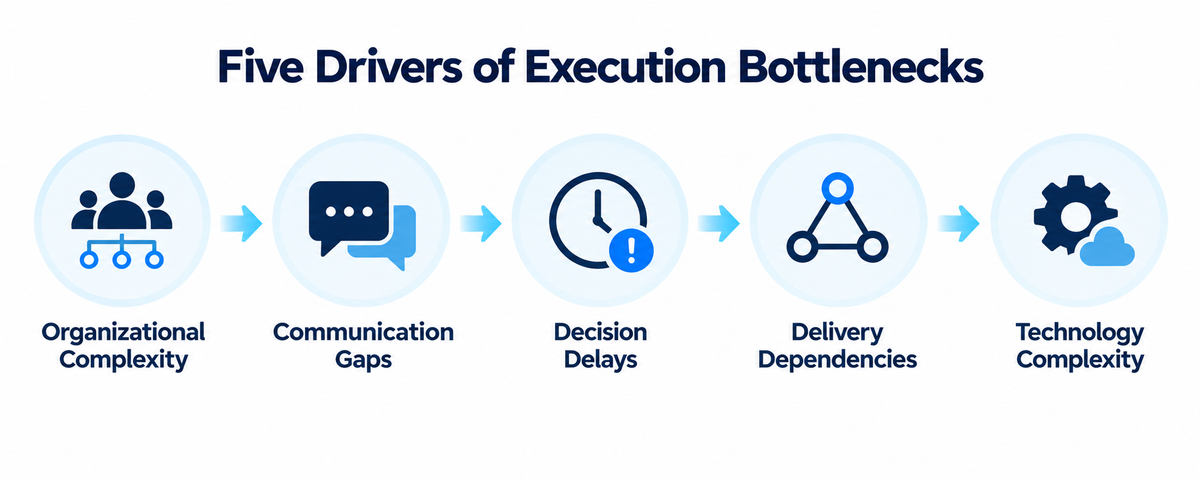
Key Takeaway: Bottlenecks often emerge from connected organizational conditions rather than a single isolated issue.
How Can Leaders Identify Bottlenecks Through Workflow Analysis?
Bottleneck identification begins by tracing how work moves through the organization.
Leaders should examine where initiatives repeatedly slow down, wait for approval, or require unexpected coordination.
Three diagnostic questions are especially useful:
- Where does work consistently wait longer than expected?
- Which decisions or dependencies affect multiple teams?
- Where do delivery commitments change without clear explanations?
For example, engineering teams may complete development work on schedule while releases repeatedly wait for cross-functional approval.
The visible delay occurs near release, but the underlying constraint may be unclear decision ownership.
Practical Tip: Review delayed work items across multiple initiatives to identify recurring patterns rather than treating each delay separately.
Which Metrics Reveal Execution Bottlenecks?
Leaders can strengthen execution bottleneck analysis by monitoring indicators that expose workflow interruptions.
Useful metrics include:
- Decision Lead Time: Time required to resolve important decisions.
- Blocked Work Time: Time initiatives spend waiting on constraints.
- Flow Efficiency: Proportion of elapsed workflow time spent on active work.
- Dependency Resolution Time: Time needed to resolve cross-team dependencies.
- Commitment Reliability: How consistently agreed delivery commitments are met.
These measures help distinguish genuine execution constraints from normal delivery variation.
Key Takeaway: Leading indicators reveal emerging delivery risks before missed milestones become visible.
How Does Leadership Visibility Improve Operational Efficiency?
Operational efficiency improves when leaders can see how priorities, decisions, dependencies, and delivery outcomes influence one another.
Without cross-team visibility, departments may optimize their own performance while unintentionally creating delays elsewhere.
For example, one team may accelerate development while another lacks the capacity to review or integrate the resulting work.
Improving individual team productivity will not necessarily remove the shared constraint.
Leadership visibility helps organizations identify where coordination and decision-making need improvement.
How Can Leaders Remove Execution Bottlenecks?
Removing bottlenecks requires more than asking teams to work faster.
A structured improvement approach connects diagnosis with leadership action.
Observe → Diagnose → Prioritize → Resolve → Monitor
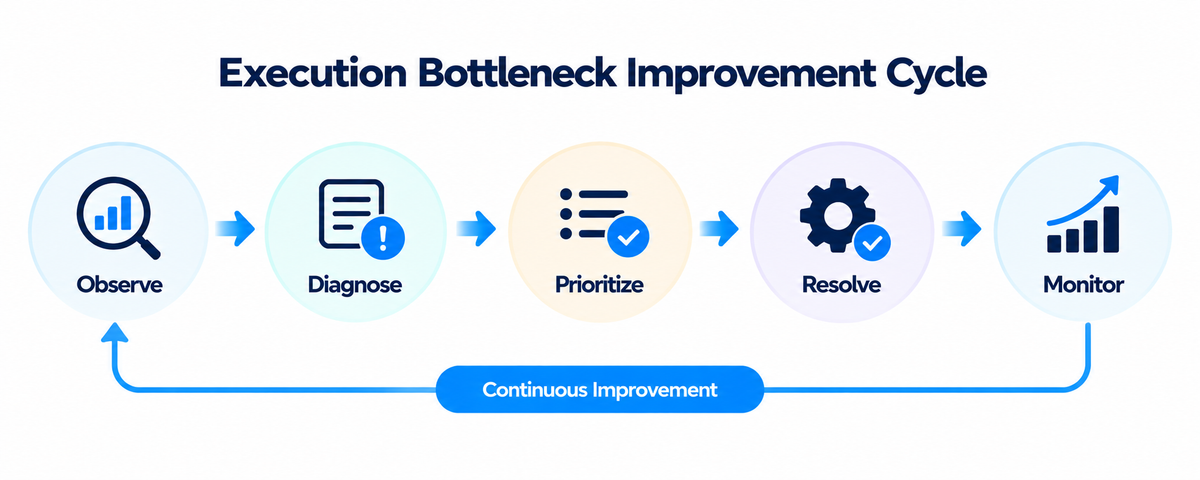
- Observe: Identify recurring workflow delays and blocked work.
- Diagnose: Determine whether the constraint involves decisions, dependencies, priorities, or systems.
- Prioritize: Focus on the constraint with the greatest impact on delivery.
- Resolve: Clarify ownership, simplify approvals, or improve coordination.
- Monitor: Track whether the change improves workflow stability and delivery outcomes.
This approach supports performance optimization at the organizational level rather than isolated productivity improvements.
Key Takeaway: Addressing the most consequential constraint often creates greater value than optimizing every team independently.
What Should Leaders Do Next?
CTOs, COOs, and engineering leaders should begin by examining one important initiative experiencing repeated delays.
Review its workflow, decision history, cross-team dependencies, and changes to delivery commitments.
Identify whether the same constraint appears across other initiatives.
Innolance helps organizations diagnose execution challenges through a structured assessment of leadership alignment, portfolio planning, and team execution.
Through ExecLens™, leaders can gain a clearer understanding of where execution is breaking down and which improvements may strengthen delivery predictability.
Frequently Asked Questions
What is the best way to uncover execution bottlenecks?
Analyze workflow delays, decision lead times, cross-team dependencies, and recurring delivery interruptions. Look for patterns across initiatives to identify the constraint affecting overall execution.
What is the difference between process bottlenecks and execution bottlenecks?
Process bottlenecks occur within a specific workflow. Execution bottlenecks may span teams, leadership decisions, organizational priorities, and delivery dependencies.
Why do execution bottlenecks persist even when teams perform well?
Teams may complete their assigned work efficiently while waiting on decisions, shared resources, or other departments. These organizational constraints can limit overall delivery performance.
How often should leaders review execution bottlenecks?
Leaders should review critical constraints during regular delivery and portfolio discussions, with additional attention when blocked work or commitment changes increase.
Conclusion
Execution bottlenecks become difficult to manage when leaders rely only on project status reports or individual team performance.
Effective execution bottleneck analysis connects workflow signals, leadership decisions, organizational dependencies, and delivery outcomes.
By identifying the constraints that repeatedly interrupt execution, organizations can improve operational efficiency, strengthen alignment, and build more predictable delivery systems.