
Execution Clarity Diagnostic: A Practical Framework for Better Business Execution
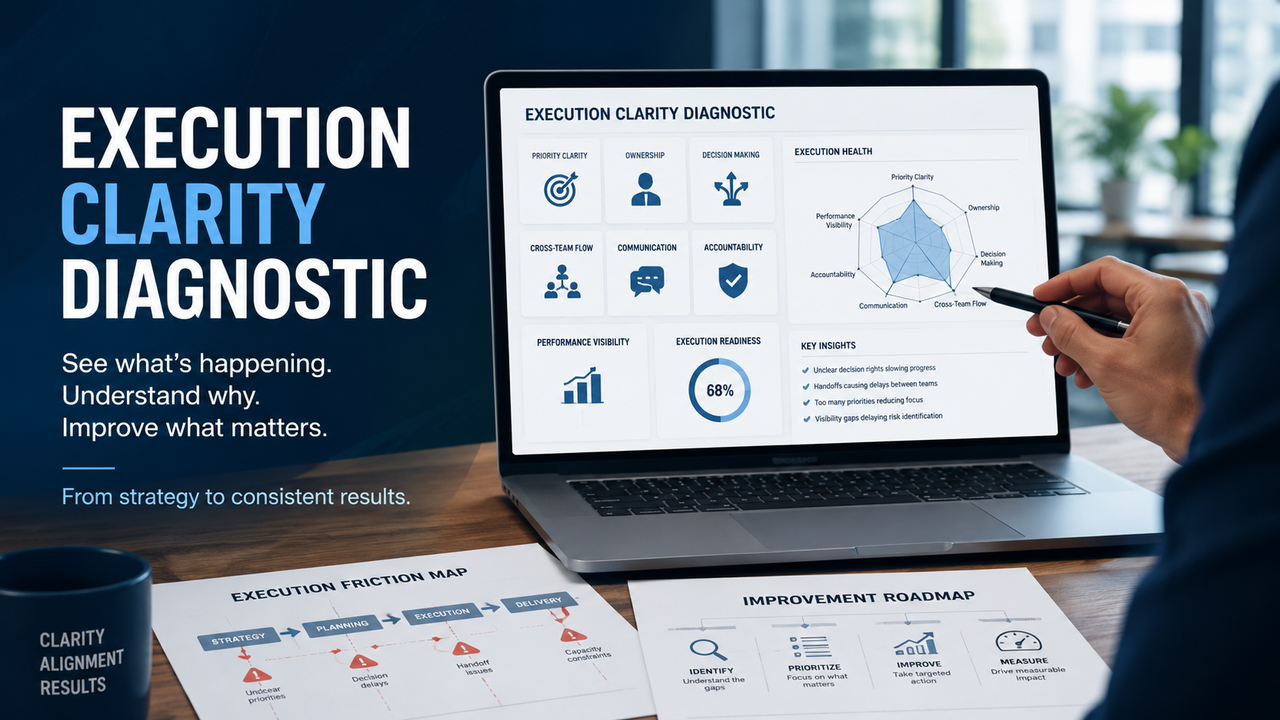
Discover how an Execution Clarity Diagnostic helps leaders uncover execution gaps, improve decision making, and create more predictable business outcomes.
An Execution Clarity Diagnostic helps leaders understand how effectively their organization turns strategy into consistent action. It reveals where unclear priorities, slow decisions, ownership gaps, communication issues, and cross team friction are affecting business outcomes. More importantly, it helps leaders determine what should improve next.
Executive Summary
Many organizations have capable people, clear strategies, and established processes, yet still struggle with missed commitments, changing priorities, slow decisions, and unpredictable outcomes.
The problem is often not effort. It is clarity.
As organizations grow more complex, leaders can lose visibility into how priorities, decisions, ownership, dependencies, and accountability affect execution.
An Execution Clarity Diagnostic provides a structured way to identify these gaps. It helps leaders answer three critical questions:
- What is happening?
- Why is it happening?
- What should improve next?
The goal is not more reporting. It is better visibility that supports faster decisions, stronger alignment, and more predictable business outcomes.
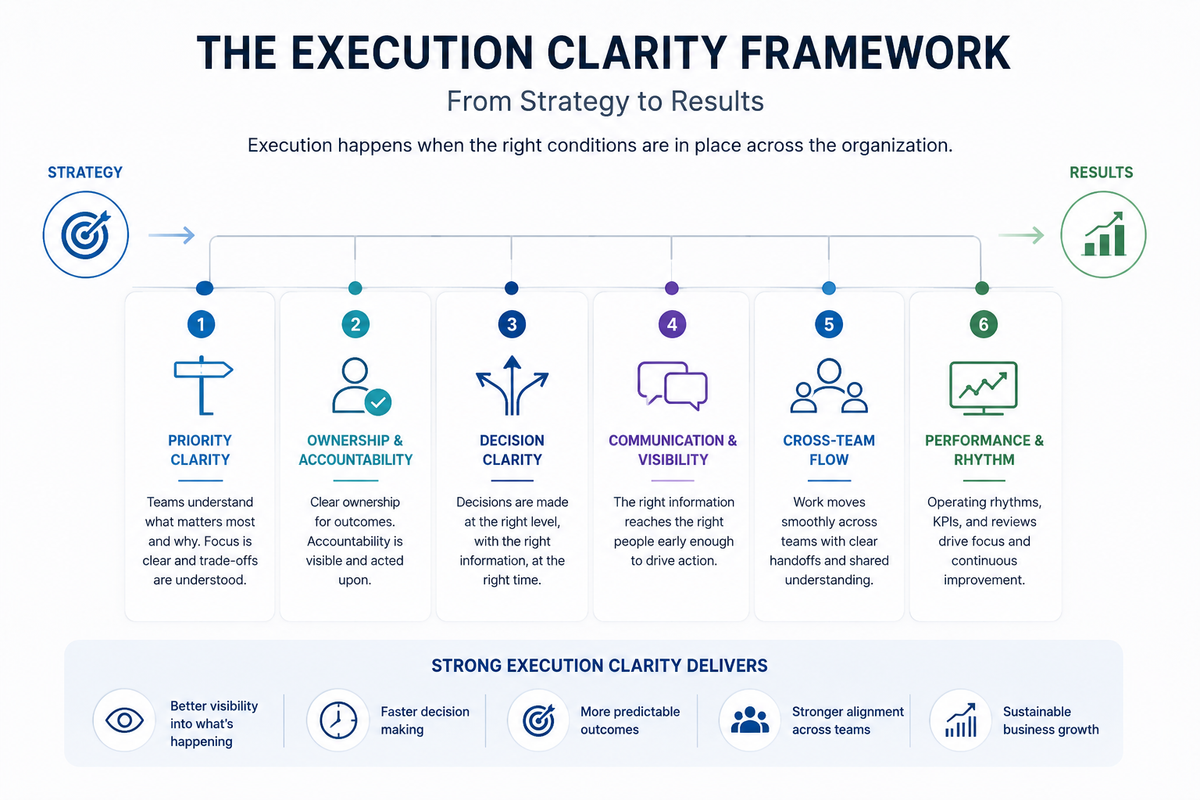
The Problem: Teams Are Busy, but Outcomes Remain Inconsistent
Execution problems are not always obvious.
Teams may be completing tasks. Projects may appear active. Leadership meetings may happen regularly. Dashboards may show progress.
Yet important commitments continue to move.
A strategic initiative expected this quarter moves into the next. A customer commitment depends on several teams with competing priorities. A critical decision waits for approval while downstream work slows.
Individually, these issues may look like planning, communication, or resource problems.
When they happen repeatedly, they often indicate a broader execution clarity problem.
Leaders need to understand not only whether work is moving, but what is affecting the organization's ability to turn strategy into results.
What Does an Execution Clarity Diagnostic Measure?
An Execution Clarity Diagnostic examines the conditions that influence how work gets done across people, teams, and processes.
Rather than focusing only on individual performance, it looks at the execution environment around the work.
A practical diagnostic should examine areas such as:
- Priority clarity: Do teams understand what matters most?
- Ownership: Is responsibility for important outcomes clear?
- Decision making: Are decisions made at the right level and at the right speed?
- Cross team coordination: Does work move effectively between functions?
- Communication: Does important information reach the right people early enough?
- Accountability: Are teams accountable for meaningful outcomes rather than activity alone?
- Performance visibility: Do leaders have the information needed to identify risks before outcomes are affected?
Together, these dimensions provide a clearer picture of how effectively strategy becomes coordinated action.
Why Execution Clarity Breaks Down
Execution becomes more difficult as organizational complexity increases.
More teams create more dependencies. More initiatives create competing priorities. More decisions create additional approval paths. Growth can introduce new processes and responsibilities without clearly defining how they should work together.
The effects often appear gradually.
A decision takes longer than expected. A dependency is discovered late. Leadership changes a priority, but not every affected team understands the implications. An issue moves through several meetings before someone takes ownership.
These small points of friction accumulate.
Eventually, leaders begin seeing the business consequences.
The Business Impact of Low Execution Clarity
Poor Execution Clarity affects more than operational efficiency.
It can directly influence business performance.
Some common effects include:
- Missed commitments: Hidden dependencies and unclear ownership make delivery harder to predict.
- Slow decision making: Teams wait for approval or escalate decisions unnecessarily.
- Constant reprioritization: New priorities disrupt existing work because tradeoffs are not clearly understood.
- Higher operating costs: Rework, additional meetings, escalations, and delays consume organizational capacity.
- Revenue unpredictability: Delayed launches, implementations, and customer commitments can affect growth expectations.
- Leadership frustration: Repeated surprises reduce confidence in plans and forecasts.
This is why improving execution requires more than asking teams to work faster.
Leaders need visibility into what is actually slowing progress.
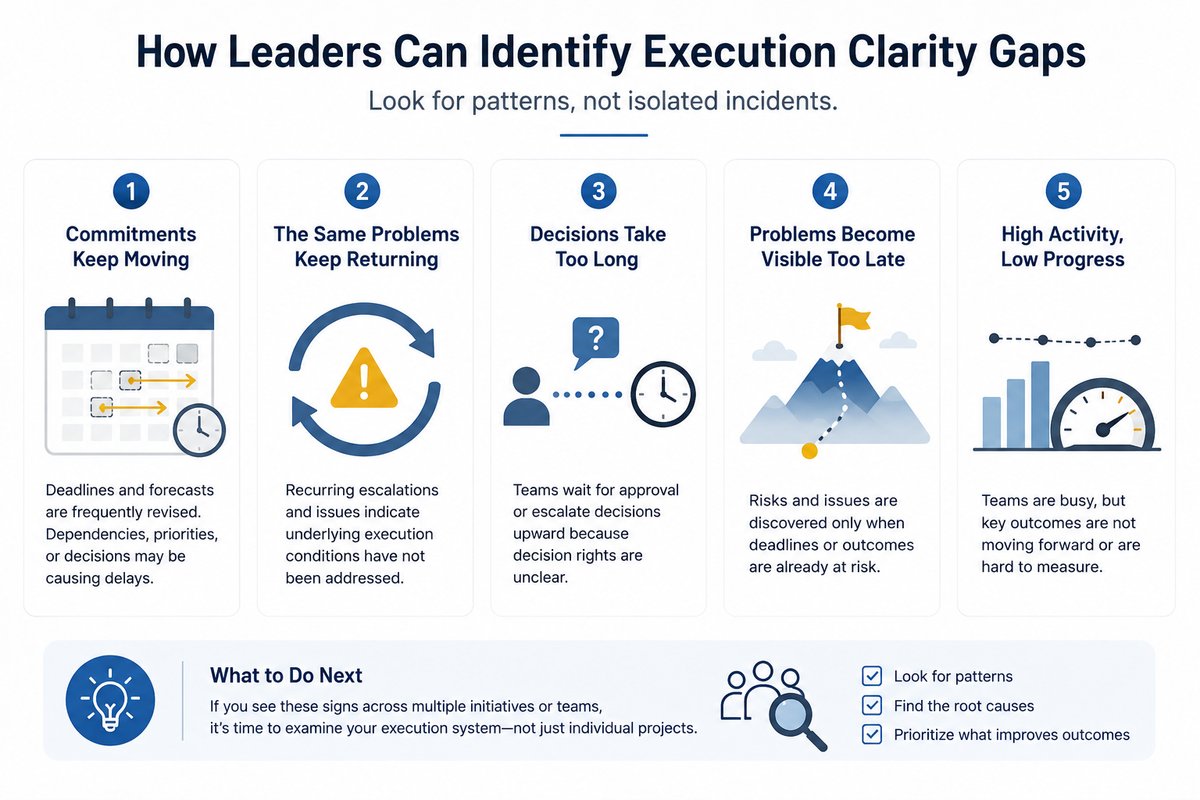
How Leaders Can Identify Execution Clarity Gaps
Several patterns can indicate that an organization has an Execution Clarity problem.
Commitments Keep Moving
If deadlines and forecasts are frequently revised, leaders should look beyond estimation. Changing priorities, delayed decisions, unclear ownership, and hidden dependencies may be affecting predictability.
The Same Problems Keep Returning
Recurring escalations are often a sign that the immediate issue is being solved while the underlying execution condition remains unchanged.
Decisions Take Too Long
When teams regularly wait for leadership approval, decision authority may not be clear enough.
Problems Become Visible Too Late
If leaders learn about significant risks only when a deadline is already threatened, the organization may have a visibility gap.
Activity Is High but Progress Is Difficult to Measure
Teams can be extremely busy while business outcomes remain inconsistent. This often happens when organizations measure activity more effectively than outcomes.
These signals should encourage leaders to examine the execution system rather than immediately attributing the problem to individual performance.
A Practical Execution Clarity Framework
An effective diagnostic should lead to focused improvement.
Innolance approaches Execution Clarity around three fundamental questions.
1. What Is Happening?
Create visibility into priorities, decisions, dependencies, ownership, risks, and outcomes.
The objective is to identify recurring patterns rather than isolated incidents.
For example, leaders may discover that several delayed initiatives depend on decisions from the same function or that frequent priority changes are creating similar disruptions across multiple teams.
2. Why Is It Happening?
Once the pattern is visible, determine what is creating it.
A delivery problem may actually originate from changing priorities.
A communication problem may originate from unclear ownership.
A resource problem may actually be caused by excessive work competing for the same capacity.
Understanding the cause helps leaders avoid solving the wrong problem.
3. What Should Improve Next?
Not every issue deserves equal attention.
Leaders should prioritize the execution constraints with the greatest effect on strategic outcomes.
Consider the impact on customers, revenue, delivery confidence, organizational capacity, and important business priorities.
This turns diagnosis into action.
Recommended Actions for Leaders
Leaders do not need to begin with a large transformation initiative.
Start with a small number of strategically important business outcomes.
Identify where progress is repeatedly slowing. Examine the decisions, dependencies, ownership, and priority changes surrounding those outcomes. Compare what leadership believes is happening with what teams experience during execution.
Then look for patterns.
If the same friction appears across multiple initiatives, it is probably not an isolated project problem.
Choose one or two execution constraints with meaningful business impact and improve those first.
Finally, measure whether the change creates better outcomes. Useful indicators may include faster decisions, fewer missed commitments, improved forecasting accuracy, reduced rework, fewer escalations, or shorter delivery cycles.
Execution Clarity becomes valuable when greater visibility leads to measurable improvement.
Conclusion
Strategy creates direction. Execution determines whether that direction becomes results.
When priorities compete, decisions slow, ownership becomes unclear, and dependencies remain hidden, organizations can stay extremely busy while outcomes become increasingly unpredictable.
An Execution Clarity Diagnostic helps leaders see these conditions before they become larger business problems.
It creates a structured way to understand what is happening, why it is happening, and what should improve next.
The objective is not to evaluate whether people are working hard enough. It is to create the clarity people need to execute effectively.
With greater Execution Clarity, leaders can make faster decisions, improve alignment, increase delivery confidence, and create more predictable business outcomes.
Frequently Asked Questions
What is an Execution Clarity Diagnostic?
An Execution Clarity Diagnostic is a structured assessment that helps leaders understand how effectively their organization turns strategy into coordinated action. It identifies execution gaps across priorities, ownership, decision making, communication, dependencies, accountability, and visibility.
What does an Execution Clarity Diagnostic measure?
It measures the organizational conditions that influence execution, including priority clarity, decision authority, ownership, cross team coordination, communication flow, accountability, and performance visibility.
What are common signs of poor Execution Clarity?
Common signs include missed commitments, frequent reprioritization, slow decisions, recurring escalations, unclear ownership, poor visibility, and teams that remain busy while business outcomes stay inconsistent.
How does Execution Clarity improve business performance?
Greater Execution Clarity helps leaders identify what is affecting outcomes and prioritize the improvements that matter most. This can support faster decisions, stronger alignment, better delivery predictability, and more effective use of organizational capacity.