
How to Build an Embedded Delivery Model in 2026: A Practical Alternative to Traditional Consulting
Learn how an embedded delivery model helps SaaS leaders move beyond traditional consulting by improving execution, optimizing delivery processes, and building long-term delivery capability.
How to Build an Embedded Delivery Model in 2026: A Practical Alternative to Traditional Consulting
Executive Summary
As SaaS organizations scale, improving software delivery becomes increasingly challenging. Growing product portfolios, cross-functional dependencies, distributed teams, and changing customer expectations make predictable execution difficult to sustain. While traditional consulting can provide valuable recommendations, many organizations struggle to convert those recommendations into lasting operational improvements. An embedded delivery model offers a practical alternative by combining external expertise with day-to-day collaboration to strengthen execution, improve delivery processes, and build long-term organizational capability.
Direct Answer
An embedded delivery model is one of the most effective delivery improvement alternatives to traditional consulting. Instead of delivering recommendations through a short-term engagement, experienced delivery advisors work alongside leadership and delivery teams to improve planning, optimize execution, strengthen collaboration, and continuously measure progress. This approach helps organizations improve delivery performance while building the internal capability needed to sustain future growth.
Why Are Organizations Looking Beyond Traditional Consulting?
Technology leaders are under constant pressure to deliver software faster without compromising quality or business outcomes. Although traditional consulting often provides strategic assessments and transformation roadmaps, implementation frequently depends entirely on internal teams once the engagement concludes.
Without ongoing support, organizations can struggle to maintain momentum. Delivery bottlenecks return, communication gaps remain unresolved, and improvements become difficult to sustain. As a result, many SaaS organizations are exploring consulting alternatives that focus on continuous improvement instead of one-time recommendations.
An embedded delivery model addresses this challenge by integrating experienced delivery specialists into everyday planning and execution rather than treating delivery improvement as a separate project.
What Is an Embedded Delivery Model?
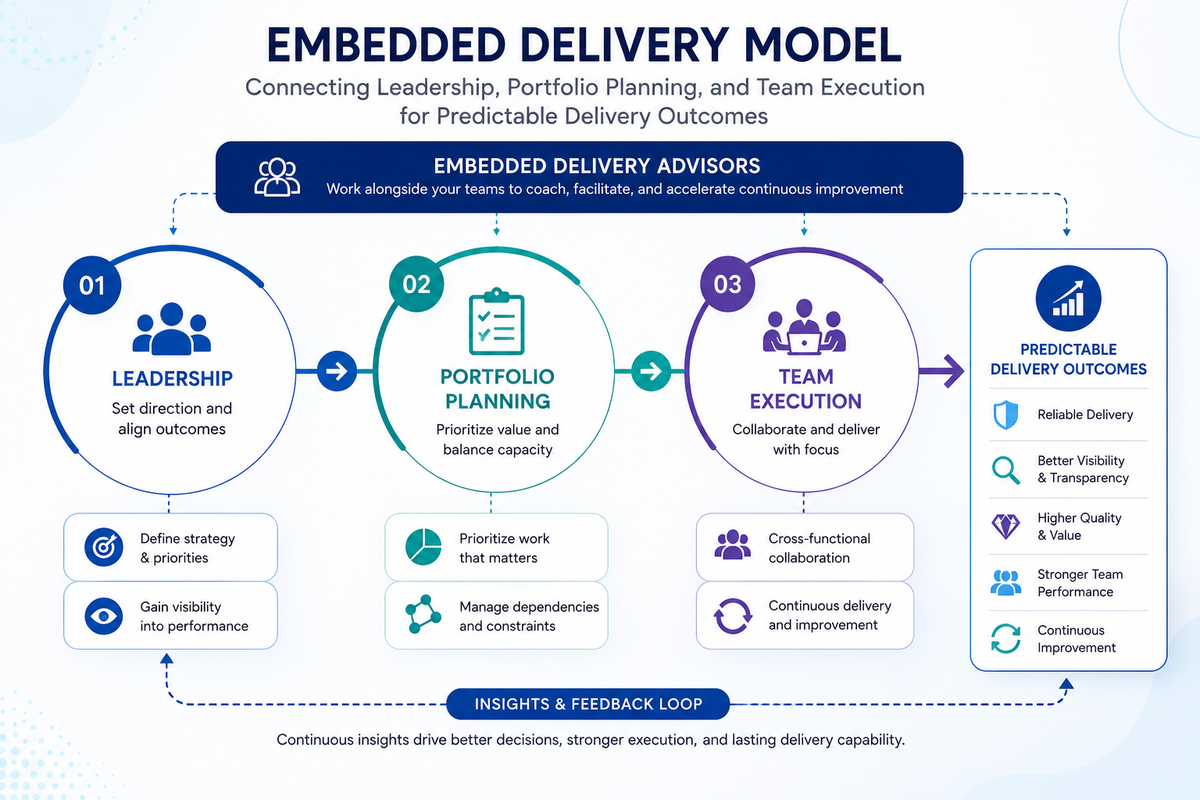
An embedded delivery model places experienced delivery professionals alongside leadership, product, engineering, and operations teams throughout the delivery lifecycle. Rather than acting solely as external consultants, they become collaborative partners who help improve the way work is planned, prioritized, and executed.
Their responsibilities typically include:
- Improving delivery planning
- Strengthening cross-functional collaboration
- Removing execution bottlenecks
- Improving delivery visibility
- Supporting delivery process optimization
- Helping leadership make informed delivery decisions
Unlike traditional consulting, the objective is not simply to recommend improvements but to help organizations successfully implement and sustain them over time.
How Do You Build an Embedded Delivery Model?
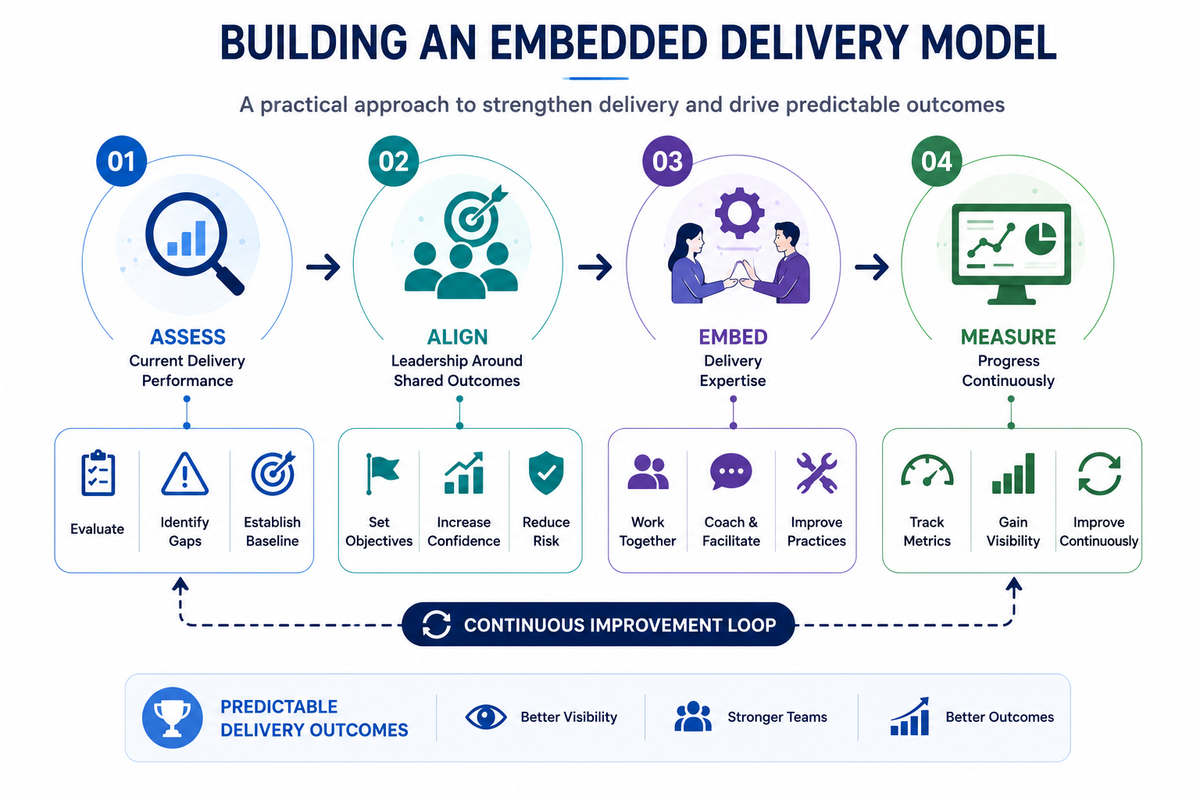
Building an embedded delivery model does not require replacing existing delivery teams. Instead, organizations strengthen their current operating model through continuous improvement.
Assess Current Delivery Performance
Begin by evaluating how delivery currently operates. Review planning effectiveness, decision-making, dependencies, communication, execution visibility, and recurring delivery challenges. A structured assessment creates a baseline for improvement and helps identify the areas with the greatest impact.
Align Leadership Around Shared Outcomes
Successful delivery depends on leadership alignment. Teams should establish measurable objectives such as improving delivery reliability, increasing roadmap confidence, reducing delivery risk, and strengthening collaboration across departments.
Embed Delivery Expertise
Experienced delivery specialists work alongside internal teams during planning, prioritization, and execution. Their role is to coach, facilitate, and support better delivery practices while enabling internal teams to become increasingly self-sufficient.
Measure Progress Continuously
Organizations should monitor indicators that reflect execution quality rather than relying only on project milestones. Metrics such as delivery predictability, commitment reliability, planning accuracy, dependency resolution, and decision turnaround provide better visibility into delivery health and continuous improvement.
Why Does Execution Clarity Matter?
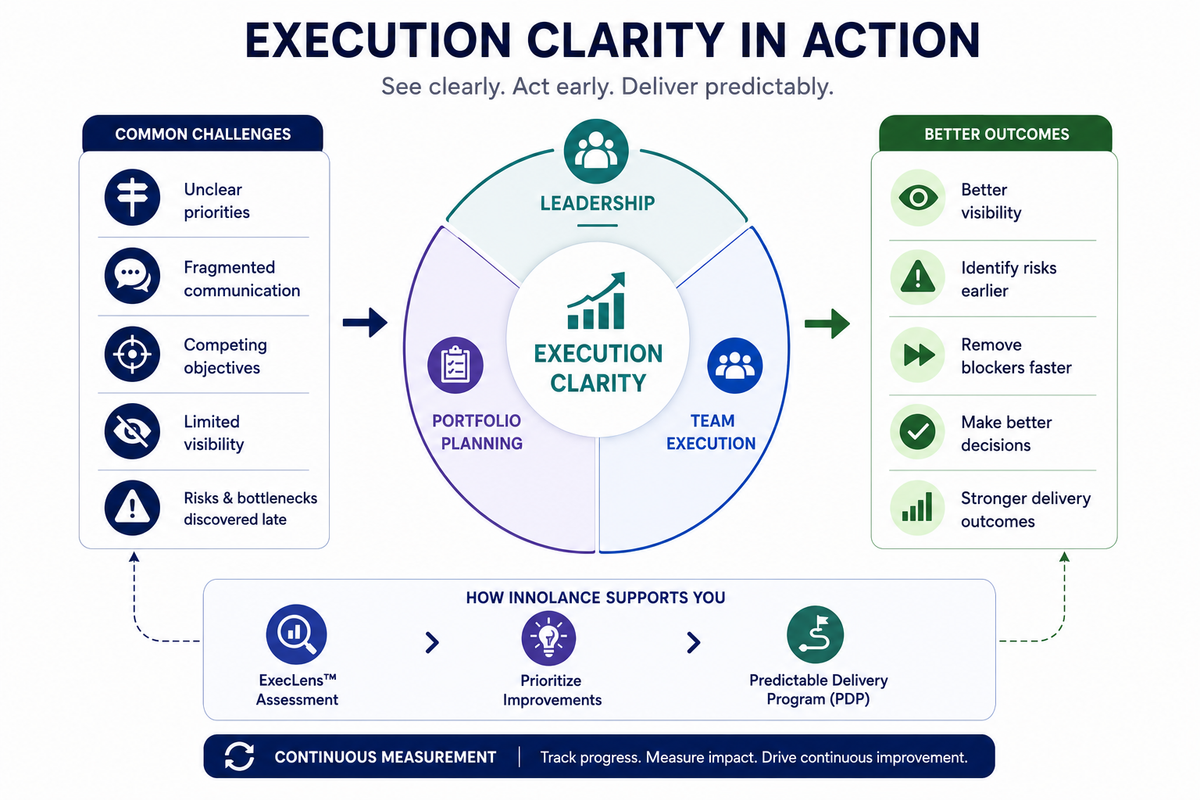
Many delivery challenges are not caused by technology alone. They often result from unclear priorities, fragmented communication, competing objectives, and limited visibility into how work progresses across teams.
This is where Execution Clarity becomes essential.
Execution Clarity helps organizations understand how leadership decisions, portfolio planning, and team execution influence delivery performance. By improving visibility into these areas, leaders can identify risks earlier, resolve bottlenecks more effectively, and make better operational decisions before delivery commitments begin to slip.
At Innolance, organizations use ExecLens™ to assess execution maturity, identify organizational gaps, and uncover opportunities for improvement. Rather than replacing internal expertise, ExecLens™ provides an independent assessment that creates awareness, validates delivery challenges, and helps leaders prioritize meaningful improvements. These insights can then support a structured improvement journey through the Predictable Delivery Program (PDP), enabling organizations to strengthen delivery capability over time.
Practical Tip
If your organization is evaluating delivery improvement alternatives, begin by understanding how work actually flows across leadership, planning, and execution. Identifying communication gaps, dependencies, and decision delays before introducing new processes will produce more sustainable improvements than implementing generic delivery frameworks.
Conclusion
As software delivery grows more complex in 2026, organizations need approaches that extend beyond traditional consulting engagements. Sustainable improvement requires continuous collaboration, measurable progress, and stronger execution practices rather than one-time recommendations.
An embedded delivery model provides a practical alternative by integrating delivery expertise into everyday operations while building internal capability. Combined with Execution Clarity, structured assessments, and continuous measurement, organizations can improve delivery management, support ongoing delivery process optimization, and create predictable delivery outcomes that continue improving long after implementation begins.
By strengthening both execution and organizational capability, SaaS leaders can move beyond temporary improvements and build a delivery model designed for long-term success.