
How to Evaluate Delivery Assessments in 2026
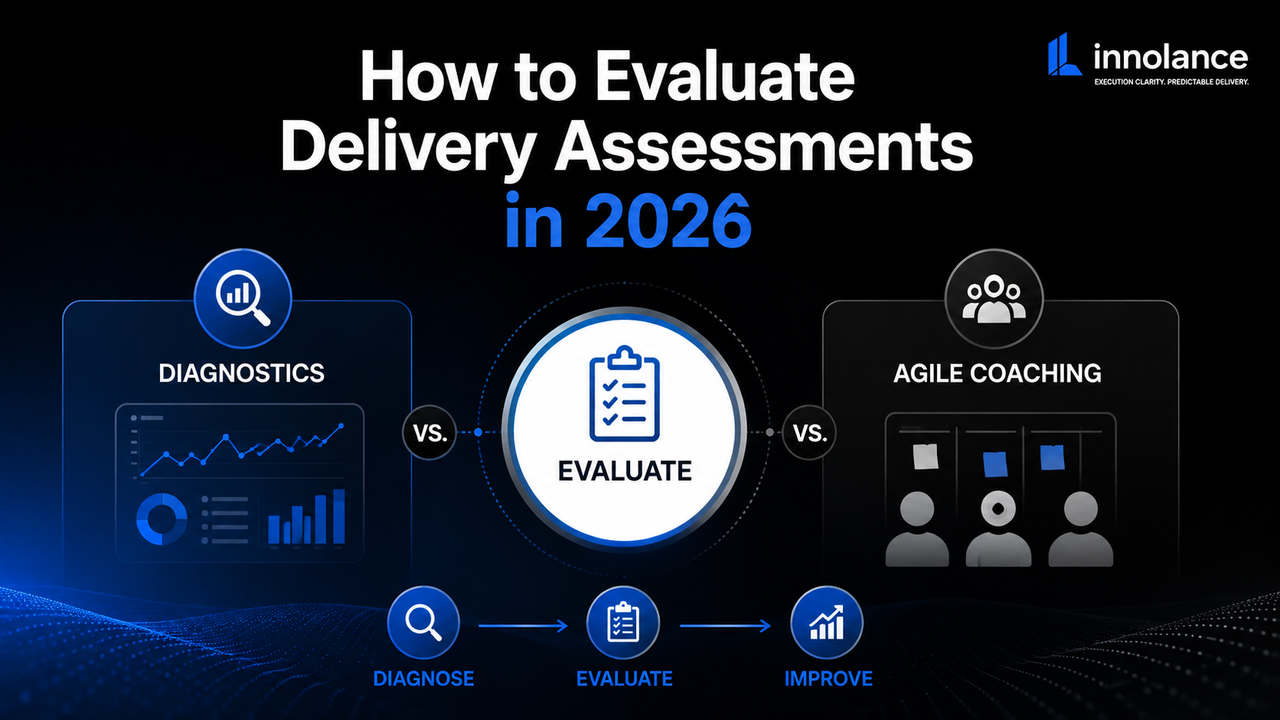
Learn how SaaS leaders can evaluate delivery assessments, compare execution diagnostics with agile coaching, and choose the right approach for improving delivery performance.
How to Evaluate Delivery Assessments in 2026
Executive Summary
SaaS leaders facing unpredictable delivery often encounter two possible approaches: agile coaching and execution diagnostics. Both can improve organizational performance, but they solve different problems.
Agile coaching typically strengthens team practices, collaboration, Agile behaviors, and ways of working. A delivery assessment or execution diagnostic starts earlier by determining where execution is breaking down and identifying the organizational conditions contributing to the problem.
For technology and operations leaders, the key is not choosing one approach over the other. It is determining which approach fits the organization's current need.
Direct Answer: Evaluate delivery assessments by examining their scope, evidence, ability to identify root causes, performance signals, prioritization method, and connection to measurable improvement. Use execution diagnostics when the cause of delivery problems is unclear; use agile coaching when team-level Agile practices are already known to require improvement.
What Is a Delivery Assessment?
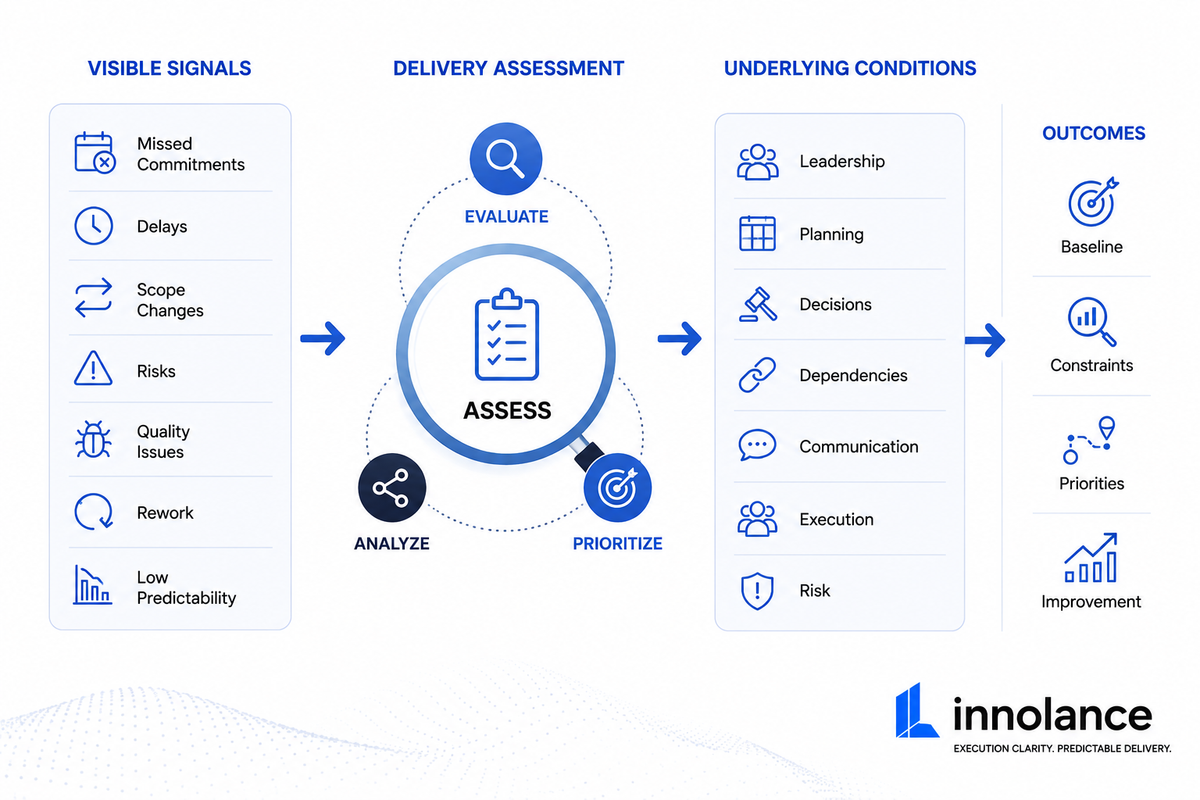
A delivery assessment is a structured evaluation of the conditions influencing an organization's ability to deliver software reliably.
Effective assessments look beyond whether teams completed planned work. They can examine factors such as:
- Leadership alignment
- Portfolio and delivery planning
- Decision-making
- Cross-team dependencies
- Communication
- Team execution
- Delivery risk
The objective is to establish a clearer baseline, identify constraints, and determine where improvement should begin.
This distinction matters because a missed commitment does not automatically indicate poor team performance or ineffective agile methodology. The underlying problem may instead involve changing priorities, delayed leadership decisions, or unresolved dependencies.
How Should Leaders Evaluate Delivery Assessments?
Not every assessment produces actionable insight. Some generate maturity scores without clearly explaining what leaders should do next.
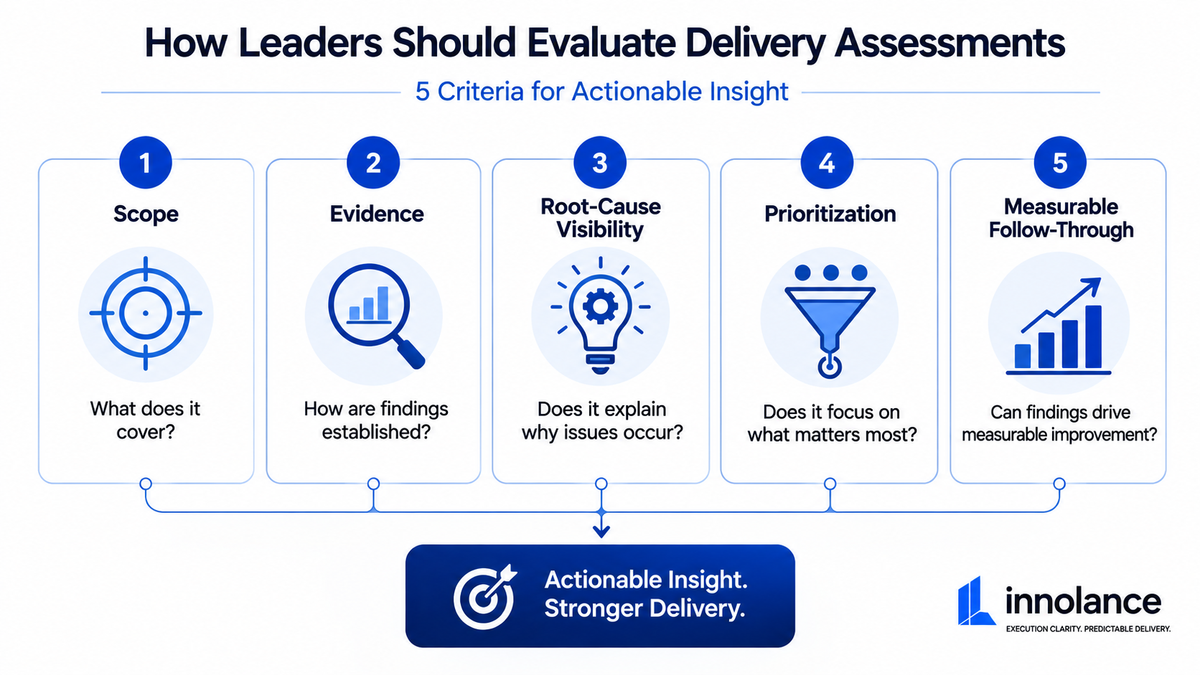
A practical evaluation should consider five criteria.
1. Scope
Determine what the assessment actually examines.
Does it focus only on team practices, or does it evaluate leadership, planning, dependencies, communication, decision-making, and execution?
Broader delivery problems usually require broader organizational visibility.
2. Evidence
Ask how findings are established.
Strong diagnostics should use consistent evidence and clearly defined signals rather than relying entirely on perceptions or isolated observations.
3. Root-Cause Visibility
A useful assessment should help explain why performance problems occur.
For example, declining delivery reliability might result from poor estimation. But it could also reflect priority instability or cross-team dependencies.
The assessment should help leaders distinguish symptoms from underlying constraints.
4. Prioritization
A long list of problems is not enough.
Leaders should expect the assessment to identify which constraints have the greatest impact and where improvement should begin.
5. Measurable Follow-Through
Finally, determine whether findings can be connected to measurable improvement.
The strongest assessments establish a baseline that leaders can revisit to determine whether execution conditions are actually improving.
Which Performance Signals Should Leaders Examine?
Delivery performance cannot be understood through a single metric.
Leaders should examine a combination of signals that reveal both outcomes and execution conditions.
Useful signals may include:
Delivery reliability: Are commitments being met consistently?
Priority stability: How frequently does planned work change?
Dependency health: Are cross-team dependencies identified and resolved early?
Decision speed: Are important decisions arriving before they become blockers?
Execution flow: Where does work repeatedly slow down?
Team effectiveness: Can teams execute effectively within the conditions created by the broader organization?
Together, these signals create a more complete picture of organizational performance than velocity or sprint completion alone.
What Is the Difference Between Agile Coaching and Execution Diagnostics?
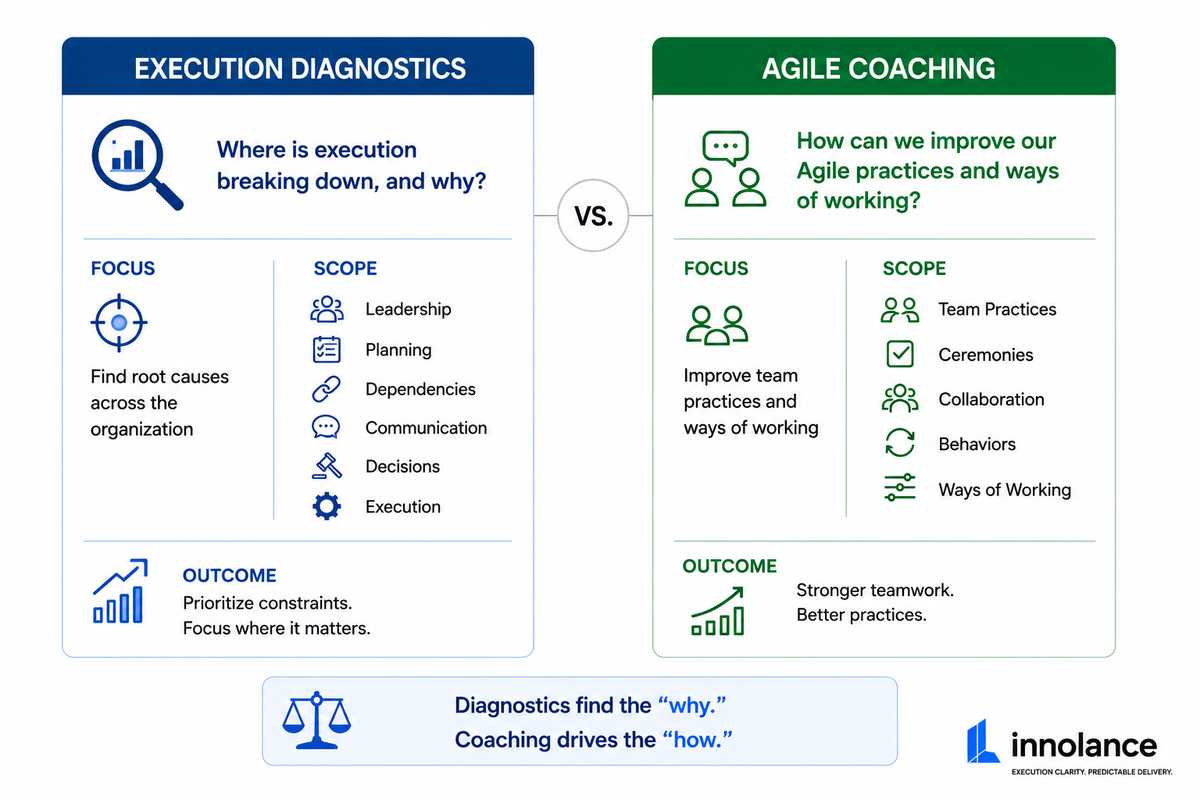
The distinction comes down primarily to diagnosis versus intervention.
Agile coaching generally helps teams improve Agile practices, collaboration, ceremonies, behaviors, and ways of working. It is especially useful when leaders already know that these practices need attention.
An execution diagnostic begins by asking:
Where is execution breaking down, and why?
Its scope can extend beyond individual teams to leadership alignment, planning, dependencies, communication, decision-making, and organizational execution.
When Should Leaders Choose Agile Coaching?
Agile coaching may be a strong fit when teams need help with areas such as:
- Agile practices and ceremonies
- Team collaboration
- Roles and responsibilities
- Continuous improvement
- Agile behaviors
- Adoption during an agile transformation
In these situations, the improvement need is already reasonably clear.
The organization knows what needs attention and requires expertise to strengthen those practices.
When Should Leaders Choose an Execution Diagnostic?
An execution diagnostic is more appropriate when leaders see delivery problems but cannot confidently explain their causes.
Typical indicators include recurring missed commitments, unstable priorities, unresolved dependencies, inconsistent leadership reporting, slow decisions, or performance differences across teams.
In these situations, immediately prescribing agile coaching could address only part of the problem.
The better sequence is:
Assess → Diagnose → Prioritize → Improve → Measure
Diagnosis establishes where intervention is actually needed.
Can Agile Coaching and Execution Diagnostics Work Together?
Yes. They should not necessarily be viewed as competing approaches.
A diagnostic can identify the organizational constraints affecting delivery. If the evidence shows that team practices or Agile behaviors are significant contributors, agile coaching can become a targeted intervention.
Conversely, if the diagnostic reveals that leadership decisions, portfolio instability, or dependencies are the primary constraints, leaders can focus improvement elsewhere.
This creates a more evidence-based path to improving team effectiveness and organizational performance.
How Does Innolance Approach Execution Diagnostics?
Innolance approaches delivery improvement through Execution Clarity understanding the organizational conditions that influence predictable execution.
ExecLens™ helps establish a baseline of execution maturity, validate suspected gaps, uncover hidden constraints, and prioritize areas requiring attention.
The objective is not simply to produce another assessment score. It is to help leaders understand where execution risk exists, why it exists, and what should improve first.
Those insights can then guide targeted improvement through Innolance's Predictable Delivery Program (PDP) and continuous measurement.
What Should Leaders Do Next?
Before selecting a delivery assessment or engaging an Agile coach, technology and operations leaders should ask three questions:
Do we know where our delivery problem originates?
Do we have evidence supporting that conclusion?
Do we know which intervention should come first?
If the answers are unclear, diagnosis should usually precede intervention.
If the organization already has strong evidence that team-level Agile practices are the constraint, coaching may be the appropriate next step.
Key Takeaways
- Agile coaching and execution diagnostics solve different problems.
- Delivery assessments should identify root causes rather than simply produce maturity scores.
- Evaluate diagnostics based on scope, evidence, prioritization, and measurable follow-through.
- Agile coaching is valuable when team-level practices are known to need improvement.
- Execution diagnostics are valuable when leaders know delivery is struggling but do not yet understand why.
Diagnosis can identify whether agile coaching, process improvement, or another intervention is most appropriate.
Conclusion
Choosing between agile coaching and execution diagnostics should begin with the organization's actual need.
When leaders already understand that Agile practices are limiting performance, coaching can provide targeted support. When delivery problems span teams, priorities, dependencies, leadership decisions, and planning or when the root cause remains unclear a structured delivery assessment provides a stronger starting point.
By diagnosing first and selecting interventions based on evidence, SaaS leaders can focus resources on the constraints that matter most and create a stronger foundation for predictable delivery.