
How to Turn Delivery Data Into Bottleneck Fixes
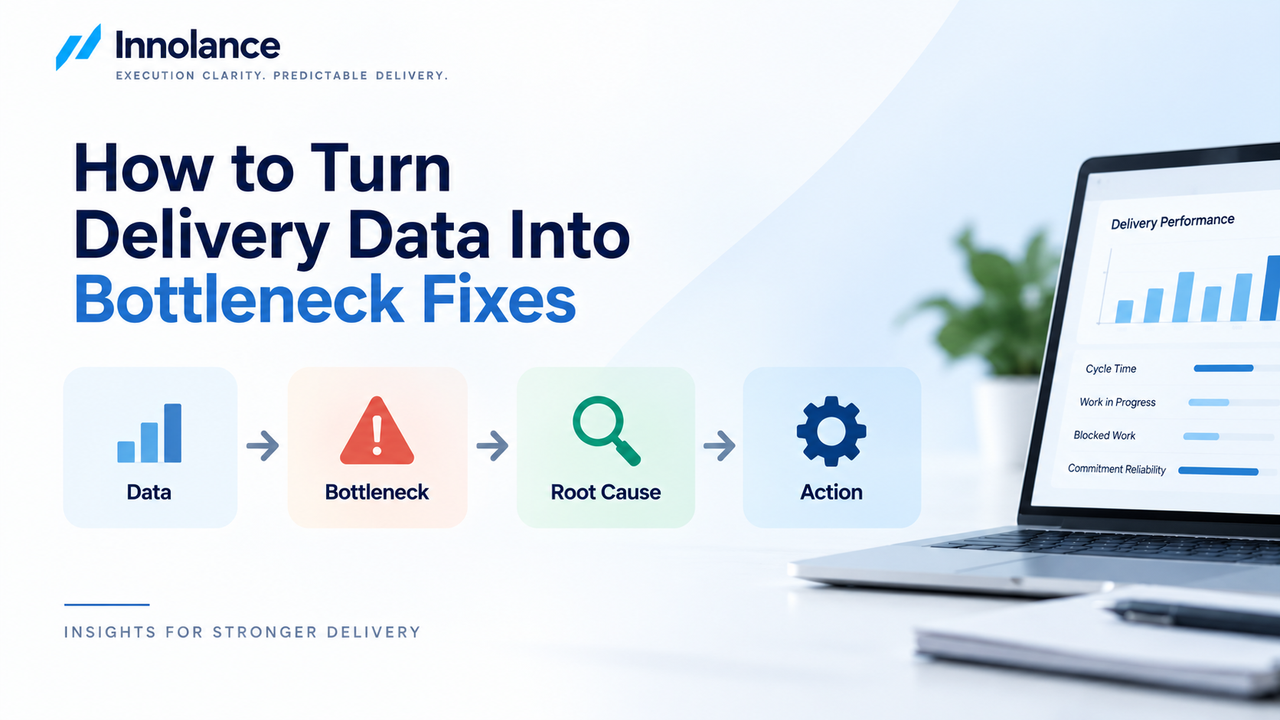
Learn how to turn delivery performance signals into bottleneck analysis, root-cause diagnosis, and targeted actions that improve software delivery.
Executive Summary
Software delivery teams generate large amounts of performance data, but more metrics do not automatically lead to better delivery. Cycle time, work in progress, blocked work, dependencies, and commitment reliability can reveal important problems but only when leaders connect those signals to where work is actually slowing down.
For CTOs, COOs, and VPs of Engineering, effective delivery bottleneck analysis means moving from data to diagnosis and then from diagnosis to corrective action.
Direct Answer: Leaders can identify what is slowing delivery by examining performance signals, locating where work repeatedly waits or accumulates, tracing the underlying constraint, and applying targeted improvements. The goal is not simply to measure delivery performance but to turn those measurements into better execution decisions.
Step 1: Which Delivery Signals Should Leaders Monitor?
Start with a focused set of signals that show how work moves through the delivery system.
Useful indicators include:
- Cycle and lead time
- Work in progress
- Blocked work
- Commitment reliability
- Dependency delays
- Decision wait time
- Rework and quality trends
A single metric rarely identifies the problem. Rising cycle time, for example, becomes more meaningful when it appears alongside increasing work in progress or repeated dependency delays.
Key Takeaway: Use multiple signals together to understand changes in delivery behavior.
Step 2: Where Is Work Actually Slowing Down?
Once a signal changes, identify where work is waiting.
A bottleneck may appear during development, but the underlying constraint could originate in planning, approvals, dependencies, testing, security, or deployment.
Leaders should ask:
- Where does work repeatedly accumulate?
- Which stage has the longest waiting time?
- Where does work frequently return for rework?
- Which dependencies repeatedly block progress?
- Which decisions take too long?
This turns delivery data into practical leadership insights rather than another reporting dashboard.
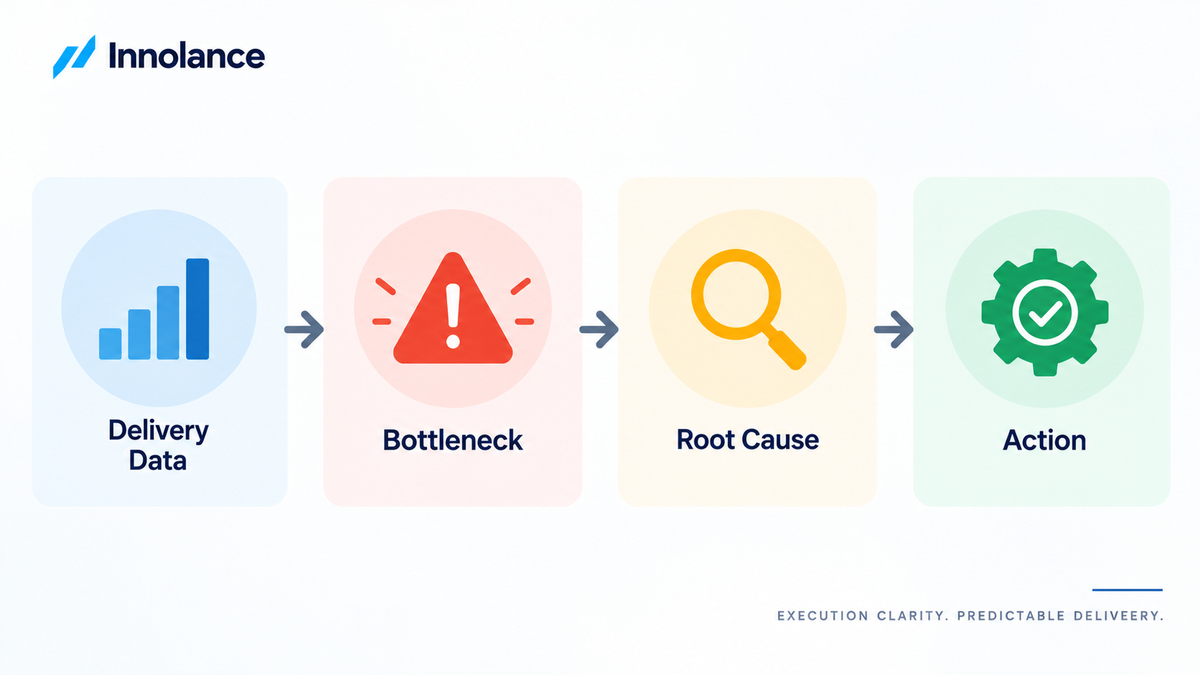
Step 3: How Do You Find the Root Cause of a Bottleneck?
Finding where work slows is only the beginning of delivery bottleneck analysis.
Suppose testing queues are increasing. Adding more testing capacity might appear to be the solution. But deeper analysis may reveal that unclear requirements are causing excessive rework or that too much work is entering testing simultaneously.
Similarly, a dependency delay may originate from unclear ownership rather than insufficient team capacity.
Leaders should distinguish the visible bottleneck from the condition creating it.
Practical Tip: Before adding people or process, determine why work is accumulating.
Step 4: How Should Leaders Prioritize Corrective Actions?
Not every bottleneck has the same impact.
Prioritize constraints based on how strongly they affect delivery flow, commitments, and business outcomes. Corrective actions might include reducing work in progress, clarifying decision ownership, resolving critical dependencies, improving planning discipline, or changing workflow policies.
Effective workflow optimization targets the constraint creating the greatest system-wide impact rather than attempting to improve everything simultaneously.
Step 5: How Do You Know Whether the Fix Worked?
After implementing a corrective action, measure the same signals that revealed the original problem.
If reducing work in progress was intended to improve flow, leaders should look for changes in cycle time, waiting time, and commitment reliability. If dependency management was the focus, blocked work and dependency delays should begin to decline.
This creates a simple improvement cycle:
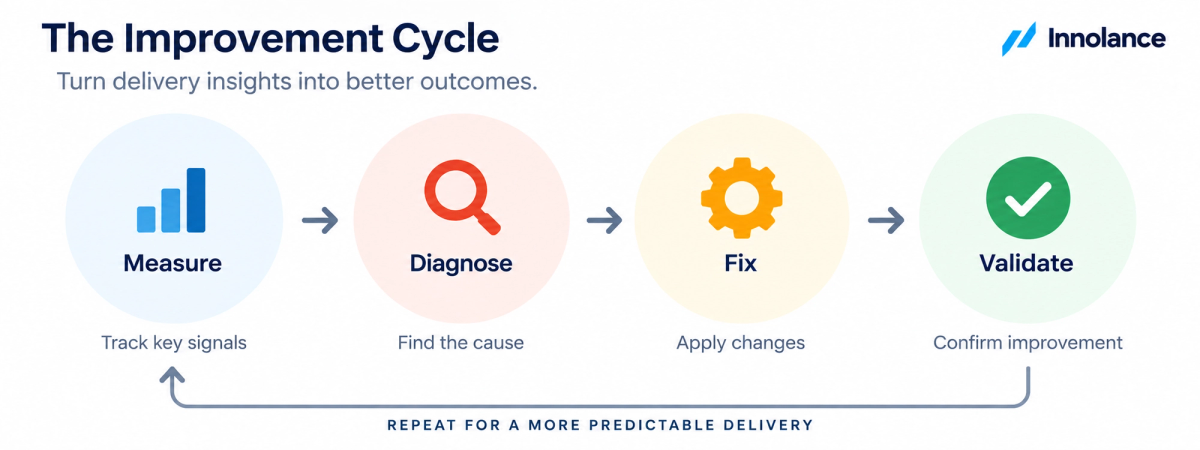
The objective is not short-term team productivity alone. It is creating more reliable flow across the overall delivery system.
How Does Execution Clarity Improve Bottleneck Analysis?
Execution Clarity the ability to understand where execution is breaking down and why helps leaders connect delivery signals to the organizational conditions creating them.
It brings together visibility across leadership priorities, portfolio planning, and team execution, helping leaders determine whether bottlenecks originate in capacity, dependencies, decisions, planning, or workflow execution.
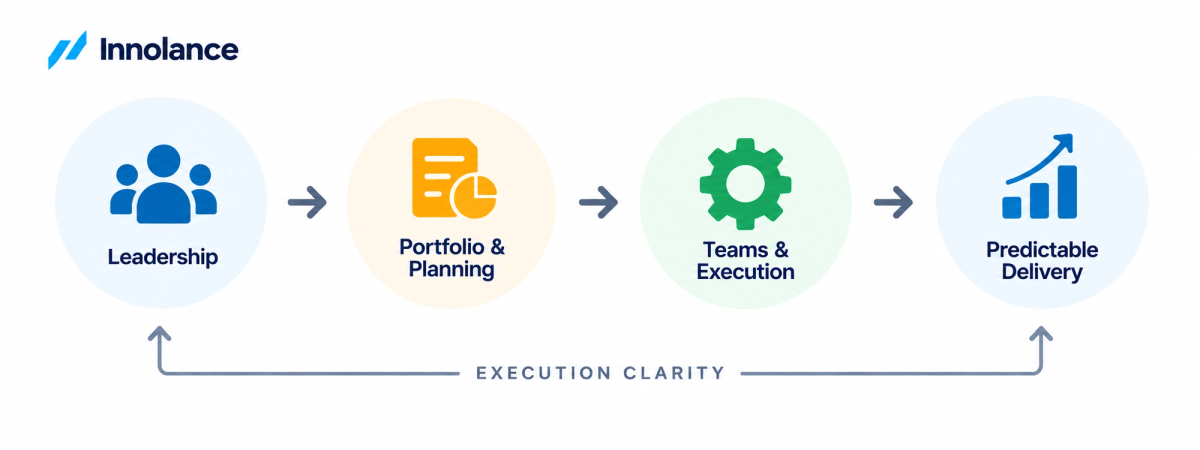
Innolance approaches bottleneck analysis from this organizational perspective, helping leaders move beyond isolated metrics to identify the execution conditions that require corrective action.
What Should Leaders Do Next?
Start with one recurring delivery problem rather than trying to optimize the entire system.
Identify the performance signals associated with it, locate where work is waiting, trace the underlying cause, and implement one targeted corrective action. Then measure whether delivery behavior improves.
This creates a repeatable approach:
Delivery Data → Diagnosis → Corrective Action → Better Delivery
Predictable delivery starts with Execution Clarity.
Conclusion
Delivery data becomes valuable when it changes decisions.
Effective delivery bottleneck analysis connects performance signals with workflow behavior, identifies the root causes of process bottlenecks, and turns findings into targeted corrective actions.
By continuously measuring, diagnosing, improving, and validating delivery conditions, leaders can strengthen delivery performance, improve workflow reliability, and build a more predictable software delivery system.