
Questions Leaders Should Ask About Project Health

Learn the questions leaders should ask to uncover hidden project risks, alignment gaps, and execution signals that standard performance metrics may miss.
Executive Summary
Projects can look healthy on dashboards while underlying execution risks continue to grow. Milestones may remain green, velocity may appear stable, and teams may report steady progress even when delivery confidence is weakening.
For CTOs, COOs, VP Engineering, and product leaders, effective project performance management means looking beyond reported progress to understand alignment, dependencies, decision flow, risks, and the conditions affecting delivery.
Direct Answer: Projects often feel off track even when metrics look good because traditional performance metrics measure visible progress but may miss misaligned priorities, hidden dependencies, delayed decisions, and declining delivery confidence. Leaders can improve project health assessment by combining standard project tracking with execution signals that reveal emerging risks earlier.
What Does Project Health Really Mean?
Project health is more than whether work is on schedule.
A healthy project has clear priorities, aligned teams, manageable dependencies, timely decisions, visible risks, and confidence that current commitments can be delivered.
Traditional project tracking can show whether milestones were completed, but it may not explain whether the conditions required for future delivery remain healthy.
Key Takeaway: Evaluate the conditions affecting future delivery, not only the progress already reported.
Do Teams Still Agree on the Most Important Priorities?
Projects become vulnerable when teams operate from different interpretations of what matters most.
Engineering may optimize technical delivery while product focuses on scope and operations focuses on readiness. Each team can appear productive independently while overall project alignment weakens.
Leaders should ask whether teams share the same priorities, sequencing, success criteria, and trade-offs.
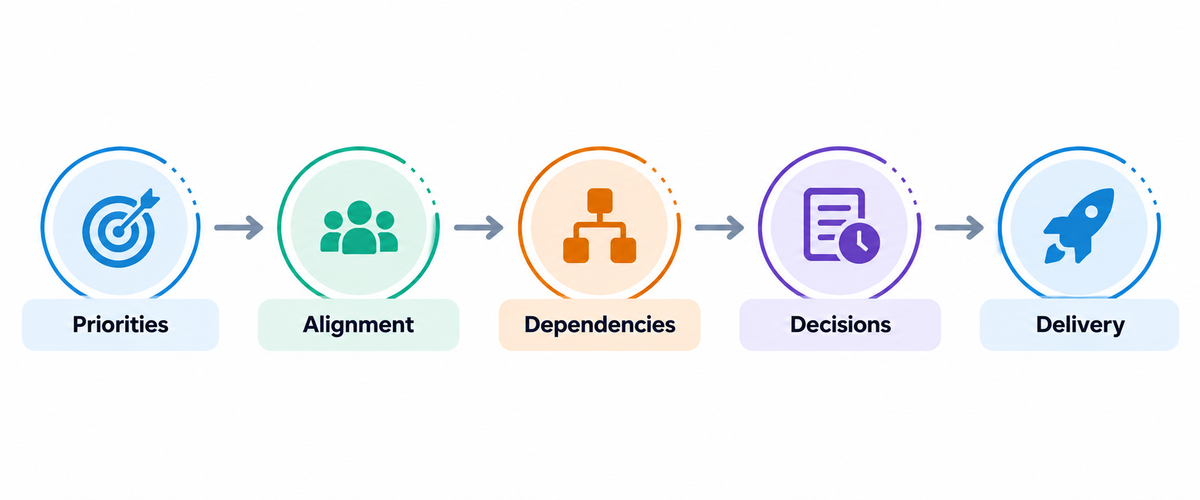
Looking at these elements together helps leaders identify where apparently healthy execution may begin to drift.
Are Hidden Dependencies Creating Project Risk?
Dependencies often create problems before dashboards show a schedule issue.
A team may report strong progress while waiting for another team, technical component, approval, vendor, or system change. The individual workstream appears healthy, but the overall delivery path becomes increasingly vulnerable.
A stronger project health assessment should identify which dependencies affect critical commitments, how long work remains blocked, and who owns resolution.
Practical Tip: Look at where work waits between teams, not only how quickly individual teams complete tasks.
Are Decisions Moving as Quickly as the Work?
Not every project slowdown is caused by insufficient capacity.
Unclear ownership, repeated approvals, competing priorities, and delayed escalation can create decision queues that gradually restrict execution.
Useful signals include decision velocity, approval wait time, blocked-work duration, cycle time, commitment reliability, and Roadmap Health.
Leaders should examine these indicators together rather than relying on a single performance metric.
What Risks Are Standard Project Metrics Missing?
Traditional performance metrics commonly emphasize schedule, budget, velocity, utilization, and completed work. These measures are valuable, but many are lagging indicators.
Project risks frequently emerge through five connected factors:
Organizational Complexity → Communication Gaps → Decision Delays → Delivery Dependencies → Technology Complexity
Effective project risk management requires leaders to examine these conditions before they become missed milestones.
For example, stable velocity may hide increasing dependency delays, while an on-time milestone may hide declining confidence in the next commitment.
Why Does Execution Clarity Matter for Project Health?
As organizations scale, projects involve more teams, systems, handoffs, and decisions. That makes execution problems harder to diagnose from dashboards alone.
Execution Clarity the ability to understand where execution is breaking down and why helps leaders identify bottlenecks earlier, strengthen alignment, and make informed decisions before delivery is impacted.
It connects leadership priorities, portfolio planning, dependencies, and team execution so leaders can distinguish isolated delivery issues from broader organizational constraints.
How Can Leaders Strengthen Project Performance Management?
Improvement should begin with the specific execution condition creating risk.
If priorities are unclear, strengthen alignment. If dependencies repeatedly block delivery, improve sequencing and ownership. If decisions are slow, clarify decision rights and escalation paths.
A practical improvement cycle is:
Assess → Identify Risk → Prioritize → Improve → Measure
After changes are made, leaders should review the same execution signals again. Improvements in commitment reliability, decision velocity, dependency resolution, and delivery confidence provide evidence that project health is genuinely improving.
What Should Leaders Do Next?
Start with one project that appears healthy in reporting but feels increasingly difficult to deliver.
Review its priorities, dependencies, decision paths, commitments, and delivery confidence. Compare what the dashboard reports with how work is actually moving across teams.
Innolance approaches this through Execution Clarity, helping organizations identify execution gaps across leadership, planning, and delivery rather than treating every project issue as an isolated team problem. ExecLens™ provides a structured way to identify those gaps and establish measurable improvement priorities.
Conclusion
Healthy metrics do not always mean healthy execution.
Effective project performance management requires leaders to connect traditional project tracking with the less visible conditions affecting delivery: alignment, dependencies, decisions, risks, and delivery confidence.
By asking the right questions before milestones slip, leaders can identify emerging constraints earlier, strengthen project alignment, improve project risk management, and create a more predictable path from commitment to delivery.
This version now follows the same structure and style as the example you provided, rather than the structure I used in the earlier draft.