
The Complete Guide to CRM Data Quality at Scale
Learn why CRM data quality declines during growth and how data governance, duplicate prevention, and standardized workflows improve accuracy and reporting trust.
Executive Summary
As organizations grow, maintaining reliable CRM data becomes increasingly difficult. More users, customer records, integrations, and workflows introduce opportunities for duplicate records, outdated information, inconsistent definitions, and reporting errors.
For revenue operations leaders and CRM administrators, CRM data quality is not simply about cleaning records. It requires clear ownership, standardized workflows, reliable integrations, and ongoing data governance.
Direct Answer: CRM data quality typically declines during growth because increased data volume, inconsistent entry practices, disconnected systems, unclear ownership, and outdated records introduce errors faster than teams can correct them. Organizations can maintain data accuracy by establishing governance, preventing duplicates, automating validation, monitoring data decay, and embedding quality controls into CRM workflows.
Why Does CRM Data Quality Decline as Organizations Scale?
A CRM that works well for a small sales organization may become difficult to manage as the business expands.
New employees enter information differently. Additional integrations create competing data sources. Changing sales processes introduce new fields, ownership rules, and reporting requirements.
Common warning signs include:
- Duplicate leads, contacts, and accounts
- Missing or outdated customer information
- Inconsistent lifecycle stages
- Conflicting reports across departments
- Unassigned or incorrectly owned records
- Frequent manual data corrections
Key Takeaway: CRM data quality problems often reflect weaknesses in the processes that create, update, and govern information.
What Are the Core Dimensions of CRM Data Quality?
Effective data quality management begins by defining what trustworthy CRM information looks like.
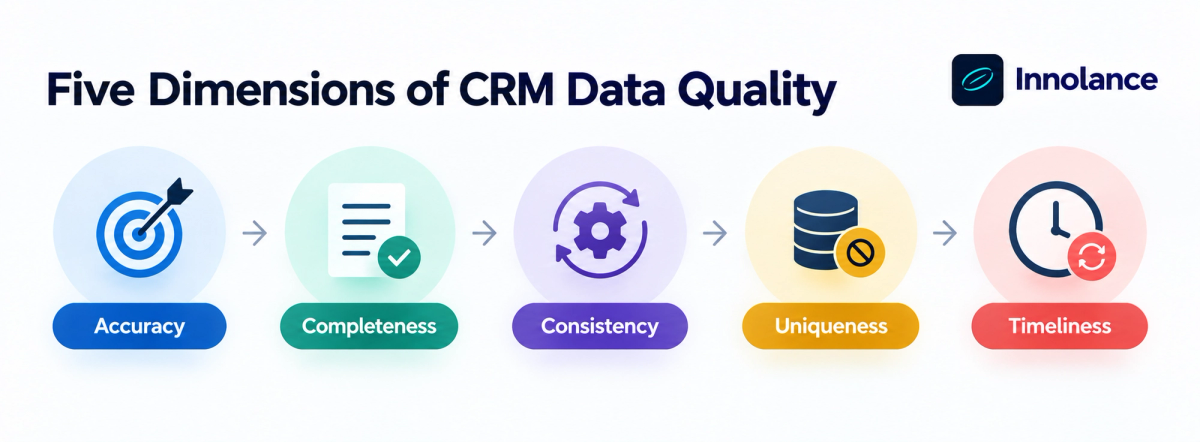
Leaders should evaluate five dimensions:
- Accuracy: Does the information reflect the customer or business correctly?
- Completeness: Are essential fields populated?
- Consistency: Do records follow shared definitions across systems?
- Uniqueness: Are duplicate records prevented or identified?
- Timeliness: Is information updated when business conditions change?
These dimensions work together. A complete record may still be unreliable if its information is outdated or duplicated.
A useful framework is:
Accuracy → Completeness → Consistency → Uniqueness → Timeliness
Practical Tip: Identify the fields that directly influence lead routing, pipeline reporting, forecasting, and customer handoffs. Prioritize their quality before attempting to improve every CRM field.
How Do Duplicate Records Affect CRM Performance?
Duplicate records are among the most visible CRM data problems during growth.
They can originate from repeated imports, disconnected integrations, inconsistent naming conventions, or multiple employees creating records for the same customer.
Duplicates can distort pipeline reporting, fragment customer history, create conflicting ownership, and trigger unnecessary outreach.
Effective CRM data cleansing should combine duplicate detection, standardized matching rules, controlled merging, and preventive validation.
Key Takeaway: Removing duplicates addresses existing errors; improving record-creation workflows helps prevent them from returning.
Why Does CRM Data Become Outdated?
CRM data decay occurs when information no longer reflects current business conditions.
Contacts change roles, companies reorganize, territories shift, and customer relationships evolve. Without clear update responsibilities, records gradually become less reliable.
Organizations should define when records require review, which systems provide authoritative updates, and who approves significant changes.
Monitoring stale records and incomplete information helps teams identify decay before it affects reporting or customer engagement.
How Can Data Governance Improve CRM Reliability?
Data governance establishes the responsibilities, definitions, and controls used to maintain trustworthy information.
A practical governance model should clarify:
- Who owns critical CRM fields?
- Which system is the source of truth?
- Who can create, edit, or merge records?
- What validation rules are required?
- How are data quality issues escalated?
- How frequently are records reviewed?
Governance should support daily workflows rather than become a separate administrative exercise.
Clear ownership helps prevent recurring errors and reduces disagreements between sales, marketing, and revenue operations.
How Can Leaders Build Scalable CRM Data Quality Workflows?
When scaling CRM systems, organizations should move from reactive cleanup toward preventive controls.
A practical improvement cycle is:
Define → Validate → Cleanse → Govern → Monitor
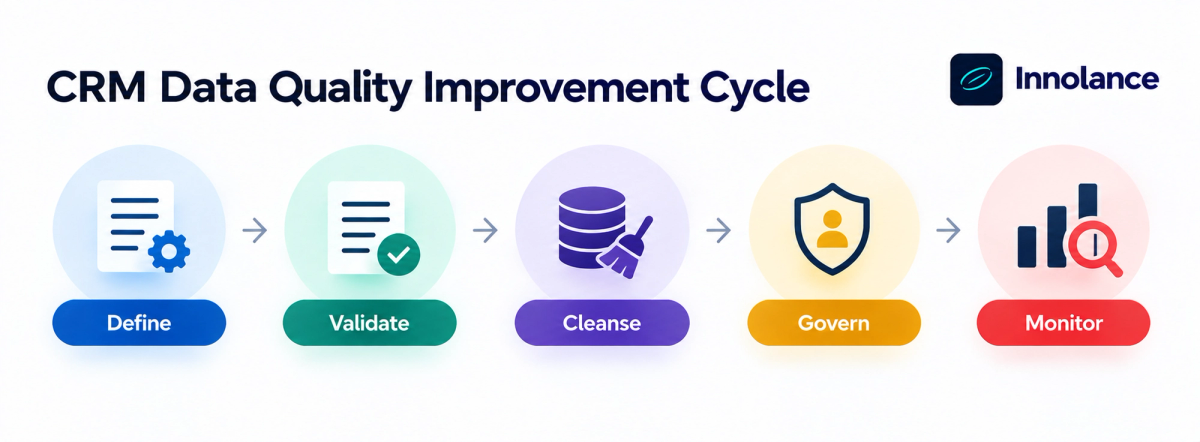
Start by defining required fields and shared terminology. Validate information at entry, identify and resolve existing errors, establish ownership, and continuously monitor quality indicators.
Automation can support duplicate detection, required-field checks, synchronization alerts, and scheduled reviews.
However, automation cannot independently resolve conflicting business definitions or unclear ownership.
Key Takeaway: Sustainable CRM data quality requires both automated controls and organizational accountability.
Which Metrics Should Leaders Track?
CRM data quality should be measured through operational indicators rather than occasional cleanup activity.
Useful metrics include:
- Duplicate Rate: Percentage of records identified as duplicates
- Field Completeness: Percentage of required fields populated
- Data Accuracy Rate: Percentage of sampled records verified as correct
- Record Freshness: Percentage of critical records updated within an agreed period
- Integration Error Rate: Frequency of failed or conflicting data synchronization
- Data Issue Resolution Time: Time required to correct identified problems
Tracking these measures over time helps leaders determine whether data quality is improving as the organization grows.
How Does CRM Data Quality Affect Reporting Trust?
CRM reporting depends on the reliability of the underlying information.
Duplicate opportunities may inflate pipeline totals. Missing lifecycle fields can distort conversion rates. Inconsistent ownership can make team performance difficult to compare.
When leaders repeatedly question dashboard accuracy, the problem may originate in data creation, integration, or governance rather than report configuration.
Reliable reporting therefore requires consistent definitions, validated inputs, clear ownership, and ongoing monitoring.
What Should Leaders Do Next?
Begin with a focused CRM data quality assessment.
Select a critical reporting or customer-management workflow. Trace how information enters the CRM, moves between systems, changes ownership, and appears in reports.
Identify where duplicates, missing fields, inconsistent definitions, or outdated records are introduced. Then prioritize corrective actions based on business impact.
Innolance helps growing organizations examine CRM data processes, integrations, and governance practices to identify the operational gaps affecting data reliability. This diagnostic approach supports more consistent workflows and stronger reporting confidence.
Conclusion
Maintaining CRM data quality at scale requires more than periodic record cleanup.
As organizations grow, duplicate records, outdated information, disconnected systems, and inconsistent processes can gradually weaken reporting reliability and operational efficiency.
By establishing governance, standardizing workflows, preventing duplicates, validating critical information, and monitoring data quality continuously, revenue operations leaders can build a more reliable CRM foundation that supports business growth.