The Complete Guide to CRM Reporting Reliability
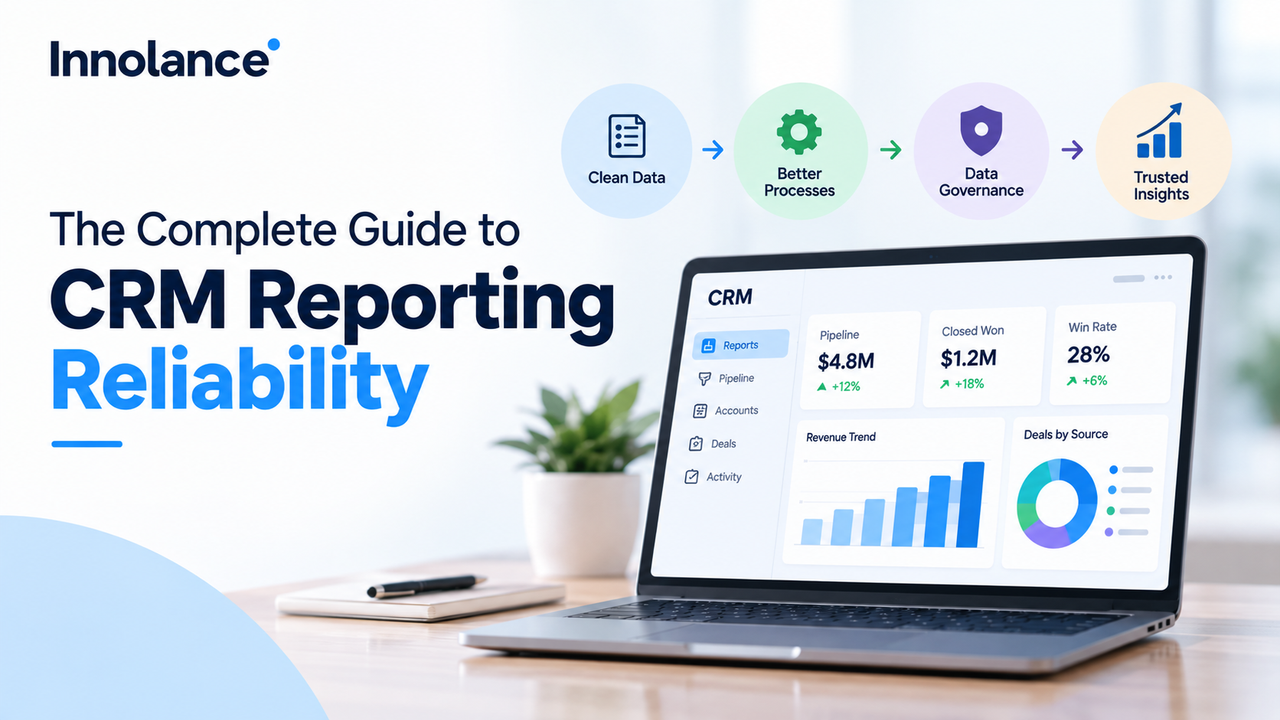
Learn why CRM reporting becomes unreliable as sales teams grow and how better data accuracy, workflows, and governance can restore trusted insights.
Executive Summary
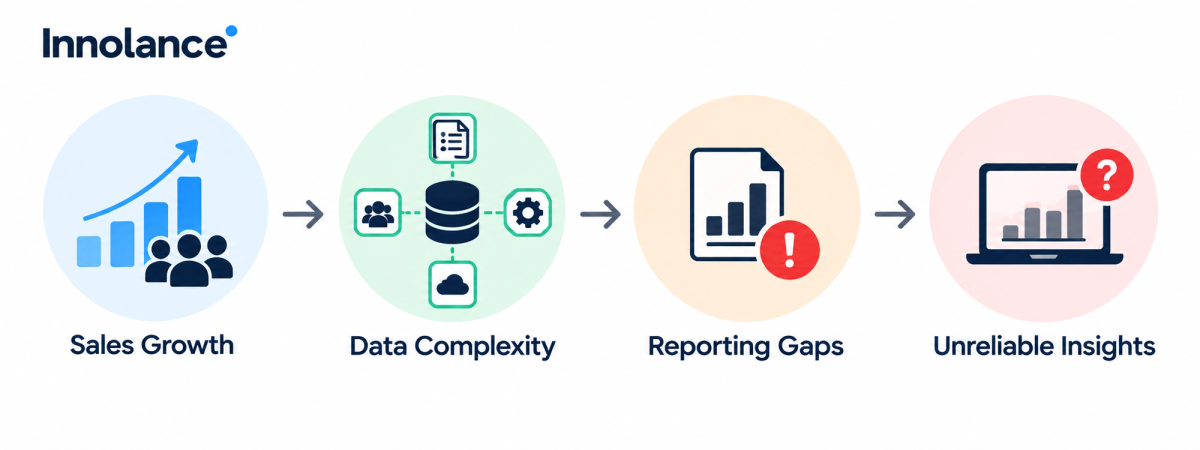
CRM reporting becomes harder to trust as sales organizations grow. More users, records, workflows, integrations, and reporting requirements introduce opportunities for inconsistent data, incomplete fields, duplicate records, and conflicting definitions.
For revenue operations leaders, reliable CRM reporting requires more than building better dashboards. The data, workflows, ownership rules, and reporting definitions behind those dashboards must remain consistent as the organization scales.
Direct Answer: CRM reporting often becomes unreliable for growing sales teams because inconsistent data entry, unclear field definitions, duplicate records, disconnected systems, and changing workflows weaken the data behind reports. Revenue operations leaders can improve reporting reliability by standardizing CRM data, automating validation, establishing governance, and continuously monitoring data quality.
Why Does CRM Reporting Become Unreliable as Sales Teams Grow?
A CRM that supports a small sales organization may become significantly more complex during growth.
New representatives enter data differently. Territories and ownership rules change. Additional tools integrate with the CRM. Sales processes evolve, and leadership asks for increasingly detailed performance insights.
Without consistent standards, these changes create gaps between what actually happens in the sales process and what appears in CRM reports.
The dashboard may look precise while the underlying information is incomplete or inconsistent.
Key Takeaway: Reliable reporting starts with reliable CRM processes—not the dashboard itself.
What Causes CRM Reporting Problems?
Several issues commonly reduce reporting reliability as sales teams scale:
- Inconsistent data entry
- Missing required fields
- Duplicate contacts or companies
- Outdated opportunity information
- Inconsistent deal-stage definitions
- Unclear record ownership
- Manual spreadsheet updates
- Integration and synchronization errors
- Different teams interpreting metrics differently
These problems can distort pipeline reporting, conversion rates, forecasting, activity analysis, and other leadership metrics.
How Does CRM Data Accuracy Affect Sales Reporting?
Every CRM report depends on the quality of its underlying records.
If opportunity amounts are outdated, forecasts become less dependable. If lifecycle stages are inconsistent, conversion reporting becomes misleading. If records are duplicated, activity and account-level reporting can become distorted.
Strong CRM data accuracy therefore requires clear definitions for important properties, required fields where appropriate, and workflows that reduce unnecessary manual entry.
Instead of repeatedly correcting reports, revenue operations teams should address the processes producing inaccurate information.
How Do Workflow Gaps Create Reporting Problems?
Reporting problems often originate earlier in the sales workflow.
For example, a dashboard may show opportunities remaining in one stage for unusually long periods. The reporting system may be working correctly the actual problem could be that sales representatives are not consistently updating deal stages.
Similarly, missing lead-source information may originate from an integration or form configuration rather than the reporting layer.
Effective sales team reporting therefore requires leaders to trace unreliable metrics back to the workflow that creates the data.
Why Do Integrations Make CRM Reporting More Complex?
Growth-stage B2B organizations commonly connect their CRM with marketing automation, sales engagement, enrichment, customer success, billing, and analytics platforms.
Each integration can introduce conflicting values or synchronization problems.
Revenue operations leaders should define which system owns important information, when data should be updated, and what happens when two systems contain different values.
Without these rules, sales analytics can combine information that appears consistent but was created using different definitions or update cycles.
What Should Revenue Operations Leaders Monitor?
Reporting reliability should be measured continuously rather than checked only when a dashboard appears incorrect.
Useful indicators include Required Field Completion, Duplicate Rate, Data Freshness, Record Ownership Coverage, Integration Errors, Stage Accuracy, and Reporting Exceptions.
Leaders should monitor trends across these signals. A sudden increase in missing fields after hiring new representatives, for example, may indicate a training or workflow problem rather than a technical reporting issue.
How Can Revenue Operations Improve CRM Reporting Reliability?
A scalable approach connects data standards, workflows, automation, and governance.
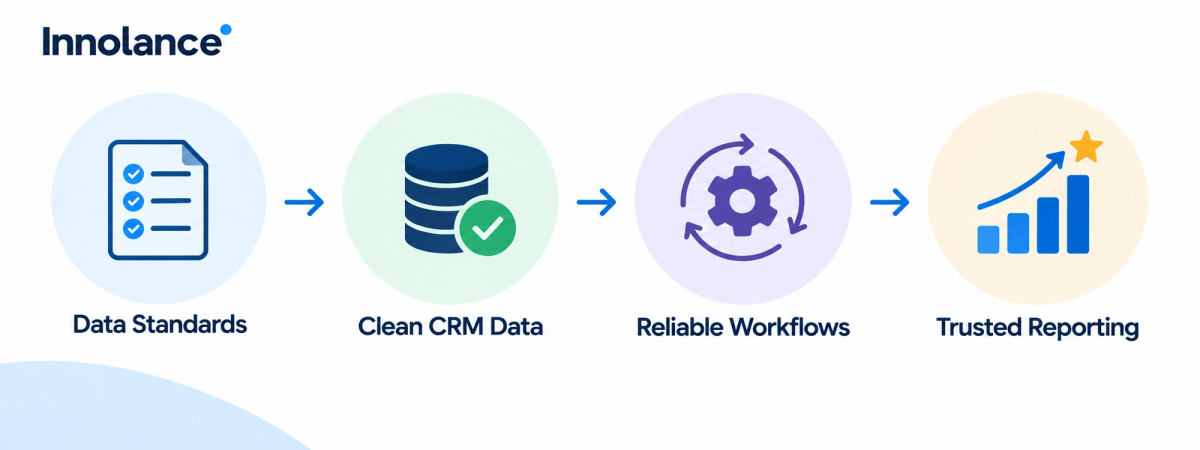
Data standards establish consistent definitions. CRM workflows reinforce how information should be captured and updated. Automation can validate, enrich, and route records. Governance establishes ownership for maintaining data and reporting rules.
Together, these practices create a stronger foundation for CRM reporting as the organization grows.
Innolance approaches CRM optimization from this operational perspective connecting CRM configuration, workflow design, automation, and data visibility so revenue leaders can make decisions using more dependable information.
What Should Revenue Leaders Do Next?
Start with one report that leadership regularly uses but does not fully trust.
Identify the metrics behind it and trace each metric back to its CRM fields and workflows. Determine where information becomes incomplete, inconsistent, duplicated, or outdated.
A simple improvement cycle is:
Trace → Standardize → Automate → Validate
Fixing the source of unreliable information creates more sustainable improvement than repeatedly adjusting dashboards.
Conclusion
CRM reporting reliability depends on much more than reporting technology.
As growing sales teams introduce more users, data, workflows, and systems, revenue operations leaders need stronger standards for how CRM information is created and maintained.
By improving CRM data accuracy, strengthening workflows, managing integrations, and establishing governance, organizations can build more reliable sales analytics and give leaders greater confidence in the information guiding revenue decisions.