
The Complete Guide to Delivery Performance Signals
Learn how delivery performance analysis helps leaders identify bottlenecks, track flow and decision signals, and improve software delivery predictability.
Executive Summary
Software delivery can appear healthy on dashboards while hidden bottlenecks slow execution. Teams may complete tasks, meet sprint goals, and report progress, yet important commitments still slip because of dependencies, decision delays, and workflow constraints.
For CTOs, CIOs, COOs, and engineering leaders, effective delivery performance analysis requires understanding how work moves across teams, where it slows, and which decisions affect delivery outcomes.
Direct Answer: Leaders can understand what is slowing software delivery by analyzing three categories of performance signals: flow signals, bottleneck signals, and decision signals. Together, these reveal where work accumulates, why delays occur, and which leadership actions can improve delivery predictability.
What Are Delivery Performance Signals?
Delivery performance signals are measurable indicators that reveal how effectively work moves through an organization's delivery system.
Unlike traditional status reports, which primarily summarize completed activities, performance signals help leaders understand emerging risks and operational constraints.
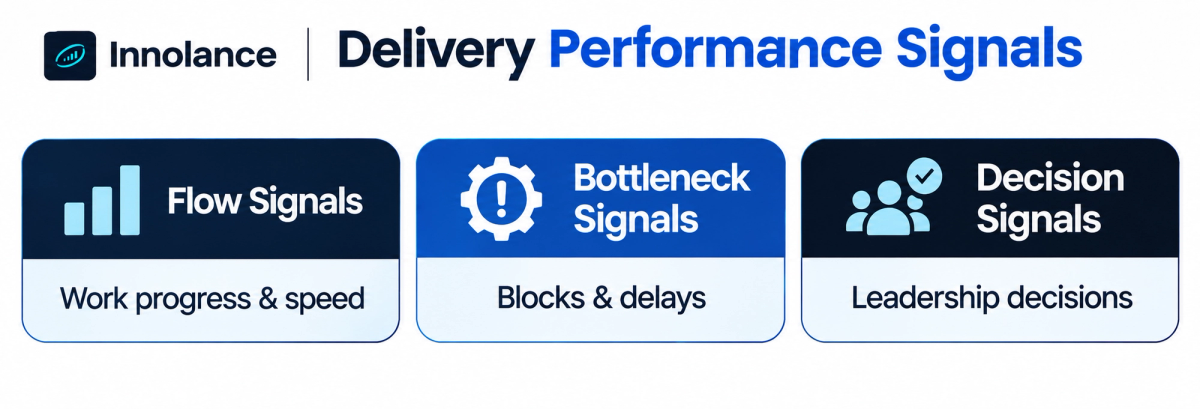
Three categories provide a practical foundation for delivery performance analysis:
- Flow Signals: Reveal how quickly and consistently work progresses.
- Bottleneck Signals: Identify where work becomes blocked or delayed.
- Decision Signals: Show how leadership decisions influence execution.
Together, these signals support stronger leadership insights and more informed delivery decisions.
Which Flow Signals Reveal Delivery Performance?
Flow signals help leaders evaluate the speed, consistency, and efficiency of software delivery.
Important indicators include:
- Cycle Time: Measures how long work takes from active development to completion.
- Lead Time: Measures the elapsed time between a defined request and its delivery.
- Work in Progress (WIP): Tracks the number of active tasks competing for team capacity.
- Throughput: Measures how many work items are completed within a period.
- Flow Efficiency: Compares active working time with total elapsed delivery time.
For example, increasing cycle time alongside growing WIP may indicate that teams are handling more work than they can complete efficiently.
Monitoring these signals helps leaders identify opportunities for workflow optimization before delivery commitments become unreliable.
How Do Bottleneck Signals Explain Delivery Delays?
Delivery bottlenecks occur when constraints prevent work from progressing at the expected pace.
Common bottleneck signals include aging blocked tasks, recurring handoff delays, overloaded review stages, and unresolved cross-team dependencies.
Leaders should examine four areas:
- Capacity Constraints: Teams or specialists cannot process incoming work quickly enough.
- Dependency Delays: Work waits for another team, system, or approval.
- Process Constraints: Unnecessary handoffs or inconsistent workflows slow progress.
- Technology Constraints: Technical debt, integration issues, or unreliable systems interrupt execution.
A project may appear on schedule until a critical dependency prevents release.
Identifying these patterns early allows leaders to prioritize targeted process improvement rather than applying broad changes without understanding the underlying constraint.
Why Are Decision Signals Important for Delivery Performance?
Not every delivery delay originates within an engineering team.
Some delays occur because teams are waiting for priorities, approvals, resource allocation, or leadership decisions.
Decision signals help reveal these constraints.
Useful indicators include:
- Decision Velocity: Time required to reach and communicate a decision.
- Escalation Age: How long unresolved issues remain escalated.
- Ownership Clarity: Whether decision responsibilities are clearly assigned.
- Priority Stability: How frequently priorities change during execution.
When decisions move slowly, otherwise capable teams may remain blocked.
Analyzing decision signals helps leaders distinguish execution problems from governance and coordination challenges.
How Can Leaders Analyze Delivery Performance Effectively?
An effective delivery performance analysis connects measurements with the causes of execution delays.
A practical five-step framework is:
Observe → Measure → Diagnose → Act → Monitor
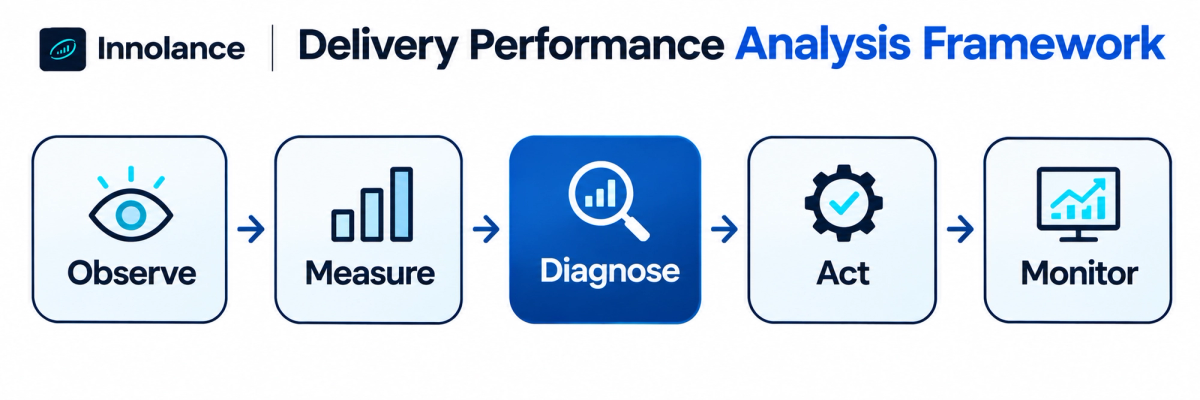
First, observe how work moves across teams and delivery stages.
Next, measure relevant flow, bottleneck, and decision signals.
Diagnose the constraints affecting delivery commitments, then implement targeted improvements.
Finally, monitor performance to determine whether the changes improve delivery reliability.
This approach shifts leadership conversations from reporting project status to understanding execution performance.
Which Delivery Metrics Should Leaders Prioritize?
Rather than tracking every available metric, leaders should focus on indicators that reveal meaningful delivery risks.
Five useful delivery metrics include:
- Commitment Reliability: Percentage of delivery commitments completed as agreed.
- Cycle Time: Time required to complete work after it begins.
- Blocked Work Age: Duration that work remains unable to progress.
- Work in Progress: Number of active work items.
- Decision Velocity: Time required to resolve execution-related decisions.
These metrics provide complementary perspectives on delivery speed, constraints, and predictability.
What Should Leaders Do Next?
Start by reviewing one initiative that experienced unexpected delays.
Examine how work progressed, where dependencies accumulated, and which decisions slowed execution.
Execution Clarity understanding where execution is breaking down and why helps leaders connect delivery signals with underlying organizational constraints.
Innolance helps organizations strengthen Execution Clarity through diagnostic approaches that examine delivery performance, operational dependencies, and leadership visibility.
Through ExecLens, leaders can gain a more structured understanding of execution challenges and identify priorities for improving delivery predictability.
Frequently Asked Questions
How can leaders understand what is slowing down delivery?
Leaders can analyze flow metrics, blocked work, cross-team dependencies, and decision delays to identify constraints affecting software delivery.
What are the most important delivery performance signals?
Cycle time, throughput, work in progress, blocked work age, commitment reliability, and decision velocity provide useful indicators of delivery performance.
How does delivery performance analysis improve predictability?
It helps leaders identify recurring constraints, address delays earlier, and evaluate whether operational improvements produce more reliable delivery outcomes.
Key Takeaways
- Delivery performance requires more than traditional project status reporting.
- Flow signals reveal speed and consistency.
- Bottleneck signals identify operational constraints.
- Decision signals expose leadership and coordination delays.
- Combining these indicators supports better execution decisions and delivery predictability.
Conclusion
Understanding what slows software delivery requires visibility into how work moves, where it becomes constrained, and which decisions affect progress.
By combining flow, bottleneck, and decision signals, leaders can strengthen delivery performance analysis, prioritize operational improvements, and create more predictable software delivery outcomes.