
The Complete Guide to Planning Accuracy in Software Delivery

Learn how better risk visibility, dependency diagnosis, and delivery forecasting improve planning accuracy and make software delivery more predictable.
Executive Summary
Software delivery can appear healthy until a milestone suddenly slips. Roadmaps remain green, sprint progress looks stable, and teams stay busy, yet unresolved dependencies, changing priorities, delayed decisions, and hidden risks may already be weakening the plan.
For CTOs, VPs of Engineering, and product leaders, improving software delivery predictability requires more than tracking whether work is currently on schedule. Leaders need visibility into the conditions that determine whether today’s commitments are still realistic.
Direct Answer: Unpredictable delivery often occurs when planning assumptions no longer match execution reality. Leaders can improve project planning accuracy by monitoring commitment changes, dependencies, capacity, workflow conditions, decision delays, and emerging risks before they affect milestones.
Why Can Delivery Look Green Before It Slips?
Traditional delivery reporting often emphasizes milestones completed, sprint progress, and roadmap status. These indicators describe visible progress but may not reveal whether future commitments are becoming unstable.
A project can remain green while a critical dependency is unresolved. Teams can complete planned work while priorities continuously change. A release can appear healthy even as testing or review queues grow.
By the time the dashboard turns red, the underlying problem may have existed for weeks.
Key Takeaway: Green status indicates current progress—not necessarily future delivery confidence.
What Causes Planning Accuracy to Deteriorate?
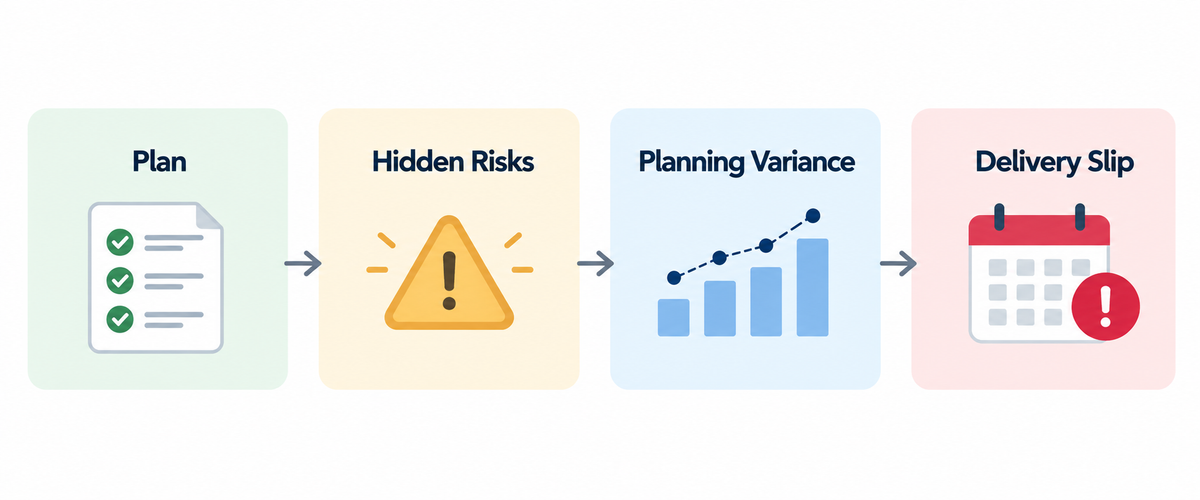
Planning accuracy rarely breaks because of one estimation error. It usually deteriorates as several execution conditions change after commitments are made.
Common causes include:
- Frequent priority or scope changes
- Capacity that does not match commitments
- Unresolved cross-team dependencies
- Increasing work in progress
- Slow approvals or decisions
- Risks identified too late
These software development risks create variance between what teams planned and what the delivery system can realistically support.
How Do Dependencies Affect Delivery Forecasting?
Dependencies introduce uncertainty whenever delivery relies on another team, system, vendor, approval, or technical component.
The risk increases when ownership, timing, or impact is unclear. Leaders should identify critical dependencies during planning and continue monitoring them throughout execution.
A dependency considered manageable four weeks ago may become the constraint that determines whether a release remains achievable. Better dependency visibility allows forecasts to change before deadlines fail.
Why Does Risk Visibility Matter for Planning Accuracy?
Traditional risk registers can become disconnected from everyday delivery activity.
Effective risk visibility requires observing execution signals such as increasing cycle time, repeated carryover, blocked work, priority changes, decision delays, and declining commitment reliability.
A strong software delivery diagnosis asks not only, “What risks have we documented?” but also, “What is execution telling us about risks we may not have recognized yet?”
This shifts risk management from retrospective reporting toward earlier intervention.
How Can Leaders Improve Delivery Forecasting?
Forecasting should evolve as execution conditions change. Leaders should compare original planning assumptions with current delivery signals and ask:
- Are commitments still stable?
- Has available capacity changed?
- Which dependencies remain unresolved?
- Where is work consistently waiting?
- Are decisions delaying execution?
- Which risks could materially affect the forecast?
These questions provide a more realistic view of delivery performance than milestone status alone.
How Does Execution Clarity Improve Planning Accuracy?
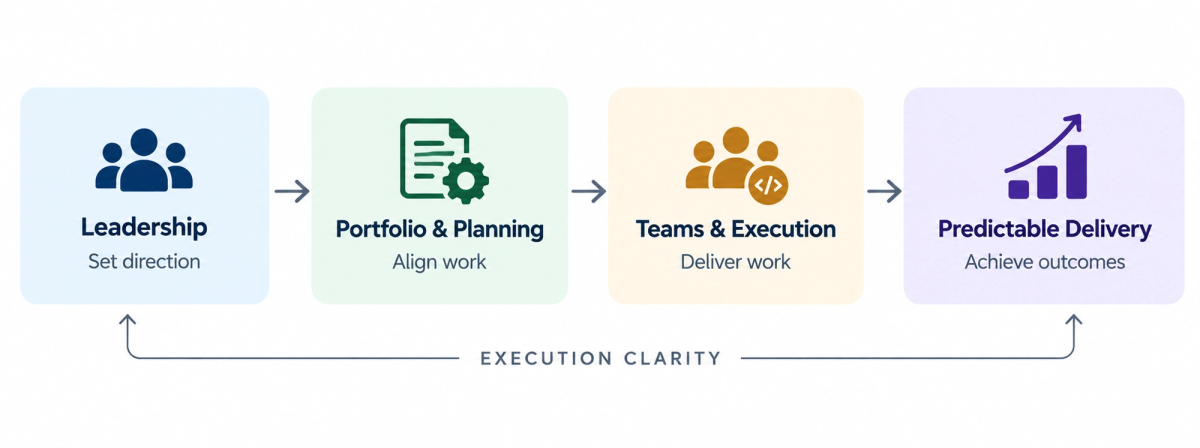
Execution Clarity the ability to understand where execution is breaking down and why helps leaders identify risks earlier, strengthen alignment, and make informed decisions before delivery is impacted.
It connects signals across leadership priorities, portfolio planning, and team execution, allowing leaders to see when planning assumptions begin diverging from execution reality.
What Should Leaders Measure?
No single metric determines software delivery predictability. Useful indicators include Commitment Reliability, Lead Time, Cycle Time, Work in Progress, Decision Velocity, dependency status, and Roadmap Health.
The value comes from examining these signals together. Rising cycle time alongside increasing work in progress, for example, may reveal a workflow constraint before a release date changes.
What Should Leaders Do Next?
Start by comparing planning assumptions with current execution conditions.
Identify where commitments are changing, work is waiting, dependencies are becoming unstable, and decisions are slowing progress. Update forecasts when those signals change rather than waiting for a milestone to fail.
Predictable delivery starts with Execution Clarity.
Conclusion
Planning accuracy is not about creating a perfect forecast at the beginning of a project. It is about continuously understanding whether the assumptions behind that forecast remain valid.
By improving risk visibility, dependency diagnosis, and delivery forecasting, software leaders can detect variance earlier, strengthen project planning accuracy, and create more predictable software delivery outcomes.