
The Complete Guide to Software Delivery Variance

Learn how to diagnose hidden causes of software delivery variance across teams, release cycles, and execution signals before delays become visible.
Executive Summary
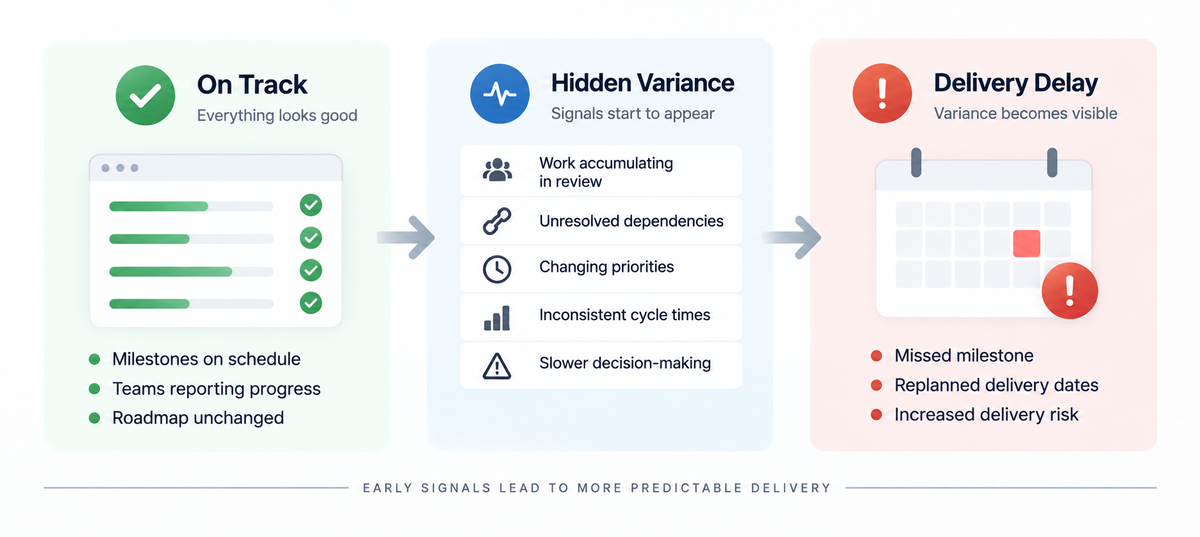
Software delivery variance rarely begins when a release misses its target. Warning signs often appear earlier through changing commitments, uneven cycle times, unresolved dependencies, workflow bottlenecks, and delayed decisions.
For SaaS delivery leaders, improving software delivery predictability requires understanding why delivery performance varies across teams and release cycles not simply whether the latest project appears on schedule.
Direct Answer: Software delivery variance occurs when planning, capacity, dependencies, workflow, and decision-making behave inconsistently across the delivery system. Leaders can diagnose it by comparing commitments with actual delivery patterns and monitoring execution signals before delays become visible.
What Is Software Delivery Variance?
Software delivery variance is the difference between expected and actual delivery behavior across teams, iterations, or releases.
A single late release does not necessarily indicate a systemic problem. The stronger warning signal is a recurring pattern: similar work takes different amounts of time, commitments frequently change, or teams repeatedly carry unfinished work into the next cycle.
Understanding these patterns helps leaders improve project predictability without assuming every variance is a team performance problem.
What Causes Software Delivery Variance?
Delivery variance rarely has one cause. Leaders should examine several connected conditions:
- Planning instability: Changing priorities or scope weaken commitments.
- Workflow constraints: Work accumulates in testing, review, security, or deployment.
- Dependencies: Cross-team dependencies create waiting time when ownership or timing is unclear.
- Capacity imbalance: Commitments exceed available capacity and increase carryover.
- Decision delays: Slow approvals or unclear ownership interrupt execution.
These conditions can interact across software development processes, making a local team issue appear to be the cause when the real constraint exists elsewhere.
How Should Leaders Diagnose Unpredictable Software Delivery?
Effective software delivery diagnosis compares planned commitments with actual execution behavior.
Leaders should ask:
- How often do commitments change after work begins?
- Where does work spend the most time waiting?
- Which dependencies repeatedly affect releases?
- Are cycle times becoming less consistent?
- How quickly are critical decisions resolved?
- Are risks identified before milestones slip?
These questions shift the conversation from “Are we on track?” to “What could prevent us from staying on track?”
Which Performance Signals Reveal Delivery Variance?
No single metric explains delivery performance. Leaders should examine patterns across indicators such as Commitment Reliability, Cycle Time, Lead Time, Work in Progress, Decision Velocity, and Roadmap Health.
For example, rising work in progress alongside longer cycle times may indicate a workflow constraint. Declining commitment reliability combined with frequent priority changes may reveal planning instability.
Metrics become valuable when they explain why delivery performance is changing, rather than simply reporting that it changed.
What Should Leaders Do Next?
When delivery performance varies repeatedly, adding more meetings, reporting, or process controls should not automatically be the first response.
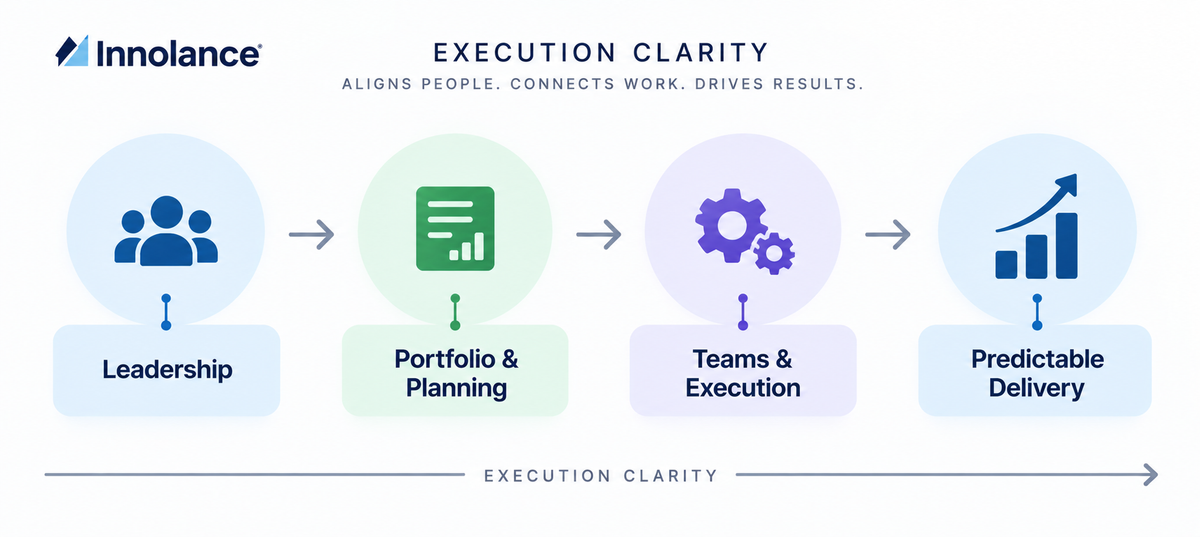
Start by identifying where commitments change, work waits, dependencies create delays, and decisions slow execution. Then connect those signals across planning and delivery to identify the underlying constraints.
Predictable delivery starts with Execution Clarity.
Conclusion
Software delivery variance is rarely random. It often develops through patterns in planning, workflow, dependencies, capacity, and decision-making long before a deadline slips.
By diagnosing these signals earlier, leaders can address the right constraints, strengthen delivery performance, and build a stronger foundation for software delivery predictability.