
Understanding Agile Coaching vs Execution Diagnostics
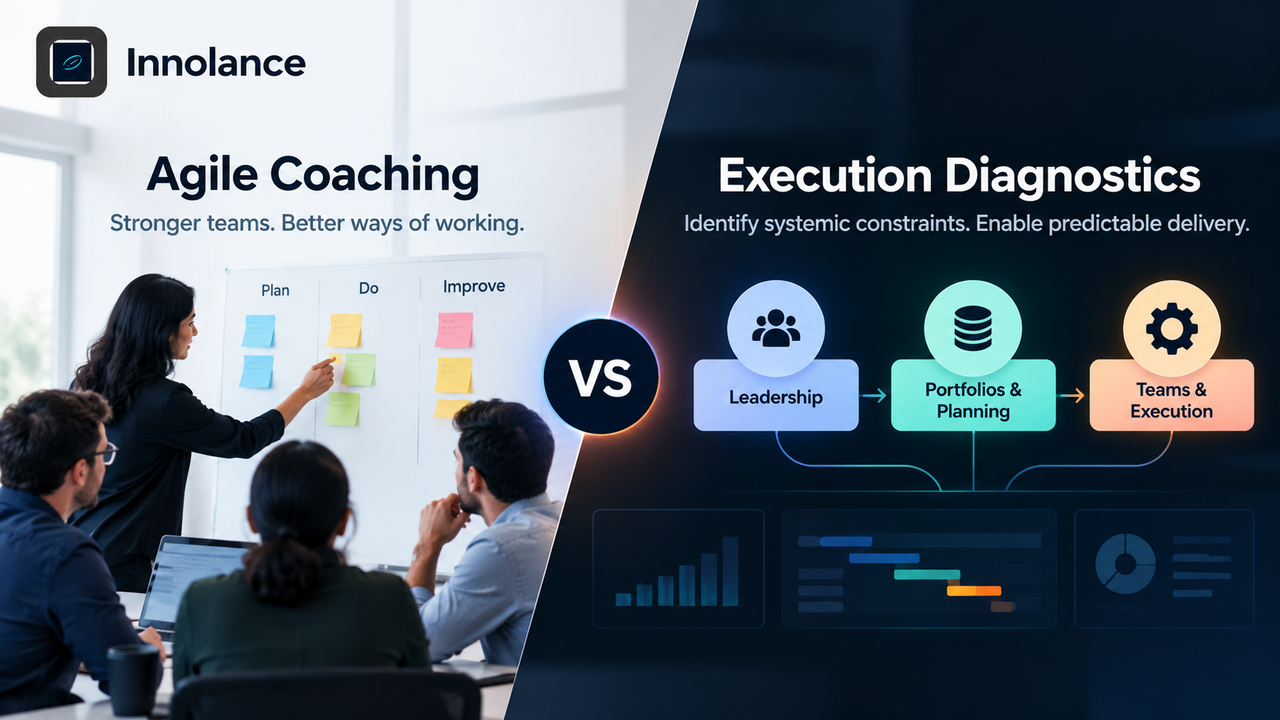
Learn when agile coaching improves team practices and when execution diagnostics are needed to identify systemic delivery constraints and visibility gaps.
Executive Summary
When software delivery becomes unpredictable, leaders often respond by improving agile practices. That can help when teams need stronger collaboration, clearer roles, better planning, or more consistent ways of working. But not every delivery problem begins inside the team.
Delays may instead come from competing priorities, cross-team dependencies, slow decisions, portfolio overload, unclear ownership, or limited leadership visibility. These conditions require a broader view of the execution system.
Direct Answer: Agile coaching helps teams and organizations improve agile behaviors, practices, collaboration, and ways of working. Execution diagnostics examine the broader organizational conditions affecting delivery, including leadership visibility, portfolio alignment, dependencies, decision flow, and execution constraints. Leaders should choose the approach based on whether the problem is primarily related to team practices or systemic execution conditions.
What Is Agile Coaching?
Agile coaching helps teams and organizations strengthen how they apply agile principles and practices.
An agile coach may work with teams on planning, retrospectives, collaboration, facilitation, roles, continuous improvement, and adoption of agile ways of working.
This can be useful when teams understand what they need to deliver but struggle with how they collaborate or execute within an agile operating model.
Common signals that agile coaching may help include:
- Inconsistent agile practices
- Ineffective planning or retrospectives
- Unclear team roles
- Weak collaboration
- Difficulty adopting agile practices
- Limited continuous-improvement habits
Key Takeaway: Agile coaching is most useful when behaviors, practices, and team ways of working are central to the problem.
What Are Execution Diagnostics?
Execution diagnostics begin with a different question:
Where is execution breaking down, and why?
Execution Clarity the ability to understand where execution is breaking down and why helps leaders identify bottlenecks earlier, strengthen alignment, and make informed decisions before delivery is impacted.
An execution diagnostic examines conditions across the organization rather than assuming the delivery team is the source of the problem.
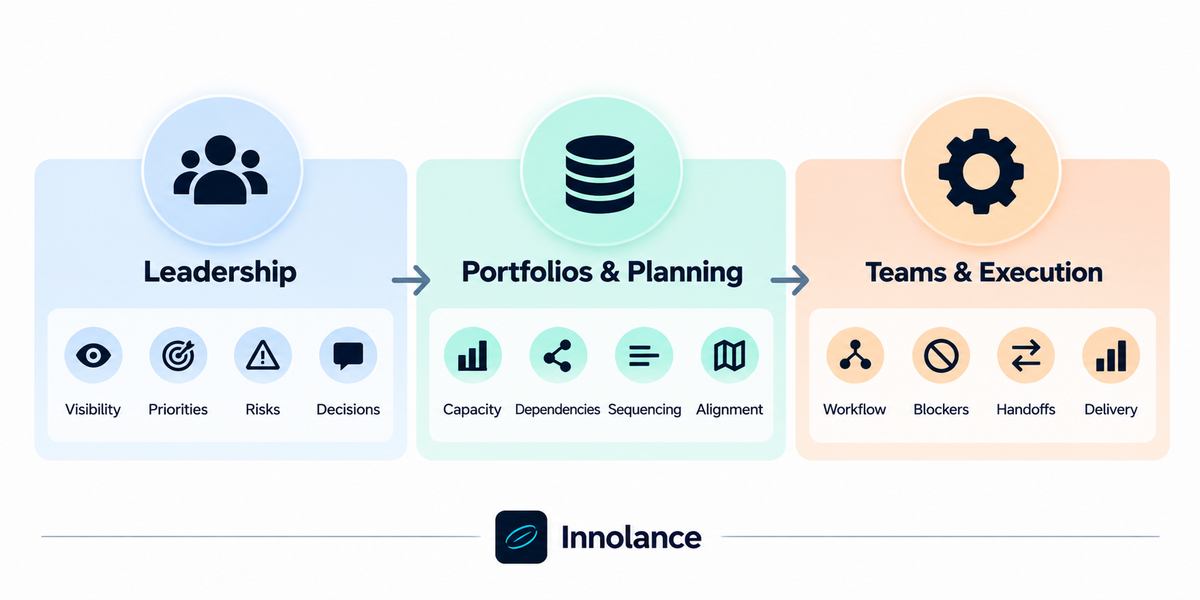
At the leadership level, the assessment examines visibility, priorities, risks, and decision flow.
At the portfolio level, it examines capacity, dependencies, sequencing, and roadmap alignment.
At the team level, it examines workflow, blockers, handoffs, and commitment reliability.
How Are Agile Coaching and Execution Diagnostics Different?
The primary difference is the question each approach is designed to answer.
Agile coaching asks: How can teams improve their behaviors, practices, and ways of working?
Execution diagnostics ask: What organizational conditions are preventing predictable execution?
A delivery team may follow strong agile practices but still miss commitments because another team controls a critical dependency. Frequent portfolio-level priority changes may also create instability that cannot be solved through better sprint ceremonies.
Conversely, when priorities and dependencies are stable but teams struggle with planning, collaboration, or continuous improvement, coaching may be appropriate.
Key Takeaway: Similar delivery symptoms can have very different causes.
What Problems Require an Execution Diagnostic?
Leaders should consider execution diagnostics when delivery problems extend beyond one team's practices.
Common signals include:
- Multiple teams missing commitments
- Persistent cross-team dependencies
- Frequent roadmap changes
- Slow leadership decisions
- Competing portfolio priorities
- Repeated approval delays
- Different views of project health across leadership and teams
- Delivery risks becoming visible too late
These conditions suggest broader organizational performance issues rather than an isolated team-practice problem.
Which Metrics Help Identify the Difference?
Metrics can help leaders determine whether delivery problems are local or systemic.
Useful indicators include:
- Commitment Reliability – whether teams consistently deliver planned commitments
- Cycle Time – how long work takes once execution begins
- Lead Time – elapsed time from request to completion
- Flow Efficiency – time spent progressing compared with waiting
- Decision Velocity – how quickly delivery-critical decisions are resolved
- Roadmap Health – how stable and achievable roadmap commitments remain
Metrics should be combined with stakeholder interviews and dependency analysis.
For example, declining commitment reliability across several teams may indicate a portfolio, dependency, or decision-flow problem rather than weak agile practice in one team.
How Should Leaders Choose the Right Approach?
Start by diagnosing the constraint before choosing the intervention.
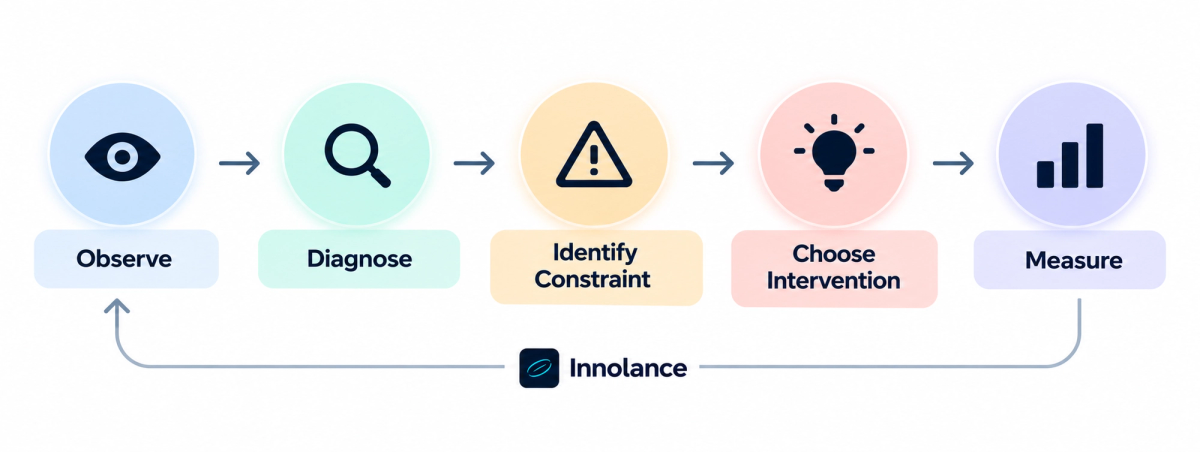
If the constraint involves team behaviors, collaboration, ceremonies, or adoption of agile practices, agile coaching may be appropriate.
If the constraint involves portfolio priorities, dependencies, decision flow, organizational complexity, or leadership visibility, an execution diagnostic provides a broader starting point.
Sometimes both approaches are useful. A diagnostic may identify team practices as one of several constraints, allowing coaching to be introduced as a targeted intervention.
Can Agile Transformation Solve Systemic Delivery Problems?
An agile transformation can improve how an organization structures and manages work, but adopting agile practices alone does not automatically remove systemic execution constraints.
Teams can run effective planning sessions and retrospectives while still waiting on unresolved dependencies, leadership decisions, or changing portfolio priorities.
The more useful question is not simply:
“Are our teams agile?”
It is:
“Can we see what is preventing reliable execution?”
That distinction helps leaders avoid treating every delivery problem as a team-practice issue.
What Should Leaders Do Next?
Start with the delivery problem rather than the intervention.
Select one strategically important delivery stream and review its commitments, dependencies, waiting time, decision delays, priority changes, and workflow constraints. Then compare operational evidence with perspectives from leadership and delivery teams.
If the evidence points toward team behaviors and practices, coaching may be the right next step. If the constraints span leadership, portfolios, dependencies, and teams, a broader execution assessment may be needed.
Innolance approaches execution improvement as an external diagnostic process helping leaders identify where execution is breaking down, clarify systemic constraints, and determine which improvements can strengthen Delivery Predictability.
Conclusion
Agile coaching and execution diagnostics are not competing solutions. They address different questions.
Agile coaching can strengthen behaviors, practices, collaboration, and agile delivery. Execution diagnostics provide a broader view of the organizational conditions influencing delivery performance.