
Understanding CRM Pipeline Visibility Gaps
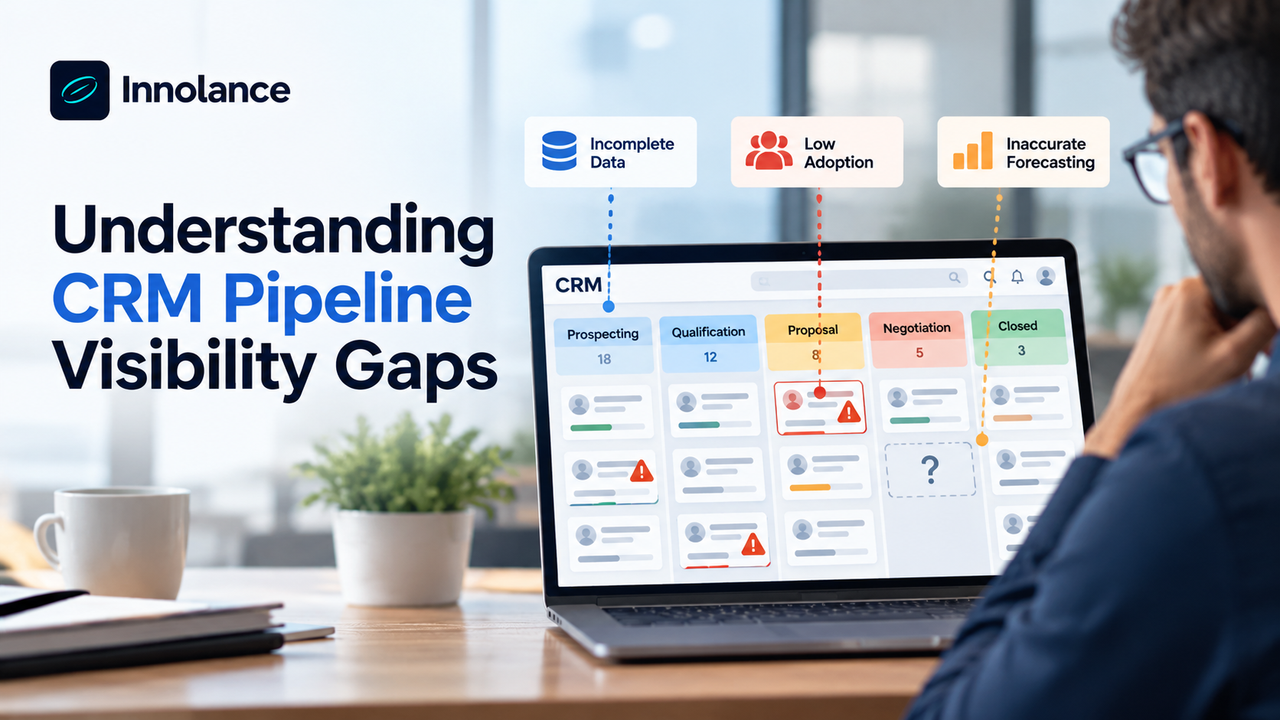
Discover why CRM pipeline visibility remains poor after implementation and how better data quality, sales processes, and CRM adoption improve forecasting accuracy.
Executive Summary
A fully implemented CRM does not automatically provide reliable pipeline visibility. Even when dashboards, integrations, and reporting tools are available, revenue operations leaders may struggle to understand deal progress, identify risks, and forecast revenue accurately.
Poor CRM pipeline visibility often results from inconsistent sales processes, incomplete customer data, outdated opportunity records, and low CRM adoption.
Direct Answer: Poor pipeline visibility in an otherwise fully implemented CRM is typically caused by inconsistent pipeline stages, unreliable CRM data quality, delayed opportunity updates, unclear ownership, disconnected workflows, and weak user adoption. Organizations can improve visibility by standardizing sales processes, validating opportunity data, strengthening CRM adoption, and monitoring pipeline health continuously.
Why Does Pipeline Visibility Remain Poor After CRM Implementation?
CRM pipeline visibility is the ability to understand where sales opportunities stand, how they are progressing, and which risks may affect expected revenue.
A successful CRM implementation establishes the technology, but it does not guarantee that employees will consistently follow the processes supporting accurate reporting.
Common warning signs include:
- Opportunities remaining in the same stage for extended periods
- Forecasts changing unexpectedly near quarter-end
- Missing close dates or inconsistent deal values
- Sales representatives updating records only before meetings
- Different teams interpreting pipeline stages differently
- Leadership dashboards showing conflicting revenue figures
Key Takeaway: CRM visibility problems often originate in the workflows and behaviors behind the system rather than the CRM platform itself.
Are Sales Teams Using Consistent Pipeline Definitions?
Reliable pipeline management requires shared definitions for opportunity stages, qualification criteria, and deal progression.
When representatives interpret stages differently, two opportunities marked as “Negotiation” may represent very different levels of readiness.
This creates misleading pipeline reports and weakens forecasting confidence.
Revenue operations leaders should establish clear entry and exit criteria for every stage.
For example, moving an opportunity into a proposal stage might require confirmed customer requirements, an identified decision-maker, and documented next steps.
Practical Tip: Review a sample of opportunities within the same stage. If their actual sales progress differs significantly, pipeline definitions may need refinement.
How Does CRM Data Quality Affect Pipeline Visibility?
CRM data quality refers to the accuracy, completeness, consistency, and timeliness of information stored within the CRM.
Poor data quality can make an otherwise functional dashboard unreliable.
Missing opportunity values distort pipeline totals. Outdated close dates weaken revenue projections. Duplicate records may inflate potential revenue, while inconsistent account ownership creates confusion.
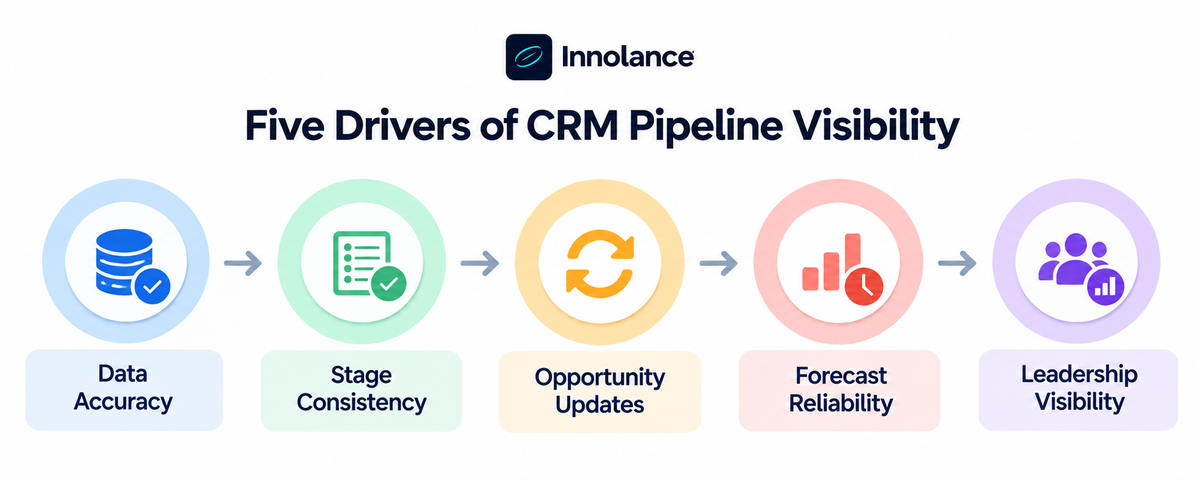
A practical visibility framework connects five elements:
Data Accuracy → Stage Consistency → Opportunity Updates → Forecast Reliability → Leadership Visibility
Improving data reliability requires validation rules, consistent field definitions, duplicate prevention, and clear ownership.
Key Takeaway: Better dashboards cannot compensate for incomplete or inaccurate opportunity data.
Does Low CRM Adoption Create Hidden Pipeline Risks?
CRM adoption measures whether employees consistently use the system as part of their everyday work.
When representatives maintain deal information in spreadsheets, personal notes, or messaging platforms, the CRM no longer reflects the complete sales pipeline.
This creates visibility gaps between actual customer activity and recorded opportunity progress.
Leaders should examine whether CRM workflows support sales activities or introduce unnecessary administrative work.
Simplifying data entry, integrating relevant tools, clarifying expectations, and providing role-specific training can improve adoption.
Practical Tip: Measure the percentage of active opportunities updated within an agreed reporting period rather than relying only on login activity.
How Do Disconnected Workflows Distort Sales Forecasting?
Sales forecasting estimates future revenue using opportunity information, historical performance, and defined forecasting assumptions.
Forecasting becomes unreliable when opportunity data moves inconsistently between sales, marketing, finance, and customer success.
For example, a closed opportunity may remain active in one system while another records the completed transaction.
Disconnected workflows can introduce reporting delays, duplicate information, and conflicting revenue expectations.
Revenue operations leaders should identify authoritative data sources, establish integration ownership, and monitor synchronization failures.
Key Takeaway: Forecast reliability depends on consistent information across the entire revenue workflow, not just within the CRM.
Which Metrics Reveal CRM Pipeline Visibility Gaps?
Leaders should evaluate both pipeline outcomes and the operational signals that influence reporting accuracy.
Useful indicators include:
- Stage Aging: Average time opportunities remain in each pipeline stage
- Opportunity Update Rate: Percentage of active opportunities updated within a defined period
- Forecast Accuracy: Difference between forecasted and actual revenue
- Required-Field Completeness: Percentage of opportunities containing essential information
- Close-Date Changes: Frequency of changes to expected closing dates
- Pipeline Conversion Rate: Percentage of opportunities advancing or converting between stages
These metrics help distinguish normal sales uncertainty from process or data-quality problems.
How Can Leaders Improve CRM Pipeline Visibility?
Improving sales process visibility requires a structured approach that connects diagnosis with operational improvements.
A practical improvement cycle is:
Assess → Standardize → Validate → Align → Monitor
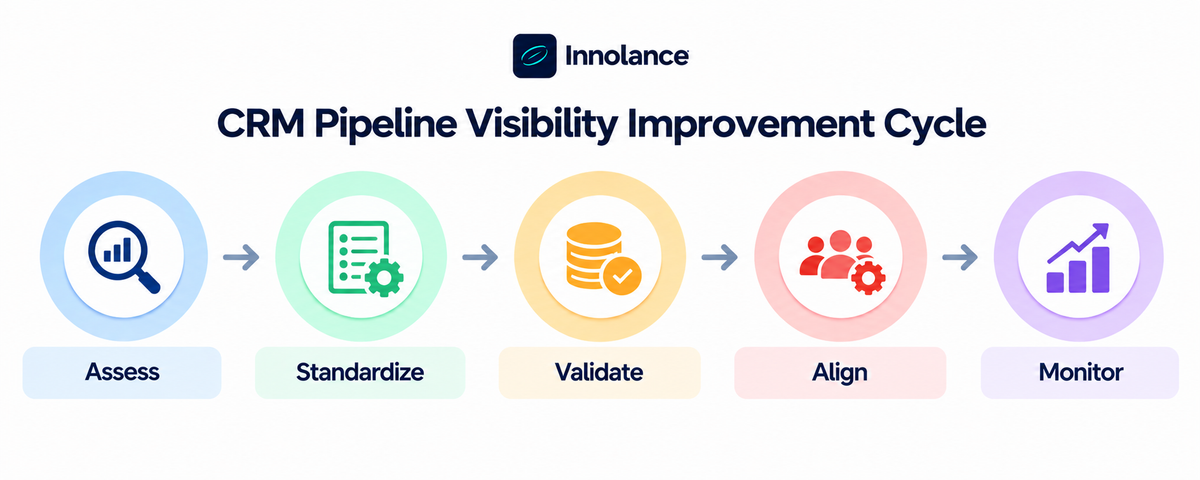
Start by assessing opportunity records, reporting discrepancies, and user adoption patterns.
Standardize pipeline definitions and ownership responsibilities. Validate critical opportunity fields and align workflows across departments.
Finally, monitor pipeline health, forecast changes, and data quality trends to identify recurring issues.
Automation can reduce manual errors and improve update consistency, but it cannot resolve unclear business rules or conflicting ownership independently.
Key Takeaway: Sustainable pipeline visibility requires reliable data, consistent workflows, employee adoption, and continuous monitoring.
What Should Revenue Operations Leaders Do Next?
Begin with a focused assessment of one important sales pipeline or forecasting workflow.
Compare CRM reports with actual opportunity activity. Identify where information becomes outdated, stage definitions become inconsistent, or handoffs create reporting gaps.
Review opportunity records alongside interviews with sales representatives, managers, and CRM administrators to understand both system behavior and operational practices.
Innolance helps organizations examine CRM processes, data quality, integrations, and adoption challenges to identify gaps affecting operational visibility. This diagnostic approach supports more consistent pipeline management and stronger forecasting confidence.
Frequently Asked Questions
Why is pipeline visibility poor even when the CRM is fully implemented?
A CRM may be technically functional while inconsistent sales processes, outdated opportunity records, incomplete data, and weak adoption prevent accurate pipeline reporting.
Can CRM automation solve pipeline visibility problems?
Automation can improve validation, updates, and reporting consistency. However, organizations must first establish clear pipeline definitions, ownership rules, and reliable workflows.
What is the difference between CRM pipeline visibility and sales forecasting?
CRM pipeline visibility shows the current status, movement, and risks of sales opportunities. Sales forecasting uses pipeline information and other evidence to estimate future revenue.
Conclusion
Strong CRM pipeline visibility depends on more than successful software implementation.
Inconsistent pipeline stages, unreliable data, disconnected workflows, and limited CRM adoption can prevent leaders from understanding actual sales performance.
By strengthening data governance, standardizing sales processes, improving adoption, and monitoring pipeline health, revenue operations leaders can build more trustworthy reporting and make better-informed revenue decisions.