
Understanding Hidden Software Delivery Risk

Learn how hidden coordination, dependency, and quality risks can undermine software delivery predictability even when surface metrics appear healthy.
Executive Summary
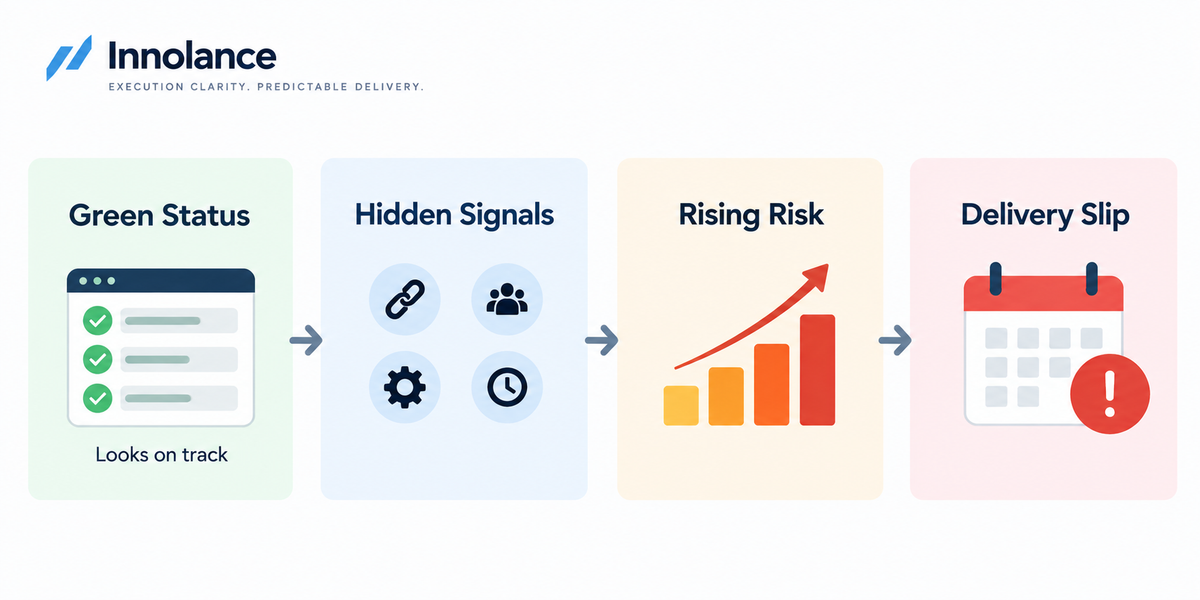
Software delivery can look healthy while risk quietly builds beneath the surface. Roadmaps remain green, sprint completion appears stable, and teams stay productive, yet unresolved dependencies, coordination gaps, quality issues, and delayed decisions may already be weakening delivery confidence.
For CTOs and software delivery leaders, improving software delivery predictability requires looking beyond surface-level status. Leaders need visibility into the execution signals that reveal whether delivery conditions are becoming unstable before milestones begin to slip.
Direct Answer: Hidden software delivery risk develops when traditional status metrics show progress but fail to expose changes in dependencies, coordination, quality, capacity, and decision flow. Leaders can diagnose these risks by monitoring multiple execution signals together rather than relying on green status alone.
Why Can Software Delivery Look Healthy While Risk Is Increasing?
Traditional reporting often focuses on visible progress: completed work, sprint velocity, milestone status, and roadmap health.
These measures are useful, but they may not reveal what is happening between teams and across the delivery system.
A project may remain green while a dependency waits for another team. Sprint goals may be achieved while technical issues accumulate. Teams may appear productive while critical decisions remain unresolved.
The result is a dangerous gap between reported status and actual delivery risk.
Key Takeaway: Healthy surface metrics do not always mean healthy execution conditions.
What Hidden Signals Increase Software Delivery Risk?
Hidden risk usually develops through several connected conditions rather than one obvious failure.
Common warning signals include:
- Growing cross-team dependencies
- Repeated priority or scope changes
- Increasing work in progress
- Longer review or testing queues
- Delayed technical or business decisions
- Repeated work carryover
- Quality issues and increasing rework
- Capacity that does not match commitments
These software development risks can accumulate gradually. Individually, they may appear manageable. Together, they can make delivery increasingly unpredictable.
How Do Coordination and Dependencies Create Hidden Risk?
Modern software delivery rarely happens within one isolated team. Product, engineering, security, infrastructure, operations, and other functions frequently depend on one another.
When dependency ownership or timing is unclear, work begins to wait.
Coordination risk grows when teams have different priorities, planning cycles, or assumptions about delivery dates. A dependency that appears minor during planning can eventually become a critical constraint.
Effective software delivery diagnosis therefore requires leaders to examine how work moves across teams not simply how individual teams perform.
Why Are Quality Signals Important for Delivery Predictability?
Quality problems can remain hidden while feature development appears to progress normally.
Increasing defects, repeated rework, unstable testing, or growing technical remediation can consume capacity that was originally expected to support planned delivery. This creates a gap between planned capacity and actual capacity.
Leaders should therefore treat quality signals as forecasting inputs rather than problems to review only after a release is delayed. Earlier visibility enables teams to adjust commitments before quality risk becomes schedule risk.
How Can Leaders Diagnose Unpredictable Delivery?
Diagnosis should begin by comparing visible status with underlying execution conditions.
Leaders should ask:
- Where is work consistently waiting?
- Which dependencies remain unresolved?
- Are priorities changing after commitments are made?
- Is work in progress increasing?
- Are defects or rework consuming more capacity?
- Which decisions repeatedly slow teams?
- Are commitments becoming less reliable over time?
Patterns across these signals provide a stronger picture of delivery performance than any single metric.
How Does Execution Clarity Reveal Hidden Delivery Risk?
Execution Clarity the ability to understand where execution is breaking down and why helps leaders identify emerging risks before they become visible delivery failures.
It connects signals across leadership priorities, portfolio planning, and team execution, giving leaders a clearer view of how coordination, dependencies, capacity, decisions, and quality affect delivery.
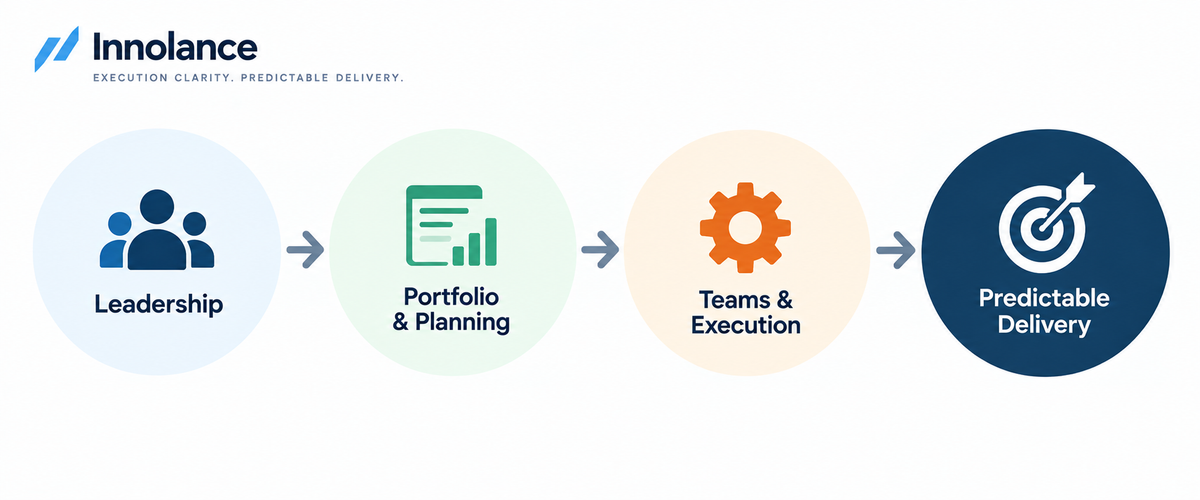
Innolance approaches delivery risk from this organizational perspective, helping leaders identify where execution conditions are creating uncertainty instead of treating every missed milestone as an isolated team problem.
What Should Leaders Measure?
No single metric can fully explain software delivery predictability. Leaders should evaluate related signals such as Commitment Reliability, Cycle Time, Lead Time, Work in Progress, dependency status, Decision Velocity, quality trends, and Roadmap Health.
The important insight comes from how these indicators change together.
What Should Leaders Do Next?
Start by looking beyond whether projects are green or red.
Compare current commitments with dependency health, coordination patterns, quality trends, capacity, and decision flow. When these signals begin deteriorating, investigate the cause and adjust plans before the milestone itself becomes at risk.
Predictable delivery starts with Execution Clarity.
Conclusion
Hidden software delivery risk develops when execution conditions deteriorate faster than traditional reporting reveals them.
By combining surface metrics with deeper coordination, dependency, quality, and workflow signals, CTOs and software delivery leaders can improve software delivery diagnosis, identify risk earlier, strengthen project planning accuracy, and create more predictable software delivery outcomes.