
What Breaks CRM Data Quality During Sales Growth
Learn what causes CRM data quality to decline during sales growth and how better workflows, governance, and automation can keep customer data accurate.
Executive Summary
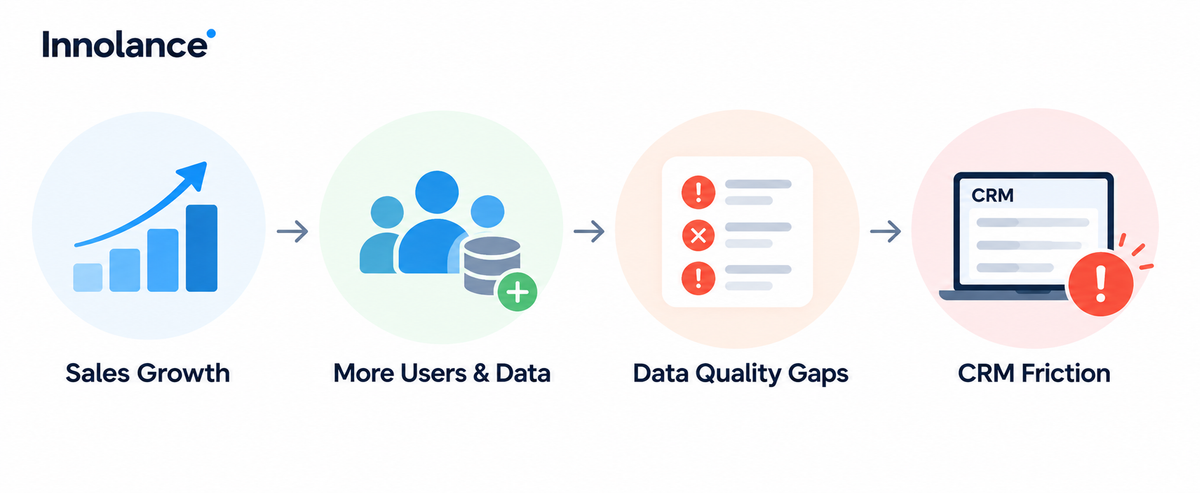
CRM data quality often declines as sales organizations grow. More representatives, expanding territories, new tools, changing processes, and increasing customer records create more opportunities for inconsistent, incomplete, or duplicate data.
For growth-stage B2B SaaS revenue operations leaders, maintaining CRM data quality requires more than periodic database cleanup. The underlying workflows, ownership rules, integrations, and governance must scale with the sales organization.
Direct Answer: CRM data quality becomes harder to maintain during growth because more users, workflows, systems, and customer records increase data-entry variation, duplicate records, integration gaps, and inconsistent ownership. Revenue leaders can protect data quality by standardizing processes, automating validation, clarifying ownership, and monitoring quality continuously.
Why Does CRM Data Quality Decline During Growth?
A CRM process that works for a small sales team may not scale effectively.
When new representatives join quickly, they may interpret lifecycle stages, required fields, lead statuses, or account ownership differently. At the same time, marketing, sales, customer success, and other systems may continuously add or update customer information.
Without clear CRM data management, small inconsistencies multiply.
The result is not simply messy data. Poor-quality information can affect segmentation, routing, forecasting, reporting, automation, and sales decisions.
Key Takeaway: CRM scalability depends on scaling the processes that create and maintain CRM data not simply increasing system capacity.
What Are the Main Causes of Poor CRM Data Quality?
Several problems commonly emerge as sales organizations expand:
- Inconsistent data entry
- Missing required information
- Duplicate contacts and companies
- Outdated customer records
- Unclear record ownership
- Conflicting lifecycle or lead statuses
- Poorly configured integrations
- Manual imports and spreadsheets
- Inconsistent field definitions
These issues become more significant as record volume and workflow complexity increase.
Why Do Duplicate Records Increase as Sales Teams Scale?
Duplicate records often appear when multiple systems and teams create customer information independently.
A salesperson may manually create a contact that already exists from a marketing form. Imports may contain companies already stored in the CRM. Integrations may also create records without sufficiently reliable matching rules.
Effective duplicate data prevention should therefore happen within the workflow rather than only through periodic cleanup.
Matching rules, standardized identifiers, controlled imports, and automated deduplication can reduce duplicate creation before it affects downstream processes.
How Do Inconsistent Workflows Affect Customer Data Accuracy?
CRM data becomes reliable when users and systems follow consistent rules.
If one salesperson records an opportunity at a different stage than another, or teams use different definitions for qualified leads, reporting may appear precise while representing inconsistent underlying information.
This weakens customer data accuracy and makes dashboards, automation, and forecasts less dependable.
Revenue operations teams should establish clear definitions for important CRM properties and ensure workflows reinforce those definitions.
How Do Integrations Create CRM Data Quality Problems?
Growing SaaS organizations rarely operate from one platform.
Marketing automation, sales engagement, customer support, enrichment, billing, and analytics systems may all exchange information with the CRM.
Every integration introduces important questions:
- Which system owns each field?
- Which system can overwrite existing data?
- How are conflicts resolved?
- When should records be created?
- What happens when synchronization fails?
Without clear answers, integrations can overwrite accurate information, create duplicates, or leave critical fields incomplete.
What Should Revenue Leaders Monitor?
Strong data quality during growth requires continuous visibility.
Revenue operations leaders should monitor indicators such as Duplicate Rate, Required Field Completion, Invalid Data Rate, Record Ownership Coverage, Integration Errors, and Data Freshness.
Trends matter more than isolated numbers. For example, a rising duplicate rate after a new integration launches may reveal a matching problem. Falling field completion after rapid hiring may indicate a training or workflow-design issue.
How Can Better CRM Processes Protect Data Quality?
The strongest approach combines process design, automation, and governance.
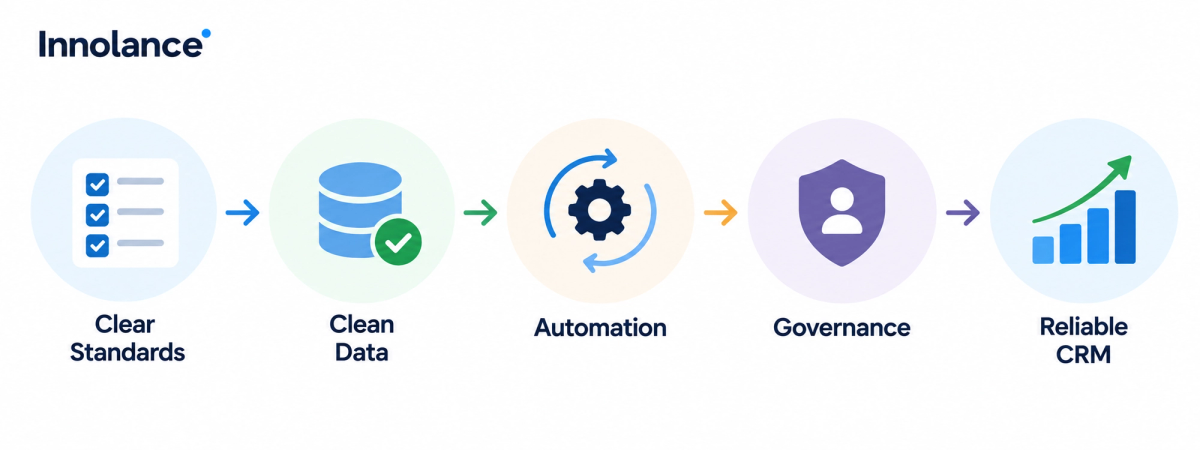
Standardized fields establish what information should look like. Automation validates and enriches information where appropriate. Governance establishes ownership and rules for maintaining records.
Together, these practices make CRM scalability less dependent on individual users remembering every data-quality requirement.
For growing organizations, Innolance approaches CRM optimization from this operational perspective connecting process design, CRM configuration, automation, and data visibility so the system remains useful as business complexity increases.
What Should Revenue Leaders Do Next?
Start by identifying where unreliable CRM data enters the system.
Review manual entry, imports, forms, integrations, ownership changes, and lifecycle updates. Then determine which recurring problems can be prevented through clearer rules or automation.
A simple improvement cycle is:
Identify → Standardize → Automate → Monitor
The objective is not simply to clean the CRM. It is to build workflows that prevent poor-quality data from repeatedly returning.
Conclusion
Sales growth increases CRM complexity. Without scalable processes, more users, systems, and records can quickly weaken data consistency and reliability.
By strengthening CRM data management, preventing duplicates, standardizing workflows, and continuously monitoring data quality, revenue operations leaders can maintain trustworthy customer information while supporting continued growth.