
What Leaders Should Check When CRM Reports Break
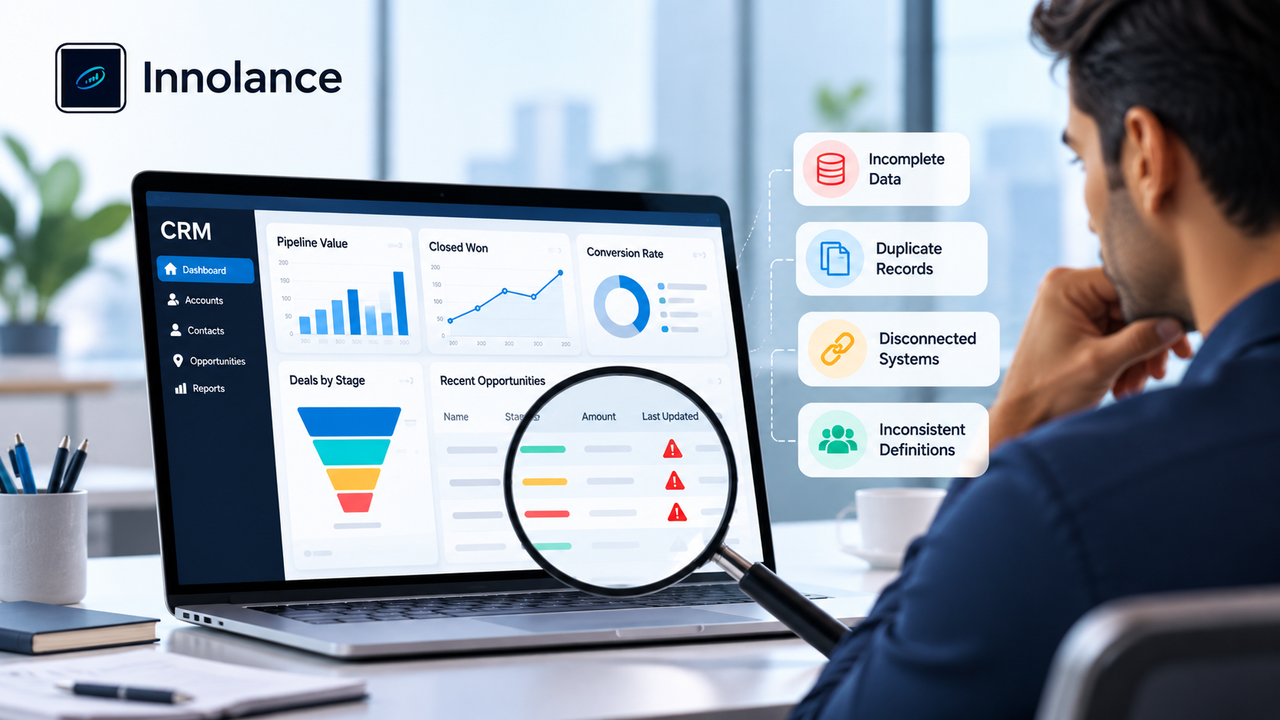
Learn why CRM reporting becomes unreliable as sales teams grow and what leaders should check first to improve data accuracy and reporting reliability.
Executive Summary
CRM reporting becomes harder to trust as sales organizations grow. More users, records, workflows, integrations, and reporting requirements introduce opportunities for inconsistent data, incomplete fields, duplicate records, and conflicting definitions.
For revenue operations leaders and CRM administrators, reliable CRM reporting requires more than building better dashboards. The data, workflows, ownership rules, and reporting definitions behind those dashboards must remain consistent as the organization scales.
Direct Answer: CRM reporting often becomes unreliable for growing sales teams because inconsistent data entry, unclear field definitions, duplicate records, disconnected systems, and changing workflows weaken the data behind reports. Revenue operations leaders can improve reporting reliability by standardizing CRM data, validating integrations, establishing governance, and continuously monitoring data quality.
Why Does CRM Reporting Become Unreliable as Sales Teams Grow?
A CRM that supports a small sales organization may become significantly more complex during growth.
New representatives enter data differently. Territories and pipeline stages change. Additional tools introduce new data sources, while custom fields and workflows accumulate over time.
The dashboard may continue functioning while the information underneath becomes less consistent.
Key Takeaway: Before changing a report, verify that the underlying data, definitions, and workflows remain consistent.
Are Teams Entering CRM Data Consistently?
The first check should be CRM data accuracy.
Different naming conventions, missing fields, outdated opportunities, duplicate accounts, and inconsistent update practices can all distort reports.
Leaders should trace how information moves from initial data entry to leadership decisions:
Data Entry → Validation → Pipeline → Reporting → Decisions
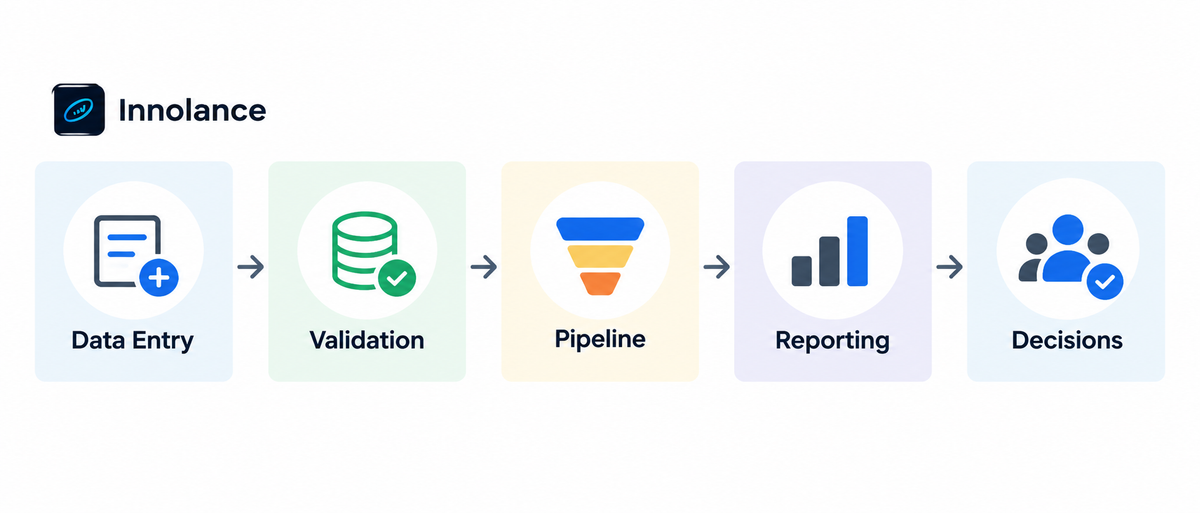
Looking across the complete reporting flow helps leaders determine whether the problem begins with the dashboard or much earlier in the process.
Are Pipeline Stages Defined Clearly?
Reliable sales team reporting depends on teams interpreting pipeline stages consistently.
One salesperson may move an opportunity forward after an initial conversation, while another waits for confirmed buying intent. Both opportunities then appear in the same stage despite representing different levels of progress.
Leaders should check whether every stage has clear entry and exit criteria and whether those rules are consistently followed.
Practical Tip: Compare several opportunities within the same pipeline stage. Significant differences in their actual progress may indicate a process-definition problem rather than a reporting problem.
Are Duplicate or Incomplete Records Distorting Sales Analytics?
Duplicate accounts, contacts, and opportunities can inflate pipeline values and distort conversion rates, activity reporting, and forecasts.
Incomplete records create another risk. A report can be technically correct while still presenting an incomplete picture of sales performance.
Leaders should regularly review missing required fields, duplicate records, stale opportunities, ownership gaps, and incomplete close dates.
Reliable sales analytics depends on reliable source data.
Are CRM Integrations Changing the Data?
Growing B2B companies often connect CRM platforms with marketing, sales engagement, customer success, finance, and analytics systems.
These integrations improve visibility but can introduce synchronization delays, conflicting values, overwritten fields, and duplicate records.
When reporting suddenly changes, leaders should identify where the data originated, which systems can modify it, and which platform serves as the source of truth.
A reporting issue may actually be an integration or data-governance issue.
Do Reports Still Match Current Business Definitions?
Sales organizations change faster than many dashboards.
Products expand, territories shift, qualification criteria evolve, and leadership asks new questions. Older reports may continue operating even though the definitions behind them are outdated.
Leaders should verify definitions for pipeline, qualified opportunities, conversion rates, win rates, forecast categories, and sales cycles.
Shared definitions strengthen reporting reliability because teams interpret the same numbers consistently.
How Can Leaders Restore Trust in CRM Reporting?
Improvement should begin with diagnosis rather than immediately rebuilding dashboards.
A practical improvement cycle is:
Audit → Standardize → Validate → Monitor → Improve
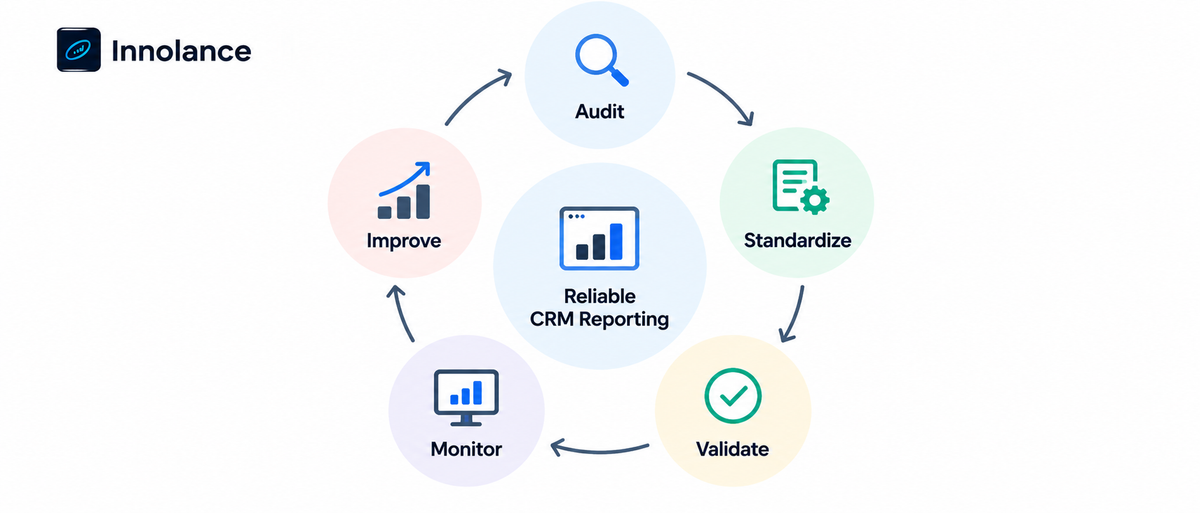
Audit the underlying data and definitions. Standardize important fields and pipeline rules. Validate integrations and report logic. Monitor data quality continuously, then improve processes as new issues emerge.
Automation can support this cycle through validation rules, required fields, duplicate detection, workflow controls, and alerts for stale records.
What Should Leaders Do Next?
Start with one important report that leadership no longer fully trusts.
Trace it backward from the dashboard through filters, definitions, source fields, integrations, and user workflows. This helps identify whether the issue originates in the visualization or somewhere earlier in the reporting process.
Innolance helps organizations identify gaps across CRM data, workflows, integrations, and reporting practices, providing a clearer foundation for targeted improvements rather than repeated dashboard fixes.
Conclusion
Reliable CRM reporting begins long before information reaches a dashboard.
For growing sales teams, reporting problems often emerge as data practices, pipeline definitions, integrations, and workflows become more complex.
By checking CRM data accuracy, pipeline consistency, duplicate records, integrations, and reporting definitions, revenue operations leaders can strengthen reporting reliability, improve sales analytics, and restore confidence in the information used to make revenue decisions.