
When Agile Coaching vs Execution Diagnostics Fits

Learn when agile coaching can improve team behaviors and when execution diagnostics can uncover systemic constraints affecting predictable software delivery.
Executive Summary
Software delivery problems do not always require the same intervention. Some teams understand what needs to change but struggle to adopt effective ways of working. Others follow agile practices yet still experience missed commitments, slow decisions, dependency issues, and unpredictable delivery.
Agile coaching is most useful when the primary challenge involves behaviors, collaboration, agile practices, and team ways of working. Execution diagnostics are more appropriate when leaders need to identify systemic constraints across teams, planning, dependencies, decision flow, and organizational execution.
Direct Answer: Agile coaching helps teams improve how they work. Execution diagnostics help leaders understand where execution is breaking down and why. Choosing between them starts with diagnosing whether the problem is primarily behavioral or systemic.
What Is Agile Coaching?
Agile coaching helps teams and leaders strengthen agile practices, collaboration, and continuous improvement.
An agile coach may work with teams to improve planning, retrospectives, backlog management, cross-functional collaboration, or the practical application of agile principles. During an agile transformation, coaching can also help teams adapt to new roles and establish more consistent working behaviors.
This makes coaching valuable when teams know the direction they need to take but require guidance to build sustainable habits.
Key Takeaway: Agile coaching is strongest when the challenge is changing behaviors and improving ways of working.
What Are Execution Diagnostics?
Execution diagnostics examine the conditions affecting delivery across the organization.
Instead of beginning with the assumption that teams need coaching, diagnostics investigate where work slows down and why. This can include capacity constraints, cross-team dependencies, planning gaps, unclear ownership, decision delays, competing priorities, and limited leadership visibility.
For example, a delivery team may follow agile practices effectively but still miss commitments because an important dependency is controlled by another team. Coaching the first team may improve its practices without removing the underlying constraint.
Execution diagnostics make those systemic issues visible before leaders decide what intervention is needed.
When Does Agile Coaching Fit Best?
Agile coaching can be appropriate when teams need help translating agile principles into consistent behaviors.
Common situations include teams struggling with sprint planning, ineffective retrospectives, unclear roles, weak collaboration, or inconsistent adoption of agile practices.
Coaching may also support organizations introducing new agile operating models where leaders and teams need guidance on how responsibilities and behaviors should change.
The important distinction is that the underlying delivery problem should reasonably be addressable through improved behaviors and practices.
When Do Execution Diagnostics Fit Best?
Execution diagnostics become important when delivery problems persist despite teams appearing to follow reasonable processes.
Leaders may see roadmaps repeatedly slipping without a clear explanation. Teams may report being busy while commitments remain unreliable. Dependencies may surface late, decisions may wait for leadership, or portfolio priorities may change faster than teams can absorb them.
These are signs that organizational performance may be constrained by the execution system rather than by one team's agile practices.
Execution Clarity the ability to understand where execution is breaking down and why helps leaders distinguish these systemic constraints from problems that coaching alone can address.
Agile Coaching vs. Execution Diagnostics: What Is the Difference?
The distinction is primarily about the problem each approach is designed to address.
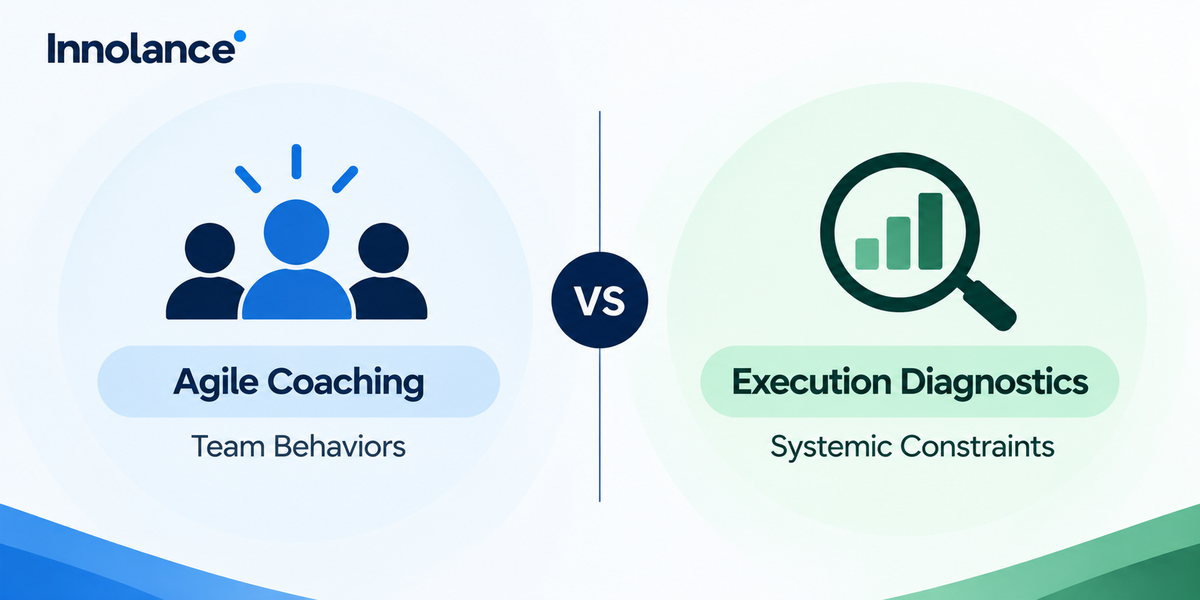
Agile Coaching → Improve behaviors and ways of working
Execution Diagnostics → Identify systemic execution constraints
Coaching asks questions such as: Are teams collaborating effectively? Are agile practices being applied consistently? Are teams learning and adapting?
Diagnostics ask different questions: Where is work waiting? Which dependencies are delaying delivery? Where are decisions slowing execution? Are portfolio commitments aligned with actual capacity?
These approaches are not necessarily competing alternatives. Diagnostics may reveal that coaching is exactly what a team needs. In another situation, the same diagnostic process may reveal that the constraint sits in portfolio planning, leadership decision-making, or cross-team dependencies.
How Should Leaders Choose the Right Approach?
CTOs, VP Engineering, and product leaders should avoid selecting an intervention before understanding the problem.
Start with the delivery evidence. Examine commitment reliability, decision delays, dependency patterns, planning stability, and where work repeatedly waits or gets reworked.
If the evidence points toward team behaviors or inconsistent agile practices, agile coaching may be appropriate. If the evidence points toward structural constraints spanning teams or leadership layers, execution diagnostics can help identify where intervention should begin.
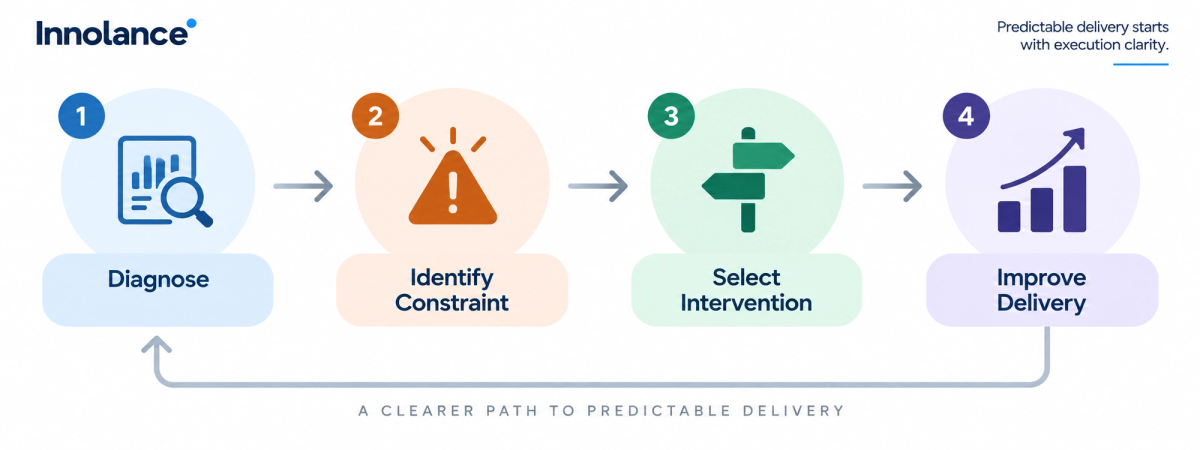
Practical Tip: Diagnose the constraint first, then select the intervention.
What Should Leaders Do Next?
When agile delivery remains unpredictable, adding more ceremonies, coaching, or process without identifying the source of the problem can create activity without resolving the constraint.
A more disciplined sequence is:
Observe → Diagnose → Intervene → Measure
Innolance applies this diagnostic perspective through Execution Clarity, examining how leadership, portfolio planning, and team execution interact so organizations can identify constraints before deciding how to improve them.
Conclusion
Agile coaching and execution diagnostics address different dimensions of software delivery improvement.
Coaching can strengthen behaviors, collaboration, and agile practices. Execution diagnostics can expose systemic constraints involving planning, dependencies, decisions, capacity, and organizational alignment.
For SaaS leaders, the central question is therefore not simply whether agile coaching works. It is whether the delivery problem being addressed is one that coaching is designed to solve. Understanding the constraint first allows leaders to choose an intervention that matches the actual execution problem.